

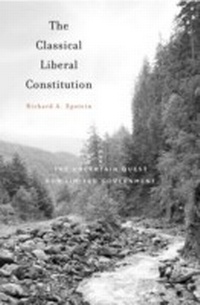
The Classical Liberal Constitution
The Uncertain Quest for Limited Government
1st Edition
Published on 14. May 2014
610 pages
978-0-674-72649-9 (ISBN)
Description

Steering clear of debates over originalism vs a living Constitution, Richard A. Epstein employs close reading, historical analysis, and political and economic theory to urge a return to federalism, restricted government, separation of powers, and strong protection of individual rights - ideas that animated the framers' constitutional design.
Steering clear of debates over originalism vs a living Constitution, Richard A. Epstein employs close reading, historical analysis, and political and economic theory to urge a return to federalism, restricted government, separation of powers, and strong protection of individual rights - ideas that animated the framers' constitutional design.
Steering clear of debates over originalism vs a living Constitution, Richard A. Epstein employs close reading, historical analysis, and political and economic theory to urge a return to federalism, restricted government, separation of powers, and strong protection of individual rights - ideas that animated the framers' constitutional design.
More details
Language
English
Place of publication
Cambridge, Mass. [u.a.]
United States
Target group
Professional and scholarly
ISBN-13
978-0-674-72649-9 (9780674726499)
Copyright in bibliographic data and cover images is held by Nielsen Book Services Limited or by the publishers or by their respective licensors: all rights reserved.
Schweitzer Classification
Other editions
Additional editions
Book
01/2014
Harvard University Press
€76.98
Article exhausted; check different version
Person
EpsteinRichard A.: Richard A. Epstein is Laurence A. Tisch Professor of Law at New York University School of Law, Peter and Kirsten Bedford Senior Fellow at the Hoover Institution, and James Parker Hall Distinguished Service Professor Emeritus of Law and Senior Lecturer at the University of Chicago Law School.
EpsteinRichard A.: Richard A. Epstein is Laurence A. Tisch Professor of Law at New York University School of Law, Peter and Kirsten Bedford Senior Fellow at the Hoover Institution, and James Parker Hall Distinguished Service Professor Emeritus of Law and Senior Lecturer at the University of Chicago Law School.
EpsteinRichard A.: Richard A. Epstein is Laurence A. Tisch Professor of Law at New York University School of Law, Peter and Kirsten Bedford Senior Fellow at the Hoover Institution, and James Parker Hall Distinguished Service Professor Emeritus of Law and Senior Lecturer at the University of Chicago Law School.
Content
- Intro
- Contents
- Preface: My Constitutional Odyssey
- Part One. Preliminaries
- Introduction: Our Two Constitutions
- 1. The Classical Liberal Synthesis
- 2. The Progressive Response
- 3. Constitutional Interpretation: The Original and the Prescriptive Constitutions
- Part Two. Constitutional Structures
- Section I: The Judicial Power
- 4. The Origins of Judicial Review
- 5. Marbury and Martin
- 6. Standing: Background and Origins
- 7. Modern Standing Law
- 8. The Political Question Doctrine
- Section II: The Legislative Power
- 9. The Commerce Power: Theory and Practice, 1787-1865
- 10. The Commerce Clause in Transition: 1865-1937
- 11. The Commerce Clause: Transformation to Consolidation, 1937-1995
- 12. Constitutional Pushback: 1995 to Present, from Lopez to NFIB
- 13. Enumerated Powers: Taxing and Spending
- 14. The Necessary and Proper Clause
- 15. The Dormant Commerce Clause
- Section III: The Executive Power
- 16. Basic Principles and Domestic Powers
- 17. Delegation and the Rise of Independent Agencies
- 18. Foreign and Military Affairs
- Part Three. Individual Rights
- Section I: Property, Contract, and Liberty
- 19. From Structural Protections to Individual Rights
- 20. Procedural Due Process: Implementing the Classical Liberal Ideal
- 21. Freedom of Contract
- 22. Takings, Physical and Regulatory
- 23. Personal Liberties and the Morals head of the Police Power
- Section II: Speech
- 24. Freedom of Speech and Religion: Preliminary Considerations
- 25. Force, Threats, and Inducements
- 26. Fraud, Defamation, Emotional Distress, and Invasion of Privacy
- 27. Government Regulation of the Speech Commons
- 28. Progressive Regulation of Freedom of Speech: Labor, Communications, and Campaign Finance
- Section III: Religion
- 29. Free Exercise
- 30. The Establishment Clause: Theoretical Foundations
- 31. Regulation and Subsidy under the Establishment Clause
- 32. The Commons
- Section IV: Equal Protection
- 33. Race and the Fourteenth Amendment
- 34. Citizenship and the Fourteenth Amendment
- 35. Equal Protection and Sex Discrimination
- Part Four. Conclusion
- Conclusion: The Classical Liberal Alternative
- Notes
- Index of Cases
- General Index
