

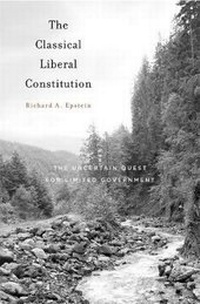
The Classical Liberal Constitution
The Uncertain Quest for Limited Government
Published on 6. January 2014
Book
Hardback
704 pages
978-0-674-72489-1 (ISBN)
Description
American liberals and conservatives alike take for granted a progressive view of the Constitution that took root in the early twentieth century. Richard Epstein laments this complacency which, he believes, explains America's current economic malaise and political gridlock. Steering clear of well-worn debates between defenders of originalism and proponents of a living Constitution, Epstein employs close textual reading, historical analysis, and political and economic theory to urge a return to the classical liberal theory of governance that animated the framers' original text, and to the limited government this theory supports.
Grounded in the thought of Locke, Hume, Madison, and other Enlightenment figures, the classical liberal tradition emphasized federalism, restricted government, separation of powers, property rights, and economic liberties. The most serious challenge to this tradition, Epstein contends, has come from New Deal progressives and their intellectual defenders. Unlike Thomas Paine, who saw government as a necessary evil at best, the progressives embraced government as a force for administering social good. The Supreme Court has unwisely ratified the progressive program by sustaining an ever-lengthening list of legislative programs at odds with the classical liberal Constitution.
Epstein's carefully considered analysis addresses both halves of the constitutional enterprise: its structural safeguards against excessive government power and its protection of individual rights. He illuminates contemporary disputes ranging from presidential prerogatives to health care legislation, while reexamining such enduring topics as the institution of judicial review, the federal government's role in regulating economic activity, freedom of speech and religion, and equal protection.
Grounded in the thought of Locke, Hume, Madison, and other Enlightenment figures, the classical liberal tradition emphasized federalism, restricted government, separation of powers, property rights, and economic liberties. The most serious challenge to this tradition, Epstein contends, has come from New Deal progressives and their intellectual defenders. Unlike Thomas Paine, who saw government as a necessary evil at best, the progressives embraced government as a force for administering social good. The Supreme Court has unwisely ratified the progressive program by sustaining an ever-lengthening list of legislative programs at odds with the classical liberal Constitution.
Epstein's carefully considered analysis addresses both halves of the constitutional enterprise: its structural safeguards against excessive government power and its protection of individual rights. He illuminates contemporary disputes ranging from presidential prerogatives to health care legislation, while reexamining such enduring topics as the institution of judicial review, the federal government's role in regulating economic activity, freedom of speech and religion, and equal protection.
More details
Language
English
Place of publication
Cambridge, Mass
United States
Target group
College/higher education
Professional and scholarly
Dimensions
Height: 235 mm
Width: 156 mm
ISBN-13
978-0-674-72489-1 (9780674724891)
Copyright in bibliographic data and cover images is held by Nielsen Book Services Limited or by the publishers or by their respective licensors: all rights reserved.
Schweitzer Classification
Other editions
Additional editions
E-Book
05/2014
1st Edition
Harvard University Press
€88.79
Available for download
Richard A. Epstein
Classical Liberal Constitution
E-Book
01/2014
1st Edition
Harvard University Press
€59.49
Available for download
Person
Richard A. Epstein is Laurence A. Tisch Professor of Law at New York University School of Law, Peter and Kirsten Bedford Senior Fellow at the Hoover Institution, and James Parker Hall Distinguished Service Professor Emeritus of Law and Senior Lecturer at the University of Chicago Law School.