

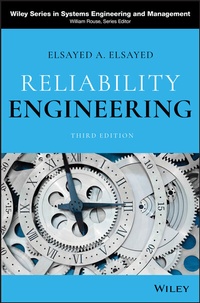
Reliability Engineering
Description

Named one of the Best Industrial Management eBooks of All Time by BookAuthority
As featured on CNN, Forbes and Inc - BookAuthority identifies and rates the best books in the world, based on recommendations by thought leaders and experts
The newly and thoroughly revised 3rd Edition of Reliability Engineering delivers a comprehensive and insightful analysis of this crucial field. Accomplished author, professor, and engineer, Elsayed. A. Elsayed includes new examples and end-of-chapter problems to illustrate concepts, new chapters on resilience and the physics of failure, revised chapters on reliability and hazard functions, and more case studies illustrating the approaches and methodologies described within.
The book combines analyses of system reliability estimation for time independent and time dependent models with the construction of the likelihood function and its use in estimating the parameters of failure time distribution. It concludes by addressing the physics of failures, mechanical reliability, and system resilience, along with an explanation of how to ensure reliability objectives by providing preventive and scheduled maintenance and warranty policies.
This new edition of Reliability Engineering covers a wide range of topics, including:
* Reliability and hazard functions, like the Weibull Model, the Exponential Model, the Gamma Model, and the Log-Logistic Model, among others
* System reliability evaluations, including parallel-series, series-parallel, and mixed parallel systems
* The concepts of time- and failure-dependent reliability within both repairable and non-repairable systems
* Parametric reliability models, including types of censoring, and the Exponential, Weibull, Lognormal, Gamma, Extreme Value, Half-Logistic, and Rayleigh Distributions
Perfect for first-year graduate students in industrial and systems engineering, Reliability Engineering, 3rd Edition also belongs on the bookshelves of practicing professionals in research laboratories and defense industries. The book offers a practical and approachable treatment of a complex area, combining the most crucial foundational knowledge with necessary and advanced topics.
More details
Other editions
Additional editions
Person
ELSAYED. A. ELSAYED, PHD is a Distinguished Professor in the Department of Industrial Engineering at Rutgers University. He is Director of the NSF/Industry/University Cooperative Research Center for Quality and Reliability Engineering, Rutgers-Arizona State University. His research interests include the areas of quality and reliability engineering, production planning, and control and manufacturing processes and engineering.
Content
Preface xi
Prelude xv
Chapter 1 Reliability and Hazard Functions 1
1.1 Introduction 1
1.2 Reliability Definition and Estimation 5
1.3 Hazard Functions 16
1.4 Multivariate Hazard Rate 57
1.5 Competing Risk Model and Mixture of Failure Rates 60
1.6 Discrete Probability Distributions 68
1.7 Mean Time to Failure 71
1.8 Mean Residual Life 74
1.9 Time of First Failure 76
Problems 79
References 91
Chapter 2 System Reliability Evaluation 95
2.1 Introduction 95
2.2 Reliability Block Diagrams 96
2.3 Series Systems 99
2.4 Parallel Systems 101
2.5 Parallel-Series, Series-Parallel, and Mixed-Parallel Systems 103
2.6 Consecutive-k-out-of-n:F System 113
2.7 Reliability of k-out-of-n Systems 121
2.8 Reliability of k-out-of-n Balanced Systems 123
2.9 Complex Reliability Systems 125
2.10 Special Networks 143
2.11 Multistate Models 144
2.12 Redundancy 150
2.13 Importance Measures of Components 154
2.14 Weighted Importance Measures of Components 165
Problems 167
References 182
Chapter 3 Time- and Failure-Dependent Reliability 185
3.1 Introduction 185
3.2 Nonrepairable Systems 185
3.3 Mean Time to Failure 194
3.4 Repairable Systems 204
3.5 Availability 215
3.6 Dependent Failures 223
3.7 Redundancy and Standby 228
Problems 238
References 247
Chapter 4 Estimation Methods of the Parameters 251
4.1 Introduction 251
4.2 Method of Moments 252
4.3 The Likelihood Function 260
4.4 Method of Least Squares 278
4.5 Bayesian Approach 284
4.6 Bootstrap Method 288
4.7 Generation of Failure Time Data 290
Problems 292
References 298
Chapter 5 Parametric Reliability Models 301
5.1 Introduction 301
5.2 Approach 1: Historical Data 302
5.3 Approach 2: Operational Life Testing 303
5.4 Approach 3: Burn-in Testing 303
5.5 Approach 4: Accelerated Life Testing 304
5.6 Types of Censoring 305
5.7 The Exponential Distribution 308
5.8 The Rayleigh Distribution 322
5.9 The Weibull Distribution 331
5.10 The Lognormal Distribution 343
5.11 The Gamma Distribution 350
5.12 The Extreme Value Distribution 357
5.13 The Half-Logistic Distribution 360
5.14 The Frechet Distribution 367
5.15 The Birnbaum-Saunders Distribution 369
5.16 Linear Models 372
5.17 Multicensored Data 374
Problems 378
References 389
Chapter 6 Accelerated Life Testing 393
6.1 Introduction 393
6.2 Types of Reliability Testing 394
6.3 Accelerated Life Testing 403
6.4 ALT Models 406
6.5 Statistics-Based Models: Nonparametric 420
6.6 Physics-Statistics-Based Models 437
6.7 Physics-Experimental-Based Models 446
6.8 Degradation Models 449
6.9 Statistical Degradation Models 453
6.10 Accelerated Life Testing Plans 459
Problems 463
References 476
Chapter 7 Physics of Failures 481
7.1 Introduction 481
7.2 Fault Tree Analysis 481
7.3 Failure Modes and Effects Analysis 488
7.4 Stress-Strength Relationship 490
7.5 PoF: Failure Time Models 492
7.6 PoF: Degradation Models 512
Problems 519
References 524
Chapter 8 System Resilience 527
8.1 Introduction 527
8.2 Resilience Overview 528
8.3 Multi-Hazard 528
8.4 Resilience Modeling 532
8.5 Resilience Definitions and Attributes 535
8.6 Resilience Quantification 536
8.7 Importance Measures 542
8.8 Cascading Failures 544
8.9 Cyber Networks 546
Problems 557
References 559
Chapter 9 Renewal Processes and Expected Number of Failures 563
9.1 Introduction 563
9.2 Parametric Renewal Function Estimation 564
9.3 Nonparametric Renewal Function Estimation 578
9.4 Alternating Renewal Process 588
9.5 Approximations of M(t) 591
9.6 Other Types of Renewal Processes 594
9.7 The Variance of the Number of Renewals 595
9.8 Confidence Intervals for the Renewal Function 601
9.9 Remaining Life at Time t 604
9.10 Poisson Processes 606
9.11 Laplace Transform and Random Variables 609
Problems 611
References 619
Chapter 10 Maintenance and Inspection 621
10.1 Introduction 621
10.2 Preventive Maintenance and Replacement Models: Cost Minimization 622
10.3 Preventive Maintenance and Replacement Models: Downtime Minimization 631
10.4 Minimal Repair Models 634
10.5 Optimum Replacement Intervals for Systems Subject to Shocks 639
10.6 Preventive Maintenance and Number of Spares 642
10.7 Group Maintenance 649
10.8 Periodic Inspection 653
10.9 Condition-Based Maintenance 663
10.10 On-Line Surveillance and Monitoring 665
Problems 669
References 676
Chapter 11 Warranty Models 679
11.1 Introduction 679
11.2 Warranty Models for Nonrepairable Products 681
11.3 Warranty Models for Repairable Products 701
11.4 Two-Dimensional Warranty 716
11.5 Warranty Claims 718
Problems 725
References 731
Chapter 12 Case Studies 733
12.1 Case 1: A Crane Spreader Subsystem 733
12.2 Case 2: Design of a Production Line 739
12.3 Case 3: An Explosive Detection System 746
12.4 Case 4: Reliability of Furnace Tubes 752
12.5 Case 5: Reliability of Smart Cards 757
12.6 Case 6: Life Distribution of Survivors of Qualification and Certification 760
12.7 Case 7: Reliability Modeling of Telecommunication Networks for the Air Traffic Control System 767
12.8 Case 8: System Design Using Reliability Objectives 776
12.9 Case 9: Reliability Modeling of Hydraulic Fracture Pumps 786
12.10 Case 10: Availability of Medical Information Technology System 791
12.11 Case 11: Producer and Consumer Risk in System of Systems 797
References 804
Appendices
Appendix A Gamma Table 805
Appendix B Computer Program To Calculate the Reliability of a Consecutive-k-Out-of-n:F System 811
Appendix C Optimum Arrangement of Components In Consecutive-2-Out-of-N:F Systems 813
Appendix D Computer Program For Solving the Time-Dependent Equations 821
Appendix E The Newton-Raphson Method 823
Appendix F Coefficients of bi's For i = 1, ..., n 829
Appendix G Variance of ¿*2's In Terms of ¿22/n and K3/K*2 843
Appendix H Computer Listing of the Newton-Raphson Method 849
Appendix I Coefficients (ai and bi) of the Best Estimates of the Mean (µ) and Standard Deviation (s) In Censored Samples Up To n = 20 From a Normal Population 851
Appendix J Baker's Algorithm 865
Appendix K Standard Normal Distribution 869
Appendix L Critical Values of ¿2 875
Appendix M Solutions of Selected Problems 879
Author Index 887
Subject Index 895
PREFACE
Reliability is one of the most important quality characteristics of components, products, and large and complex systems. The role of reliability is observed daily by each one of us, when we start a vehicle, attempt to place a phone call, use a copier, use a computer, or take a train. In all instances, the user expects that the machine or the system to provide the designed functions as expected. Most likely, you have experienced machines that do not always function or deliver the desired quality of service when needed. Machines and systems experience failures, interruption, and possibly termination of service.
Engineers spend a significant amount of time and resources during the design, product (or service) development, and production phases of the product life cycle to ensure that the product or system will provide the desired service level. In doing so, engineers start with a concept design, select its components, construct prototypes, test its functionality, and estimate its reliability. Modifications and design changes are usually made, and these steps are repeated until the product (or service) satisfies its reliability requirements. The prelude of this book presents these steps in the design and life cycle of the "One-Hoss-Shay."
Designing the product may require redundancy of components (or subsystems), or introduction of newly developed components or materials or changes in design configuration. These will have a major impact on the product reliability. Once the product is launched and used in the field, data are collected, so improvements can be made in the newer versions of the product. Moreover, these data become important in identifying potential safety issues or hazards for the users, so recalls can be quickly made to resolve these issues. In other words, reliability is a major concern during the entire life of the product and is subject to continuous improvement. This is noticeable by the frequent and continuous updates of the operating systems of cell phones, computers, and software applications.
This book is an engineering reliability book. It is organized according to the same sequence followed when designing a product or service. The book consists of four parts. Part I focuses on system reliability estimation for time-independent and time-dependent models. Chapter 1 addresses on the basic definitions of reliability, extensive coverage of failure-time distributions and their hazard functions, reliability metrics, and methods for its calculations. Chapter 2 describes, in greater detail, methods for estimating reliabilities of a variety of engineering systems configurations starting with series systems, parallel systems, series-parallel, parallel-series, consecutive k-out-of-n:F, k-out-of-n, and complex network systems. It also addresses systems with multistate devices and concludes by estimating reliabilities of redundant systems and the optimal allocation of components in a redundant system. Finally, several importance measures of components in the system are presented since these measures could be used to determine the components and subsystems that require "hardening" through replacements of components with "more reliable" ones or assigning higher priorities of repair in case of failures. The next step in the product design is to study the effect of time on system reliability, since reliability is a time-dependent characteristic of the products and systems. Therefore, Chapter 3 discusses, in detail, time- and failure-dependent reliability and the calculation of mean time to failure (MTTF) of a variety of system configurations. It also introduces availability as a measure of system reliability for repairable systems. Once the design is "firm," the engineer assembles the components and configures them to achieve the desired reliability objectives. This may require conducting reliability tests on components or using field data from similar components.
Therefore, Part II of the book, starting with Chapter 4, presents introduces for estimating the parameters of the failure-time distributions including method of moments, regression, and the concept of constructing the likelihood function and its use in estimating the parameters. Chapter 5 provides a comprehensive coverage of parametric and nonparametric reliability models for failure data (censored or noncensored) and testing for abnormally long or short failure times. The extensive examples and methodologies, presented in this chapter, will aid the engineer in appropriately modeling the test data. Confidence intervals for the parameters of the models are also discussed. More importantly, the book devotes a full chapter, Chapter 6, to accelerated life testing and degradation testing. The main objective of this chapter is to provide varieties of statistical-based models, physics-statistics-based models, and physics-experimental-based models to relate the failure time and data at accelerated conditions to the normal operating conditions at which the product is expected to operate.
This leads to Part III, which focuses on the understanding of failure causes, mechanism of failures, and the physics of failures, as described in Chapter 7. This chapter also provides the physics of failure of the failure mechanisms in electronic and mechanical components. It demonstrates the use of the parameters of the failure mechanism in the estimation of the reliability metrics. In addition to making a system reliable, other metrics may include resilience that demonstrates the ability of the system to absorb and withstand different hazards and threats. This is detailed in Chapter 8, where resilience quantifications of both nonrepairable and repairable systems are presented and demonstrated through examples.
Finally, once a product is produced and sold, the manufacturer and designer must ensure its reliability objectives by providing preventive and scheduled maintenance and warranty policies. Part IV of the book focuses on these topics; it begins with Chapter 9, which presents different methods (exact and approximate) for estimating the expected number of system failures during a specified time interval. These estimates are used in Chapter 10 in order to determine optimal maintenance schedules and optimum inspection policies. Methods for estimating the inventory levels of spares required to ensure predetermined reliability and availability values are also presented. Chapter 11 explains different warranty policies and approaches for determining the product price including warranty cost, as well as, the estimation of the warranty reserve fund. Chapter 12 concludes the book. It presents actual case studies which demonstrate the use of the approaches and methodologies discussed throughout the book in solving real life cases. The role of reliability during the design phase of a product or a system is particularly emphasized.
Every theoretical development in this book is followed by an engineering example to illustrate its application. In addition, many problems are included at the end of each chapter. These two features increase the usefulness of this book as being a comprehensive reference for practitioners and professionals in the quality and reliability engineering area. In addition, this book may be used for either a one- or two-semester course in reliability engineering geared toward senior undergraduates or graduate students in industrial and systems engineering, mechanical, and electrical engineering programs. It may also be adapted for use in a life data analysis course offered in many graduate programs in statistics. The book presumes a background in statistics and probability theory and differential calculus.
ACKNOWLEDGMENTS
This book represents the work of not just the author, but also many others whose works are referenced throughout the book. I have tried to give adequate credit to all those whose work has influenced this book. Particular acknowledgments are made to the Institute of Electrical and Electronic Engineers, CRC Press, Institute of Mathematical Statistics, American Society of Mechanical Engineers, Seimens AG, Electronic Products, and Elsevier Applied Science Publishers for the use of figures, tables in the appendices, and permissions to include material in this book.
I would like to thank the students of the Department of Industrial and Systems Engineering at Rutgers University, who have been using the earlier versions and editions of this book for the past 25 years and provided me with valuable input. In particular, I would like to thank Askhat Turlybayev, Xi Chen, and Yao Cheng for providing extensive input and comments and Changxi Wang, for drawing many of the figures and providing the corrosion example in Chapter 7. I also acknowledge the collaboration with Haitao Liao and Xiao Liu of the University of Arkansas.
Special gratitude goes to the Council for International Exchange of Scholars for the Fulbright Scholar and to the National Science Foundation, the Federal Aviation Administration, and many industries who supported my research and teachings over many years. Special thanks to one of my favorite students, John Sharkey and his wife Chris, for their generous support that provided me with release time to complete this book.
I would like to acknowledge Dr. Mohammed Ettouney for his support and many detailed discussions regarding resilience and failure examples of civil engineering infrastructures. I am also thankful to Joe Lippencott for...
