

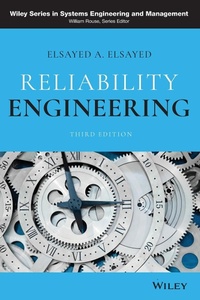
Reliability Engineering
Published on 5. January 2021
Book
Hardback
1000 pages
978-1-119-66592-2 (ISBN)
Description
This book divides the engineering reliability process into multiple parts. Part I focuses on system reliability estimation for time independent and time dependent models, helping engineers create a "firm" design. Part II presents the concept of constructing the likelihood function and its use in estimating the parameters of a failure time distribution. This aids the reader in assembling necessary components and configures them to achieve desired reliability objectives, conducting reliability tests on components and using field data from similar components. Part III addresses Physics of Failures, Mechanical Reliability and System Resilience. Finally, Part IV of the book focuses on ensuring reliability objectives by providing preventive and scheduled maintenance and warranty policies.
More details
Series
Edition
3rd Edition
Language
English
Place of publication
Hoboken
United States
Publishing group
John Wiley and Sons Ltd
Target group
Professional and scholarly
Dimensions
Height: 260 mm
Width: 183 mm
Thickness: 54 mm
Weight
1909 gr
ISBN-13
978-1-119-66592-2 (9781119665922)
Schweitzer Classification
Other editions
Additional editions
Elsayed A. Elsayed
Reliability Engineering
E-Book
11/2020
3rd Edition
Wiley
€147.99
Available for download
Elsayed A. Elsayed
Reliability Engineering
E-Book
11/2020
3rd Edition
Wiley
€147.99
Available for download
Previous edition
Elsayed A. Elsayed
Reliability Engineering
Book
06/2012
2nd Edition
Wiley
Unfortunately, price unknown
Article exhausted; check for reprint
Person
E. A. ELSAYED, PhD, is a Professor in the Department of Industrial Engineering, Rutgers University. He is also the Director of the NSF/ Industry/ University Co-operative Research Center for Quality and Reliability Engineering, Rutgers-Arizona State University. His research interests are in the areas of quality and reliability engineering, production planning and control and manufacturing processes and engineering.
Content
CHAPTER 1 RELIABILITY AND HAZARD FUNCTIONS
1.1 Introduction
1.2 Reliability Definition and Estimation
1.3 Hazard Functions
1.4 Multi-Variate Hazard
1.5 Competing Risk Model and Mixture of Failure Rates
1.6 Discrete Probability Distributions
1.7 Mean Time to Failure
1.8 Mean Residual Life (MRL)
1.9 Time of First Failure
Problems
References
CHAPTER 2 SYSTEM RELIABILITY EVALUATION
2.1 Introduction
2.2 Reliability Block Diagrams
2.3 Series Systems
2.4 Parallel Systems
2.5 Parallel-Series, Series-Parallel, and Mixed-Parallel Systems
2.6 Consecutive k-out-of-n:F Systems
2.7 Reliability of k-out-of-n Systems
2.8 Reliability of k-out-of-n Balanced Systems
2.9 Complex Reliability Systems
2.10 Special Networks
2.11 Multistate Models
2.12 Redundancy
2.13 Importance Measures of Components
2.14 Weighted Importance of Components
Problems
References
CHAPTER 3 TIME - AND FAILURE-DEPENDENT RELIABILITY
3.1 Introduction
3.2 Non-Repairable Systems
3.3 Mean Time to Failure (MTTF)
3.4 Repairable Systems
3.5 Availability
3.6 Dependent Failures
3.7 Redundancy and Standby
Problems
References
CHAPTER 4 ESTIMATION METHODS OF THE PARAMETERS
4.1 Introduction
4.2 Method of Moments
4.3 The Likelihood Function
4.4 Method of Least Squares
4.5 Bayesian Approach
4.6 Boot-Strap Method
4.7 Generation of Failure Time Data
Problems
References
CHAPTER 5 PARAMETRIC RELIABILITY MODELS
5.1 Introduction
5.2 Approach 1: Historical Data
5.3 Approach 2: Operational Life Testing
5.4 Approach 3: Burn-In Testing
5.5 Approach 4: Accelerated Life Testing
5.6 Types of Censoring
5.7 The Exponential Distribution
5.8 The Rayleigh Distribution
5.9 The Weibull Distribution
5.10 The Lognormal Distribution
5.11 The Gamma Distribution
5.12 The Extreme Value Distribution
5.13 The Half-Logistic Distribution
5.14 The Frechet Distribution
5.15 The Birnbaum-Saunders Distribution
5.16 Linear Models
5.17 Multi-Censored Data
Problems
References
CHAPTER 6 ACCELERATED LIFE TESTING
6.1 Introduction
6.2 Types of Reliability Testing
6.3 Accelerated Life Testing
6.4 ALT Methods
6.5 Statistics-Based Models: Non-Parametric
6.6 Physics-Statistics-Based Models
6.7 Physics-Experimental-Based Models
6.8 Degradation Models
6.9 Statistical Degradation Models
6.10 Accelerated Life Testing Plans
Problems
References
Chapter 7 PHYSICS OF FAILURES
7.1 Introduction
7.2 Fault Tree Analysis
7.3 Failure Modes and Effects Analysis
7.4 Stress-Strength Relationship
7.5 PoF: Failure Time Models
7.6 PoF: Degradation Models
Problems
References
Chapter 8 SYSTEM RESILIENCE
8.1 Introduction
8.2 Resilience Overview
8.3 Multi Hazard
8.4 Resilience Modeling
8.5 Resilience Definitions and Attributes
8.6 Resilience Quantifications
8.7 Importance Measures
8.8 Cascading Failures
8.9 Cyber Networks
Problems
References
Chapter 9 RENEWAL PROCESSES AND EXPECTED NUMBER OF FAILURES
9.1 Introduction
9.2 Parametric Renewal Function Estimation
9.3 Non-Parametric Renewal Function Estimation
9.4 Alternating Renewal Process
9.5 Approximations of M(t)
9.6 Other Types of Renewal Processes
9.7 The Variance of the Number of Renewals
9.8 Confidence Intervals for the Renewal Function
9.9 Remaining Life at Time t
9.10 Poisson Processes
9.11 Laplace Transform and Random Variables
Problems
References
Chapter 10 MAINTENANCE AND INSPECTION
10.1 Introduction
10.2 Preventive Maintenance and Replacement Models: Cost
Minimization
10.3 Preventive Maintenance and Replacement Models: Downtime
Minimization
10.4 Minimal Repair Models
10.5 Optimum Replacement Intervals for Systems Subject to Shocks
10.6 Preventive Maintenance and Number of Spares
10.7 Group Maintenance
10.8 Periodic Inspection
10.9 Condition Based Maintenance
10.10 On-Line Surveillance and Monitoring
Problems
References
Chapter 11 WARRANTY MODELS
11.1 Introduction
11.2 Warranty Models for Non-Repairable Products
11.3 Warranty Models for Repairable Products
11.4 Two-Dimensional Warranty
11.5 Warranty Claims
Problems
References
Chapter 12 CASE STUDIES
Case 1: A Crane Spreader Subsystem
Case 2: Design of a Production Line
Case 3: An Explosive Detection System
Case 4: Reliability of Furnace Tubes
Case 5: Reliability of Smart Cards
Case 6: Life Distribution of Survivors of Qualification and Certification
Case 7: Reliability Modeling of Telecommunication Networks for the Air Traffic Control Center
Case 8: System Design Using Reliability Objectives
Case 9: Reliability Modeling of Hydraulic Fracture Pumps
Case 10: Availability of Medical Information Technology System
Case 11: Producer and Consumer Risk in System of Systems
References
APPENDICES
APPENDIX A GAMMA TABLE
APPENDIX B COMPUTER PROGRAM TO CALCULATE THE RELIABILITY OF A CONSECUTIVE-K-OUT-OF-N:F SYSTEM
APPENDIX C OPTIMUM ARRANGEMENT OF COMPONENTS IN CONSECUTIVE-2-OUT-OF-N:F SYSTEMS
APPENDIC D COMPUTER PROGRAM FOR SOLVING THE TIME-DEPENDENT EQUATIONS
APPENDIX E THE NEWTON-RAPHSON METHOD
APPENDIX F COEFFICIENTS OF FOR
APPENDIX G VARIANCE OF 's IN TERMS OF AND
APPENDIX I COEFFICIENTS AND OF THE BEST ESTIMATES OF THE MEAN ( ) AND STANDARD DEVIATION ( ) IN CENSORED SAMPLES UP TO n= 20 FROM A NORMAL POPULATION
APPENDIX J BAKER'S ALGORITHM
APPENDIX K STANDARD NORMAL DISTRIBUTION
APPENDIX L CRITICAL VALUES OF
APPENDIX M SOLUTIONS OF SELECTED PROBLEMS
AUTHOR INDEX
SUBJECT INDEX