

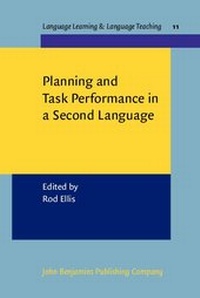
Planning and Task Performance in a Second Language
1st Edition
Published on 11. March 2005
VIII, 313 pages
978-90-272-9464-7 (ISBN)
Description

The last decade has seen a growing body of research investigating various aspects of L2 learners' performance of tasks. This book focuses on one task implementation variable: planning. It considers theories of how opportunities to plan a task affect performance and tests claims derived from these theories in a series of empirical studies. The book examines different types of planning (i.e. task rehearsal, pre-task planning and within-task planning), addressing both what learners do when they plan and the effects of the different types of planning on L2 production. The choice of planning as the variable for investigation in this book is motivated both by its importance for current theorizing about L2 acquisition (in particular with regard to cognitive theories that view acquisition in terms of information processing) and its utility to language teachers and language testers, for unlike many other constructs in SLA 'planning' lends itself to external manipulation. The study of planning, then, provides a suitable forum for demonstrating the interconnectedness of theory, research and pedagogy in SLA.
More details
Other editions
Additional editions
Book
03/2005
John Benjamins Publishing Co
€111.30
Shipment within 10-15 days
Person
Content
- Planning and Task Performance in a Second Language
- Editorial page
- Title page
- LCC data
- Table of contents
- Preface
- I. Introduction
- 1. Planning and task-based performance
- Types of planning
- Principal types of task planning
- Sub-categories of task planning
- Theoretical background to the study of planning in task-based research
- L2 production as information processing: Some key constructs
- Theoretical bases for task planning
- Previous research on task planning
- Pre-task planning
- Unpressured on-line planning
- Planning in a language testing context
- Final comments
- Methodological issues
- Investigating the effects of planning on acquisition
- Investigating learners' planning strategies
- Measuring learner production
- Conclusion
- II. Task rehearsal
- 2. Integrative planning through the use of task-repetition
- Introduction
- Types of planning
- Strategic planning
- On-line planning
- Task repetition as integrative planning
- Method
- Participants
- Procedure
- Analysis
- Group results
- General statistical results
- Framing results
- Impact of repetition on framing
- Case studies
- Case study 1: CH
- Case 2: UJ
- Case 3: AG
- Discussion
- Conclusion
- Note
- Appendix. Full extracts of three case study participants
- Case 2: UJ
- Case 3: AG
- III. Strategic planning
- 3. What do learners plan?
- Introduction
- The two planning studies: Background and linguistic outcomes
- Participants
- Elicitation of the oral narrative tasks with and without planning
- Linguistic outcomes of pre-task planning in the two studies
- Methodology: Elicitation and analysis of interviews
- Results
- Learners' strategy use during pre-task planning
- Learners' perceptions about planning
- Individual differences in learner orientation: Communication versus accuracy
- Language expertise differences: Retrieval vs. rehearsal and self-monitoring
- Listener sensitivity and prioritization of communication
- Explicit focus on form during planning
- Summary of interview findings
- Conclusion
- Notes
- 4. The effects of focusing on meaning and form in strategic planning
- Introduction
- Effects of the focus of strategic planning on speech performance
- Method
- Operationalization of strategic planning conditions
- Research question and hypotheses
- Research design
- Participants
- Experimental tasks
- Strategic planning instructions and note-sheets
- Procedures
- Data coding and scoring
- Data analysis
- Results
- Attention under each of the three foci of strategic planning
- Application of strategic plans
- Effects of foci of strategic planning on quality of speech
- Discussion
- Conclusion
- Appendix 1 Meaning/form planning guidelines for the instruction task
- Appendix 2 Meaning/form guidelines for the argumentative task
- Appendix 3 Meaning and form planning note-sheet for the instruction task
- Appendix 4 Meaning and form planning note-sheet for the argumentative task
- Appendix 5 Categories and sub-categories of the plan-aloud protocol coding scheme
- 5. The effects of strategic planning on the oral narratives of learners with low and high intermediate L2 proficiency
- Introduction
- Method
- Participants
- Materials
- Design
- Procedures
- Measures
- Analysis
- Results
- Discussion
- Conclusion
- IV. Within-task planning
- 6. The effects of careful within-task planning on oral and written task performance
- Introduction
- An early study
- Other studies of on-line planning
- Modelling the planning processes in speaking and writing
- Research questions
- Method
- Design
- Participants
- Pre-test material
- Tasks
- Task conditions
- Questionnaires and interviews
- Measures
- Data analysis
- Results
- Fluency
- Complexity
- Accuracy
- Summary of main results
- Questionnaire and interview
- Discussion
- Conclusion
- Notes
- 7. Strategic and on-line planning
- Introduction
- Method
- Results
- Discussion
- Summary and conclusions
- Notes
- Appendix 1
- Appendix 2 Detailed planning instructions for the ``Judge'' task
- V. Planning in language testing
- 8. Planning for test performance
- Introduction
- Research questions
- Method
- Design
- Participants
- Materials
- Analysis
- Results
- Discussion
- Notes
- Appendix Rating scales
- 9. Strategic planning, task structure, and performance testing
- Introduction
- Modelling and researching task-based performance
- Task structure and task performance
- Method
- Design
- Task
- Analytic measures
- Results
- Underlying factors in language performance
- The effects of task structure, planning condition and proficiency level on language performance
- The effects of task structure
- The effects of strategic planning and proficiency
- Perceptions of task difficulty
- Discussion
- Conclusions
- Notes
- VI. Conclusion
- 10. Planning as discourse activity
- Planning and language learning: Automaticity
- Towards a discourse/sociocognitive reconceptualization of planning
- Evidence of pushed output? Issues around the definition of `complexity'
- Planning as skilled discourse
- Planning as meta-cognitive skill
- The best laid plans: Strategic planning as discourse skill
- Discourse relevance and planning for interaction
- Underrating the learners' potential agency
- Planning, socio-history and educational culture
- Communicative constraints or learning discourse: The arguments in principle
- Discourse motivation in SLA: Communicative need or explicit learning purpose?
- Different discourses: Communicative discourse and learning discourse
- Matters of degree: Interpretation, agency and submissiveness
- Communicative constraints or learning discourse: Some tentative evidence
- Clarity, comprehensibility and risk in communicative discourse
- Redundancy and economy in a communicative discourse
- Redundancy, economy and relevance in a learning discourse
- Planning meaning as a means in a learning discourse
- Implications and applications
- Summary
- Implications
- References
- Index
- The series Language Learning & Language Teaching
