

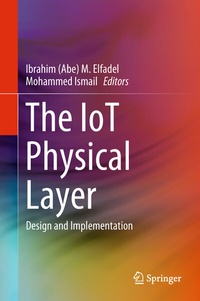
The IoT Physical Layer
Description

This book documents some of the most recent advances on the physical layer of the Internet of Things (IoT), including sensors, circuits, and systems. The application area selected for illustrating these advances is that of autonomous, wearable systems for real-time medical diagnosis. The book is unique in that it adopts a holistic view of such systems and includes not only the sensor and processing subsystems, but also the power, communication, and security subsystems. Particular attention is paid to the integration of these IoT subsystems as well as the prototyping platforms needed for achieving such integration. Other unique features include the discussion of energy-harvesting subsystems to achieve full energy autonomy and the consideration of hardware security as a requirement for the integrity of the IoT physical layer. One unifying thread of the various designs considered in this book is that they have all been fabricated and tested in an advanced, low-power CMOS process, namely GLOBALFOUNDRIES 65nm CMOS LPe.
More details
Other editions
Additional editions
Persons
Dr. Ibrahim (Abe) M. Elfadel
is a Professor of ECE at Khalifa University of Science and Technology, UAE. Prior to his current position, he was with IBM Research and the IBM Systems and Technology Group, Yorktown Heights, NY, where his research on computer-aided design (CAD) for high-end microprocessors was recognized with several IBM awards. His current research interests include IoT platform prototyping; energy-efficient edge and cloud computing; IoT communication; and CAD for VLSI, MEMS, and Silicon Photonics. Dr. Elfadel is the inventor or co-inventor of 50 issued US patents and the co-recipient of the D. O. Pederson Best Paper Award from the IEEE Transactions on CAD. He is currently serving as Associate Editor of the IEEE Transactions on VLSI and is the General Co-chair of VLSI-SoC 2017. He received his PhD from MIT in 1993.
Mohammed Ismail , a prolific author and entrepreneur , is currently a Professor and Chair of Electrical and Computer Engineering at Wayne State University in Detroit, MI. He spent over 25 years in academia and industry in the US, Europe and the Mid-East and was the Founding Director of Ohio State University's Analog VLSI Lab , one of the foremost research entities in the field of analog and RF integrated circuits and of Khalifa University 's Semiconductor Research Center, Abu Dhabi . He also had a Research Chair at the Swedish Royal Institute of Technology (KTH) and Founded the RaMSiS (Radio and Mixed Signal Integrated Systems) Research Group there. He advised to completion over 50 doctoral and 100 master students. He is the Founding Editor of the Springer Journal of Analog Integrated Circuits and Signal Processing and serves as the Journal Editor in Chief, and has served the IEEE in many editorial and Administrative capacities. He is the Founder of the IEEE International Conference on Electronics, Circuits and Systems (ICECS), the flagship Region 8 Conference of the IEEE Circuits and Systems Society and a Co-Founder of the IEEE ISQED. He is a consulting Editor of the Springer Advanced Analog Book Series. Dr. Ismail is a Co-Founder of Micrys Inc., Columbus, Ohio, Spirea AB, Stockholm, Firstpass Technologies Inc., Dublin, Ohio and ANACAD-Egypt (now part of Mentor Graphics, a Siemens company). He is a Fellow of IEEE.
