

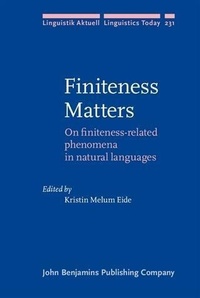
Finiteness Matters
On finiteness-related phenomena in natural languages
1st Edition
Published on 25. August 2016
352 pages
978-90-272-6697-2 (ISBN)
Description

"e;Although standardly recognized by linguists of many diverse theoretical persuasions, finiteness continues to figure among [...] the most poorly understood concepts of linguistic theory"e;. This was eloquently stated by Ledgeway (2000, 2007) and remains true even today. The present volume thus aims to shed some much needed light on this area of linguistic theorizing, with eleven chapters approaching finiteness phenomena from the fields of syntax, semantics, language acquisition, and Creole studies, and providing data from a range of different languages. Traditionally, approaches to finiteness within the Principles and Parameters framework have seen as their main aim to understand the relation between the morphological exponents of finiteness and the syntactic operations seemingly depending on these exponents. The papers in this volume mostly take their point of departure from this more traditional view on finiteness, before elaborating on, modifying and diverging from this tradition in novel and interesting ways.
More details
Other editions
Additional editions
Book
08/2016
John Benjamins Publishing Co
€123.30
Shipment within 10-15 days
Content
- Intro
- Finiteness Matters
- Editorial page
- Title page
- LCC data
- Table of contents
- Introduction
- 1. A quest for universal morphological reflexes of finiteness
- 2. Binarity versus graduality - and a way to reconcile the two in recent approaches
- 3. The individual papers of this volume
- References
- Part I. Finiteness: underlying relations
- Finiteness and Pseudofiniteness
- 1. Introduction
- 2. Historical and Theoretical Context
- 2.1 Finiteness in traditional grammar
- 2.2 Finiteness in Generative Grammar
- 2.3 Assumptions and Background
- 3. Personal and inflected infinitives: Case and agreement without finiteness?
- 3.1 Personal Infinitives
- 3.2 Inflected Infinitives
- 3.3 Prepositional infinitives
- 4. Greek Subjunctives: f-Agreement without nominative case?
- 5. A proposal: Pseudofiniteness
- 5.1 The source of pseudofiniteness in Romance languages
- 5.2 Apparent pseudofiniteness in West Flemish
- 5.3 Pseudofiniteness and Finiteness: A comparison
- 5.4 Pseudofiniteness and syntactic operations
- 6. Pseudofiniteness in Southern Calabrian
- 7. Greek again
- 8. Turkish Gerunds: Case and agreement without finiteness
- 9. Conclusion
- References
- The Split T Analysis
- 1. Introduction
- 2. Basic analysis
- 3. Anaphoric TS
- 3.1 Sequence of Tenses (SOT) - Tense Agreement
- 3.2 Double Access Reading (DAR)
- 3.3 Non-SOT (absent Tense Agreement) vs. SOT
- 4. Concluding remarks on the syntax-PF correlation
- References
- Universals and variation
- 1. Introduction
- 2. Theoretical perspectives on binding
- 3. How diverse is the diversity?
- 4. Reflexivity, reflexives, economy and chains
- 4.1 Licensing reflexivity.
- 4.2 Licensing versus enforcing reflexivity
- 4.3 Encoding dependencies by feature chains
- 5. The cases of Fijian and Chamorro
- 5.1 Fijian
- 5.2 Chamorro
- 5.2.1 Restrictions on subject-object combinations
- 5.2.2 The subject effect
- 6. Conclusion
- References
- Finiteness, inflection, and the syntax your morphology can afford
- 1. Introduction
- 2. Verbs and auxiliaries in English and Norwegian
- 2.1 Auxiliaries in English
- 2.2 Auxiliaries in Norwegian
- 2.3 Main verbs and auxiliaries in nine different constructions
- 2.3.1 S (sigma) negation, negative inversion, and polarity questions
- 2.3.2 Declarative main clauses
- 2.3.3 Intermediate summery, seminal works, and brief discussion
- 2.3.4 Subjunctives/infinitives/small clauses/why-not-constructions
- 2.3.5 Preterit-participle and participle-preterit mix-ups
- 2.3.6 Summary: Main vs. auxiliary verbs in nine constructions
- 3. Morphological finiteness in Norwegian and English
- 3.1 Morphological finiteness versus lexical finiteness
- 4. Diagnosing the nine phenomena
- 4.1 S (sigma) negation/Negative inversion/Polarity questions
- 4.2 Declaratives
- 4.3 Subjunctives/to-infinitives/Small clauses/Why (not)-constructions
- 4.4 Preterit-participle and participle-preterit mix-ups
- 5. Summing up
- References
- Part II. Morphosyntactic exponents of (non-)finiteness
- Agreement is not an Essential Ingredient of Finiteness
- 1. Introduction
- 2. Norwegian data
- 3. Analysis: English
- 4. Analysis: Norwegian
- 5. Some consequences
- 6. A remaining puzzle
- 7. Summary and conclusion
- References
- Non-finiteness in Saamáka
- 1. Introduction
- 2. Characteristics of fu
- 2.1 Characteristics of clauses embedded under fu
- 3. Lack of infinitival clauses in Saamáka: Discussion of Bickerton and Byrne
- 4. Semantic composition of finiteness
- 5. Decomposition of fu-clauses
- 5.1 Do fu-clauses carry the feature assertion?
- 5.2 Do fu-clauses carry the feature Topic Time?
- 5.2.1 Decomposing the morpheme bi
- 5.2.1.1 Characteristics of bi
- 5.2.2 Availability of Topic Time in fu-clauses
- 5.3 Semantic decomposition of fu
- 5.4 Syntactic decomposition of fu
- 6. Summary
- References
- Finiteness and response particles in West Flemish
- 1. Introduction: The domain of finiteness
- 1.1 The empirical data: Finite response particles
- 1.2 Aim and scope of the paper
- 1.3 Organisation of the paper
- 2. The data
- 2.1 Response particles in Lapscheure West Flemish
- 2.2 Morphological marking and subject clitics
- 2.3 Bare ja/neen
- 3. The ingredients of the analysis
- 3.1 Against a PF ellipsis account
- 3.2 A TP pro form
- 3.2.1 Morphologically marked ja/neen in Wambeek Dutch
- 3.3 Morphologically marked ja/neen, TP pro-forms and V2
- 3.4 The nature of morphological marking on ja/neen
- 4. The syntax of morphologically marked ja/neen
- 4.1 Background assumptions: Cartography and SubjP
- 4.2 Morphologically marked ja/neen and the satisfaction of V2
- 4.3 The syntax of reversal ja-s-e and nee-s-e
- Anchor 121
- 4.4 Reversal ja/nee and SDR
- 5. The distribution of bare ja/nee
- 5.1 The data
- 5.2 Morphological marking on ja/neen and finiteness
- 5.2.1 Finite clauses: Root contexts
- 5.2.2 Finite clauses: Embedded contexts
- 5.2.3 Clausal van
- 5.2.4 Non-finite clauses
- 6. Summary of the paper
- References
- Part III. Finiteness in language acquisition
- Word order and finiteness in acquisition
- 1. Introduction
- 2. Background
- 2.1 The syntax-morphology interface
- 2.2 Acquisition research on V2 and tense/agreement morphology
- 2.3 Wh-questions in English and Norwegian
- 3. Finiteness morphology and verb movement in English child language
- 4. Finiteness and verb movement in Norwegian child language
- 5. Discussion: The difference between English and Norwegian wh-questions
- 6. Summary and conclusion
- References
- The influence of phonological factors on the expression of finiteness by children learning dutch as their first and second language
- 1. Introduction
- 1.1 Finiteness in Dutch
- 1.2 Finiteness in child L1 and child L2 Dutch
- 1.3 Approaches to the development of finiteness
- 1.4 The impact of phonological factors on finiteness marking
- 1.5 Comparing L1 and L2 groups
- 1.6 Research questions for the study
- 2. Method
- 2.1 Participants
- 2.2 Materials
- 2.3 Procedures
- 2.3.1 TAK grammar comprehension and receptive vocabulary
- 2.3.2 Experimental task eliciting 3sg inflection
- 2.3.3 Non-word repetition task
- 3. Results
- 4. Discussion
- 4.1 The role of sonority in children's use of 3sg -t
- 4.2 Comparing L1 and L2 groups
- 4.3 Sonority and complexity
- 4.4 The interplay between morphology and phonology
- 5. Concluding remarks
- Acknowledgments
- References
- Appendix
- Contradictory parameter settings in one mind
- 1. Introduction
- 2. Parametric differences between Norwegian and Mandarin: Finiteness and V2
- 2.1 The verb second ("V2") feature of Norwegian
- 2.2 Finiteness and the productive verbal paradigm in Norwegian
- 2.3 Finiteness and word order in Mandarin as compared with Norwegian
- 2.4 Hypotheses and predictions for the study
- 3. Methodology of the case study
- 4. Results
- 4.1 Declarative main clauses
- 4.2 Imperatives
- 4.3 Yes/no questions (polarity questions)
- 4.4 Wh-questions
- 4.5 Embedded sentences
- 4.6 Micro non-V2 cues
- 4.7 M-finiteness
- 4.8 Conclusion
- References
- Index
