

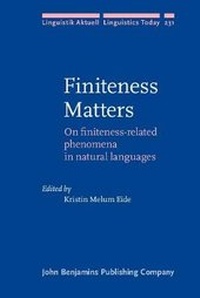
Finiteness Matters
On finiteness-related phenomena in natural languages
Published on 25. August 2016
Book
Hardback
346 pages
978-90-272-5714-7 (ISBN)
Description
"Although standardly recognized by linguists of many diverse theoretical persuasions, finiteness continues to figure among [...] the most poorly understood concepts of linguistic theory". This was eloquently stated by Ledgeway (2000, 2007) and remains true even today. The present volume thus aims to shed some much needed light on this area of linguistic theorizing, with eleven chapters approaching finiteness phenomena from the fields of syntax, semantics, language acquisition, and Creole studies, and providing data from a range of different languages. Traditionally, approaches to finiteness within the Principles and Parameters framework have seen as their main aim to understand the relation between the morphological exponents of finiteness and the syntactic operations seemingly depending on these exponents. The papers in this volume mostly take their point of departure from this more traditional view on finiteness, before elaborating on, modifying and diverging from this tradition in novel and interesting ways.
Reviews / Votes
Integrating syntactic theory, cross-linguistic variation, and acquisition, this is the most wide ranging and up-to-date set of studies available on the concept of finiteness. -- David Adger, Queen Mary University LondonMore details
Series
Language
English
Place of publication
Amsterdam
Netherlands
Target group
Professional and scholarly
Weight
760 gr
ISBN-13
978-90-272-5714-7 (9789027257147)
Copyright in bibliographic data and cover images is held by Nielsen Book Services Limited or by the publishers or by their respective licensors: all rights reserved.
Schweitzer Classification
Other editions
Additional editions
E-Book
08/2016
1st Edition
John Benjamins Publishing Company
€123.99
Available for download
Person
Content
1. Introduction (by Eide, Kristin Melum); 2. Part I: Finiteness: underlying relations; 3. Finiteness and Pseudofiniteness (by Cowper, Elizabeth); 4. The Split T Analysis (by Sigur sson, Halldor Armann); 5. Universals and variation: Encoding anaphoric dependencies (by Reuland, Eric J.); 6. Finiteness, inflection, and the syntax your morphology can afford (by Eide, Kristin Melum); 7. Part II: Morphosyntactic exponents of (non-)finiteness; 8. Agreement is not an essential ingredient of finiteness: Evidence from impersonal sentences in Norwegian dialects and in English (by Afarli, Tor A.); 9. Non-finiteness in Saamaka (by van de Vate, Marleen Susanne); 10. Finiteness and response particles in West Flemish (by Haegeman, Liliane); 11. Part III: Finiteness in language acquisition; 12. Word order and finiteness in acquisition: A study of Norwegian and English Wh-questions (by Westergaard, Marit); 13. The influence of phonological factors on the expression of finiteness by children learning Dutch as their first and second language (by Blom, Elma); 14. Contradictory parameter settings in one mind: A case study of a Mandarin-Norwegian bilingual's acquisition of finiteness and V2 in Norwegian (by Jin, Fufen); 15. Index