

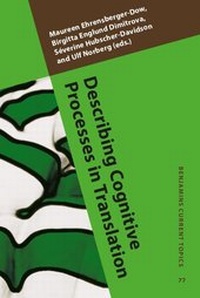
Describing Cognitive Processes in Translation
Acts and events
1st Edition
Published on 1. October 2015
V, 151 pages
978-90-272-6820-4 (ISBN)
Description

This volume addresses translation as an act and an event, having as its main focus the cognitive and mental processes of the translating or interpreting individual in the act of translating, while opening up wider perspectives by including the social situation in explorations of the translation process. First published as a special issue of Translation and Interpreting Studies (issue 8:2, 2013), the chapters in this volume deal with various aspects of translators' and interpreters' observable and non-observable processes, thus encouraging further research at the interface of cognitive and sociological approaches in this area. In terms of those distinctions, the chapters can be characterized as studies of the actual cognitive translation acts, of other processes related to the translation acts, or of processes that are related to the sociological translation event.
More details
Other editions
Additional editions
Maureen Ehrensberger-Dow | Birgitta Englund Dimitrova | Severine Hubscher-Davidson
Describing Cognitive Processes in Translation
Acts and events
Book
10/2015
John Benjamins Publishing Co
€90.10
Shipment within 10-15 days
Persons
Content
- Intro
- Describing Cognitive Processes in Translation
- Editorial page
- Title page
- LCC data
- Table of contents
- Introduction
- References
- Models of what processes?
- 1. Act and event
- 2. Models and problems
- 3. Models of virtual processes
- 4. Models of reverse-engineered processes
- 5. Models of actual processes
- 6. Relations between types of models
- 7. Some models of the translation event
- 8. The translation practice?
- 9. Concluding remarks
- References
- Shared representations and the translation process
- 1. Introduction
- 2. The literal translation hypothesis and the monitor model
- 3. Automatic translation
- 4. The regeneration hypothesis (Potter and Lombardi 1990
- Lombardi and Potter 1992)
- 5. Recall as a measure of monolingual priming
- 6. Bilingual priming
- 7. Semantic bilingual priming
- 8. The shared syntax account (Hartsuiker et al. 2004)
- 9. Syntactic bilingual priming
- 10. Priming in translation
- 10.1 Participants
- 10.2 Procedure
- 10.3 Scoring
- 10.4 Results
- 10.5 Discussion
- 11. The revised literal translation hypothesis
- 12. Recursive model of translation: the revised monitor model
- 13. Conclusion
- References
- ELF speakers' restricted power of expression
- 1. Introduction
- 2. Theoretical background - a cognitive discourse model of interpreting
- 3. Changing contexts - the ELF dimension of bilingual processing
- 4. Evidence from a small-scale case study - ELF-related stumbling blocks for interpreter trainees
- 4.1 Incoherent input - investment of extra capacity to clear up the input
- 4.2 Imprecise input - need for additional resources and/or background knowledge to pin down the intended meaning/message
- 4.3 Comprehensible but unconventional input - erosion of direct SL-TL links
- 5. Discussion - effects of ELF speakers' appropriation of resources on interpreters' comprehension and transfer processes
- 6. Conclusion
- References
- The role of intuition in the translation process
- 1. Introduction
- 2. Intuition in Translation Studies
- 3. Intuition in Psychology
- 3.1 The dual process model
- 3.2 Intuitive judgments: Characteristics, process and reliability
- 3.2.1 Different types of intuition
- 3.2.2 Accuracy and reliability of intuitive responses
- 3.3 Measurement
- 4. The case study
- Excerpt 1
- Excerpt 2
- Excerpt 3
- 5. Discussion
- 5.1 An intuitive personality trait
- 5.2 The relationship between holistic/inferential intuitions and expertise
- 5.3 Developing intuition
- 6. Conclusion
- References
- Appendices
- T2 Experiment Data: Text, Translation, and Think Aloud Protocols
- Source Text Extract
- Target Text Extract
- TAPs excerpt 1: can the moon be pompous?
- TAPs excerpt 2: the one minute option
- TAPs excerpt 3: icy glow on the (Esplanade des) Invalides
- The effect of interpreting experience on distance dynamics
- 1. Introduction
- 2. Aims and hypotheses
- 3. Method
- 4. Findings
- 4.1 Number of self-revisions
- 4.2 Distance dynamics
- 4.2.1 Distance dynamics over the whole self-revision process
- 4.2.2 Change of distance in first self-revisions only
- 4.2.3 Distance dynamics in the post-drafting phase
- 5. Conclusions with regard to the hypotheses
- 5.1 Conclusions with regard to the general hypothesis
- 5.2 Conclusions with regard to the specific hypothesis
- 6. Methodological concerns and future research
- 6.1 Lack of routine in the interpreter group
- 6.2 Small samples
- 6.3 Terminological inconsistency
- 6.4 Other possible variables
- References
- The impact of process protocol self-analysis on errors in the translation product
- 1. Introduction
- 2. Primary objectives of process-oriented translator training
- 3. Methods for training problem recognition
- 3.1 IPDR logs
- 3.2 Audio recordings of verbalized thought processes
- 3.3 Screen recording
- 3.4 Eye-tracking: A promising method on the horizon?
- 4. Research design and methods
- 4.1 Research questions
- 4.2 Participants
- 4.3 Materials and procedures
- 4.4 Error classification
- 5. Results and discussion
- 6. Conclusion and future directions
- References
- Opening eyes to opera
- 1. Introduction
- 2. Problematizing translation in opera audio description and touch tours
- 2.1 Definition and types of AD
- 2.2 Touch tours
- 3. The impact of audience reception on the translation process
- 3.1 Reception project research methodology
- 3.2 The participants
- 3.3 Reception of different types of AD
- 3.4 Reception of features provoking an emotional response
- 3.5 Reception of touch tours
- 3.6 Discussion of findings from the reception project
- 4. Concluding remarks
- References
- Notes on contributors
- Index
