

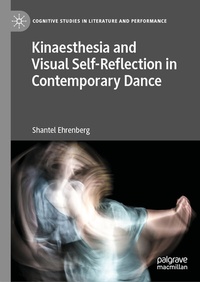
Kinaesthesia and Visual Self-Reflection in Contemporary Dance
Description

Kinaesthesia and Visual Self-reflection in Contemporary Dance features interviews with UK-based professional-level contemporary, ballet, hip hop, and breaking dancers and cross-disciplinary explication of kinaesthesia and visual self-reflection discourses. Expanding on the concept of a 'kinaesthetic mode of attention' leads to discussion of some of the key values and practices which nurture and develop this mode in contemporary dance. Zooming in on entanglements with video self-images in dance practice provides further insights regarding kinaesthesia's historicised polarisation with the visual. It thus provides opportunities to dwell on and reconsider reflections, opening up to a set of playful yet disruptive diffractions inherent in the process of becoming a contemporary dancer, particularly amongst an increasingly complex landscape of visual and theoretical technologies.
Reviews / Votes
"This book makes an extraordinarily timely contribution to the field of dance studies, through articulating the kinaesthetic awareness that contemporary dancers cultivate in their professional practice. Artfully synthesising previous scholarly research concerning the embodied knowledge of contemporary dancing subjects, Ehrenberg proposes exciting new ways of conceptualising the intra-action between dancers and the ubiquitous technology supporting dancemaking processes. A highly engaging and impactful read, it points to important new directions in dance and related research fields." (-Dr Jenny Roche, Senior Lecturer in Contemporary Dance, University of Limerick, Ireland)
"This book offers an invaluable insight to how dancers respond to and speak about the tension they may experience between the 'felt-sense' of their dancing and their visual image. As such it provides new understandings about how dancers experience being watched. By combining dancer commentary with a range of theories as diverse as feminist philosophy, post-structuralism and posthumanism, the book adeptly conceptualises and interrogates the concept of a 'kinaesthetic mode of attention' for contemporary dance." (-Professor Sarah Whatley, C-DaRE, Coventry University, UK)
"Sparse are the dance scholarly works that explicitly focus on kinaesthesia - our feeling of movement. Kinaesthesia and Visual Self-Reflection in Contemporary Dance is one of these relatively rare books. In this book Shantel Ehrenberg not only qualifies the concept of kinaesthesia, she also places the use of the concept in a historical context as well as describes it phenomenologically. This book is without doubt a great resource for anyone interested in the moving body." (-Professor Susanne Ravn, University of Southern Denmark, Denmarj)
More details
Other editions
Additional editions
Person
Shantel Ehrenberg is a practitioner/researcher/academic. Her research and practice focus on the complexity of the corporeal. She is Lecturer in Dance & Theatre at the University of Surrey, UK. Her research is also found in publications such as Choreographic Practices, Dance Research Journal , and Research in Dance Education .
Content
1. Chapter 1: Introducing, situating, positioning(s)- Chapter 2: Illuminating dancers' kinaesthetic experience.- Chapter 3: A Kinaesthetic Mode of Attention.- Chapter 4: Practices and values which develop and nurture a kinaesthetic mode of attention.- Chapter 5: Kinaesthesia and video self-image(s): foregrounding the imagination.- Chapter 6 Concluding Diffractions | Diffracting Conclusions.
