

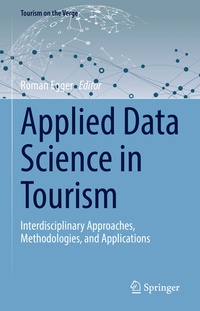
Applied Data Science in Tourism
Description

The book is a very well-structured introduction to data science - not only in tourism - and its methodological foundations, accompanied by well-chosen practical cases. It underlines an important insight: data are only representations of reality, you need methodological skills and domain background to derive knowledge from them
- Hannes Werthner, Vienna University of Technology
Roman Egger has accomplished a difficult but necessary task: make clear how data science can practically support and foster travel and tourism research and applications. The book offers a well-taught collection of chapters giving a comprehensive and deep account of AI and data science for tourism
- Francesco Ricci, Free University of Bozen-Bolzano This well-structured and easy-to-read book provides a comprehensive overview of data science in tourism. It contributes largely to the methodological repository beyond traditional methods.
- Rob Law, University of Macau
Reviews / Votes
"Applied Data Science in Tourism is an incredibly helpful contribution to data science research in the fields of tourism and hospitality that is both easy to read and tremendously fascinating. This book is a valuable source of theoretical and methodological knowledge for both academics and industry practitioners of tourism and related fields such as hospitality, leisure, and event management. Especially considering the increasing demand for data analytics and the use of big data in service industries." (Omid Oshriyeh, Information Technology & Tourism, Vol. 25 (1), 2023)More details
Other editions
Additional editions
Person
Content
Part I: Theoretical Fundaments.- AI and Big Data in Tourism.- Epistemological Challenges.- Data Science and Interdisciplinarity.- Data Science and Ethical Issues.- Web Scraping.- Part II: Machine Learning.- Machine Learning in Tourism: A Brief Overview.- Feature Engineering.- Clustering.- Dimensionality Reduction.- Classification.- Regression.- Hyperparameter Tuning.- Model Evaluation.- Interpretability of Machine Learning Models.- Part III: Natural Language Processing.- Natural Language Processing (NLP): An Introduction.- Text Representations and Word Embeddings.- Sentiment Analysis.- Topic Modelling.- Entity Matching: Matching Entities Between Multiple Data Sources.- Knowledge Graphs.- Part IV: Additional Methods.- Network Analysis.- Time Series Analysis.- Agent-Based Modelling.- Geographic Information System (GIS).- Visual Data Analysis.- Software and Tools.
