

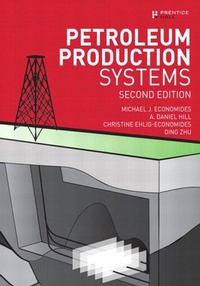
Petroleum Production Systems
Description

Petroleum Production Systems, Second Edition, is the comprehensive source for clear and fundamental methods for about modern petroleum production engineering practice. Written by four leading experts, it thoroughly introduces modern principles of petroleum production systems design and operation, fully considering the combined behavior of reservoirs, surface equipment, pipeline systems, and storage facilities. Long considered the definitive text for production engineers, this edition adds extensive new coverage of hydraulic fracturing, with emphasis on well productivity optimization. It presents new chapters on horizontal wells and well performance evaluation, including production data analysis and sand management.
This edition features
- A structured approach spanning classical production engineering, well testing, production logging, artificial lift, and matrix and hydraulic fracture stimulation
- Revisions throughout to reflect recent innovations and extensive feedback from both students and colleagues
- Detailed coverage of modern best practices and their rationales
- Unconventional oil and gas well design
- Many new examples and problems
- Detailed data sets for three characteristic reservoir types: an undersaturated oil reservoir, a saturated oil reservoir, and a gas reservoir
All prices
More details
Other editions
Additional editions
Persons
A. Daniel Hill is professor in the Harold Vance Department of Petroleum Engineering at Texas A&M University, holds the R.L. Whiting endowed chair, and is a Distinguished Member of the Society of Petroleum Engineers (SPE).
Christine Ehlig-Economides is professor in the Harold Vance Department of Petroleum Engineering at Texas A&M University and holds the A.B. Stevens endowed chair. She is a member of the U.S. National Academy of Engineering.
Ding Zhu, is associate professor in the Harold Vance Department of Petroleum Engineering at Texas A&M University, holds the W.D. Von Gonten Faculty Fellowship, and is a Distinguished Member of the Society of Petroleum Engineers (SPE).
Content
Preface xvii
About the Authors xix
Chapter 1: The Role of Petroleum Production Engineering 1
1.1 Introduction 1
1.2 Components of the Petroleum Production System 2
1.3 Well Productivity and Production Engineering 11
1.4 Units and Conversions 15
References 18
Chapter 2: Production from Undersaturated Oil Reservoirs 19
2.1 Introduction 19
2.2 Steady-State Well Performance 19
2.3 Transient Flow of Undersaturated Oil 24
2.4 Pseudosteady-State Flow 26
2.5 Wells Draining Irregular Patterns 30
2.6 Inflow Performance Relationship 34
2.7 Effects of Water Production, Relative Permeability 37
2.8 Summary of Single-Phase Oil Inflow Performance Relationships 39
References 39
Problems 39
Chapter 3: Production from Two-Phase Reservoirs 41
3.1 Introduction 41
3.2 Properties of Saturated Oil 42
3.3 Two-Phase Flow in a Reservoir 53
3.4 Oil Inflow Performance for a Two-Phase Reservoir 55
3.5 Generalized Vogel Inflow Performance 56
3.6 Fetkovich's Approximation 57
References 58
Problems 58
Chapter 4: Production from Natural Gas Reservoirs 61
4.1 Introduction 61
4.2 Correlations and Useful Calculations for Natural Gases 66
4.3 Approximation of Gas Well Deliverability 76
4.4 Gas Well Deliverability for Non-Darcy Flow 79
4.5 Transient Flow of a Gas Well 84
References 91
Problems 93
Chapter 5: Production from Horizontal Wells 95
5.1 Introduction 95
5.2 Steady-State Well Performance 97
5.3 Pseudosteady-State Flow 103
5.4 Inflow Performance Relationship for Horizontal Gas Wells 114
5.5 Two-Phase Correlations for Horizontal Well Inflow 115
5.6 Multilateral Well Technology 116
References 117
Problems 119
Chapter 6: The Near-Wellbore Condition and Damage Characterization; Skin Effects 121
6.1 Introduction 121
6.2 Hawkins' Formula 122
6.3 Skin Components for Vertical and Inclined Wells 126
6.4 Skin from Partial Completion and Well Deviation 128
6.5 Horizontal Well Damage Skin Effect 134
6.6 Well Completion Skin Factors 138
6.7 Formation Damage Mechanisms 151
6.8 Sources of Formation Damage During Well Operations 157
References 163
Problems 165
Chapter 7: Wellbore Flow Performance 167
7.1 Introduction 167
7.2 Single-Phase Flow of an Incompressible, Newtonian Fluid 168
7.3 Single-Phase Flow of a Compressible, Newtonian Fluid 179
7.4 Multiphase Flow in Wells 184
References 214
Problems 215
Chapter 8: Flow in Horizontal Wellbores, Wellheads, and Gathering Systems 217
8.1 Introduction 217
8.2 Flow in Horizontal Pipes 217
8.3 Flow through Chokes 236
8.4 Surface Gathering Systems 247
8.5 Flow in Horizontal Wellbores 250
References 256
Problems 258
Chapter 9: Well Deliverability 261
9.1 Introduction 261
9.2 Combination of Inflow Performance Relationship (IPR) and Vertical Flow Performance (VFP) 262
9.3 IPR and VFP of Two-Phase Reservoirs 268
9.4 IPR and VFP in Gas Reservoirs 270
Problems 274
Chapter 10: Forecast of Well Production 275
10.1 Introduction 275
10.2 Transient Production Rate Forecast 275
10.3 Material Balance for an Undersaturated Reservoir and Production Forecast Under Pseudosteady-State Conditions 277
10.4 The General Material Balance for Oil Reservoirs 281
10.5 Production Forecast from a Two-Phase Reservoir: Solution Gas Drive 286
10.6 Gas Material Balance and Forecast of Gas Well Performance 294
References 296
Problems 297
Chapter 11: Gas Lift 299
11.1 Introduction 299
11.2 Well Construction for Gas Lift 299
11.3 Continuous Gas-Lift Design 303
11.4 Unloading Wells with Multiple Gas-Lift Valves 310
11.5 Optimization of Gas-Lift Design 312
11.6 Gas-Lift Performance Curve 316
11.7 Gas-Lift Requirements versus Time 328
References 332
Problems 333
Chapter 12: Pump-Assisted Lift 335
12.1 Introduction 335
12.2 Positive-Displacement Pumps 338
12.3 Dynamic Displacement Pumps 354
12.4 Lifting Liquids in Gas Wells; Plunger Lift 359
References 362
Problems 362
Chapter 13: Well Performance Evaluation 365
13.1 Introduction 365
13.2 Open-Hole Formation Evaluation 366
13.3 Cased Hole Logs 368
13.4 Transient Well Analysis 387
References 438
Problems 439
Chapter 14: Matrix Acidizing: Acid/Rock Interactions 443
14.1 Introduction 443
14.2 Acid-Mineral Reaction Stoichiometry 446
14.3 Acid-Mineral Reaction Kinetics 453
14.4 Acid Transport to the Mineral Surface 460
14.5 Precipitation of Acid Reaction Products 461
References 464
Problems 466
Chapter 15: Sandstone Acidizing Design 469
15.1 Introduction 469
15.2 Acid Selection 470
15.3 Acid Volume and Injection Rate 472
15.4 Fluid Placement and Diversion 496
15.5 Preflush and Postflush Design 509
15.6 Acid Additives 512
15.7 Acidizing Treatment Operations 512
References 513
Problems 516
Chapter 16: Carbonate Acidizing Design 519
16.1 Introduction 519
16.2 Wormhole Formation and Growth 522
16.3 Wormhole Propagation Models 525
16.4 Matrix Acidizing Design for Carbonates 535
16.5 Acid Fracturing 541
16.6 Acidizing of Horizontal Wells 554
References 555
Problems 558
Chapter 17: Hydraulic Fracturing for Well Stimulation 559
17.1 Introduction 559
17.2 Length, Conductivity, and Equivalent Skin Effect 562
17.3 Optimal Fracture Geometry for Maximizing the Fractured Well Productivity 566
17.4 Fractured Well Behavior in Conventional Low-Permeability Reservoirs 574
17.5 The Effect of Non-Darcy Flow on Fractured Well Performance 579
17.6 Fractured Well Performance for Unconventional Tight Sand or Shale Reservoirs 585
17.7 Choke Effect for Transverse Hydraulic Fractures 592
References 594
Problems 597
Chapter 18: The Design and Execution of Hydraulic Fracturing Treatments 601
18.1 Introduction 601
18.2 The Fracturing of Reservoir Rock 602
18.3 Fracture Geometry 609
18.4 The Created Fracture Geometry and Net Pressure 616
18.5 Fracturing Fluids 635
18.6 Proppants and Fracture Conductivity 642
18.7 Fracture Diagnostics 646
18.8 Fracturing Horizontal Wells 651
References 655
Problems 657
Chapter 19: Sand Management 661
19.1 Introduction 661
19.2 Sand Flow Modeling 662
19.3 Sand Management 676
19.4 Sand Exclusion 677
19.5 Completion Failure Avoidance 698
References 699
Problems 702
Appendix A: 703
Appendix B: 705
Appendix C: 709
Index 711
