

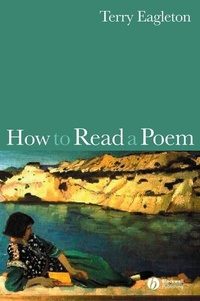
How to Read a Poem
Description

* Offers a detailed examination of poetic form and its relation to content.
* Takes a wide range of poems from the Renaissance to the present day and submits them to brilliantly illuminating closes analysis.
* Discusses the work of major poets, including John Milton, Alexander Pope, John Keats, Christina Rossetti, Emily Dickinson, W.B. Yeats, Robert Frost, W.H.Auden, Seamus Heaney, Derek Mahon, and many more.
* Includes a helpful glossary of poetic terms.
More details
Other editions
Additional editions

Person
Content
Preface vii
Acknowledgements viii
1 The Functions of Criticism 1
1 The End of Criticism? 1
2 Politics and Rhetoric 8
3 The Death of Experience 17
4 Imagination 22
2 What is Poetry? 25
1 Poetry and Prose 25
2 Poetry and Morality 28
3 Poetry and Fiction 31
4 Poetry and Pragmatism 38
5 Poetic Language 41
3 Formalists 48
1 Literariness 48
2 Estrangement 49
3 The Semiotics of Yury Lotman 52
4 The Incarnational Fallacy 59
4 In Pursuit of Form 65
1 The Meaning of Form 65
2 Form versus Content 70
3 Form as Transcending Content 79
4 Poetry and Performance 88
5 Two American Examples 96
5 How to Read a Poem 102
1 Is Criticism Just Subjective? 102
2 Meaning and Subjectivity 108
3 Tone, Mood and Pitch 114
4 Intensity and Pace 118
5 Texture 120
6 Syntax, Grammar and Punctuation 121
7 Ambiguity 124
8 Punctuation 130
9 Rhyme 131
10 Rhythm and Metre 135
11 Imagery 138
6 Four Nature Poems 143
1 William Collins, 'Ode to Evening' 143
2 William Wordsworth, 'The Solitary Reaper' 149
3 Gerard Manley Hopkins, 'God's Grandeur' 153
4 Edward Thomas, 'Fifty Faggots' 157
5 Form and History 161
Glossary 165
Index 169
Chapter 2
What is Poetry?
2.1 Poetry and Prose
A poem is a fictional, verbally inventive moral statement in which it is the author, rather than the printer or word processor, who decides where the lines should end. This dreary-sounding definition, unpoetic to a fault, may well turn out to be the best we can do. Before we dissect it piece by piece, however, let us note what it doesn't say, rather than what it does.
To begin with, it makes no reference to rhyme, metre, rhythm, imagery, diction, or symbolism and so on. This is because there are plenty of poems which do not use these things, and quite a lot of prose that does. Prose may use internal rhymes, and quite commonly raids the resources of rhythm, imagery, symbolism, word-music, figures of speech, heightened language and the like. Wallace Stevens is rhythmical, but so is Marcel Proust. Virginia Woolf 's prose is much more metaphorically charged than John Dryden's poetry, not to mention Gregory Corso's. There is more rhetorically heightened language in Joseph Conrad than there is in Philip Larkin.
It is true that prose does not generally use metre. On the whole, metre, like end-rhymes, is peculiar to poetry; but it can hardly be of its essence, since so many poems survive quite well without it. We are left, then, with line-endings, which the poet herself gets to decide on. Even this is only true up to a point: a particular kind of metre may itself determine where the lines have to end. But the poet gets to choose the metre, at least within certain constraints. A dramatist writing around 1600 was normally expected to use blank verse, while a satirist writing around 1750 would probably find heroic couplets the most appropriate form.
Line-endings in poetry may not always signify, but they can always be made to. They can even act as a kind of image, of the kind F. R. Leavis discerns in these lines from John Keats's ode 'To Autumn':
And sometimes like a gleaner thou dost keep
Steady thy laden head across a brook ...
'As we pass across the line-division from "keep" to "steady"', Leavis observes, 'we are made to enact, analogically, the upright steadying carriage of the gleaner as she steps from one stone to another.'1 The reader may find the comment genuinely perceptive, or just a more subtle version of the kind of criticism that claims to hear the cut and thrust of the rapiers in the swishing sibilants of some poetic description of a duel.
Prose, by contrast, is the kind of writing in which where the lines end is a matter of indifference. It is a purely technical affair. All the same, there is hardly a device thought of as 'poetic' which some piece of prose somewhere does not exploit. Prose may be lyrical, introspective and brimming with delicate feeling, while poetry may recount narratives about the land wars in nineteenth-century Ireland. The distinction between the two is ripe for dismantling.
Take, for example, this sourly misogynistic piece by D. H. Lawrence:
The feelings I don't have, I don't have.
The feelings I don't have, I won't say I have.
The feelings you say you have, you don't have.
The feelings you would like us both to have, we neither of us have.
The feelings people ought to have, they never have.
If people say they've got feelings, you may be pretty sure they haven't got them.
So if you want either of us to feel anything at all,
You'd better abandon all idea of feelings altogether.
('To Women, As Far As I'm Concerned')
What makes this a poem? Surely not the quality of the language, which is aggressively prosaic. The piece is as rough-and-ready in its language as it is in its attitudes. The poem doesn't rhyme (unless repeating 'have' counts as a rhyme), or employ metre (it is in so-called free verse). It also avoids symbolism, allegory, figurative speech, ambiguity, metaphor, suggestive connotation and the rest. Rather than exploring intricate states of feeling, it wrathfully rejects that whole enterprise. It does, however, manipulate rhythm and repetition to make its point. And setting up this rhythmical pattern involves an attention to line-endings. If the lines were strung out together like prose, this vital rhythmic pounding, like someone banging his fist on a table, might well be lost. So composing the piece as a poem has a point. By breaking it up like this on the page, the abrasive, staccato impact of the lines, each of which seems to end with a series of irascible thumps, is thrown into high relief. So is the parallelism between them, as each line weaves a variation on the last. And this sense of mechanical repetition captures something of the speaker's emotionally depleted state, as well as his sexual irritability.
The repetition also plays a major part in another of the poem's effects, which is that despite its dyspeptic quality, it is mildly funny. Its cut-the-crap bluntness, its bull-headed refusal to qualify or elaborate, make us smile, as we might at someone carelessly paring his corns on a Queen Anne chair. There is something wryly amusing about the poem's downrightness, which allows us to enjoy a momentary relief from the exacting complexities of feeling. It is the kind of brutal candour we might be tempted to go in for ourselves, if only we weren't so cravenly civil. The lines are wonderfully unsubtle. Indeed, the fact that the piece is comic and disgusted at the same time is part of its peculiar emotional impact. If it is deadly serious in its savage dismissal of fine feelings, there is a sense in which it is also sending itself up, or at least is ironically aware of its own exasperation. The emphatic refrain 'I don't have', 'you don't have', 'we don't have', 'neither of us have' is a kind of heavy-handed wit. It has the air of a comic riddle about it. The wordplay shows the poet as slightly detached from his own exasperation.
No doubt there should be a brief, suspenseful pause in the middle of each line after the first 'have', as with a stand-up comic about to deliver a punch line. (In English poetry, as opposed to some other kinds, a pause can come anywhere in the line.) Each line is in this sense a minor drama, cruelly pulling the carpet out from under whomever the speaker is addressing. One can imagine the speaking voice rising suggestively with 'The feelings you say you have', only to crash bathetically down with the matter-of-fact flatness of 'you don't have'. It is not the kind of piece you could vocalise very successfully in standard English. There is a lot about the language which suggests Lawrence's own provincial speech.
So one can see why it suits the poem to be in the form of verse. It is also poetry because it is a 'moral' statement, an idea we shall be examining in a moment. And calling it a poem, a title which the author acquires for it simply by organising his words on the page in this way, also suggests that it has a bearing beyond himself and his partner, or whoever the addressee may be. We shall be examining this idea in a moment as well. Even so, the lines have as little in common with the usual stereotype of the poetic as they can get away with. And to this extent, their form reflects their content. Their brusque way with self-conscious cults of feeling comes through in their calculatedly artless language, with its sense of rasping immediacy.
2.2 Poetry and Morality
The word 'moral' usually poses a problem, not least in Anglo-Saxon cultures. It suggests codes and prohibitions, grim strictures and civilised behaviour, rigorous distinctions between right and wrong. This forbidding notion of morality was what inspired the philosopher Bertrand Russell to remark that the Ten Commandments ought to come with the sort of rubric which is sometimes to be found on examination papers of ten questions: 'Only six need be attempted'. If poetry is about pleasure, morality would seem to be its opposite. In fact, morality in its traditional sense, before the advocates of duty and obligation got their hands on it, is the study of how to live most fully and enjoyably; and the word 'moral' in the present context refers to a qualitative or evaluative view of human conduct and experience. Moral language does not only include terms like good and bad, or right and wrong: its lexicon extends to such epithets as 'rash', 'exquisite', 'placid', 'sardonic', 'vivacious', 'resilient', 'tender', 'blasé' and 'curmudgeonly'. All these are as much moral terms as 'saintly' or 'genocidal'. Morality has to do with behaviour, not just with good behaviour. Moral judgements include such statements as 'Her protestations were more disquieting than reassuring', as well as statements like 'this evildoer ought to have his eyes gouged out'. The vocabulary of criticism is for the most part a moral one, with an admixture of technical or aesthetic terms.
'Moral', in this traditional usage, contrasts not with 'immoral', but with terms like...
