

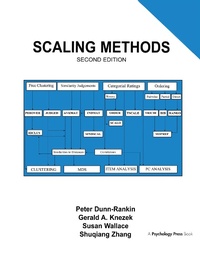
Scaling Methods
2nd Edition
Published on 4. April 2014
254 pages
978-1-135-69295-7 (ISBN)
Description

Scaling Methods is written for professionals in the behavioral sciences who analyze data that results from subjective responses. Other books on scaling attitudes or measuring perceptions focus on the psychometrician's view of measurement. This book focuses on the users' view by concentrating on effective ways to analyze data rather than the mathematical details of how each program works. The methods included handle the majority of data analysis problems encountered and are accompanied by a software solution. Each chapter features the theory surrounding that methodology, an example, a real-world application, and a computer solution.
This book introduces the major uni- and multi-dimensional scaling method techniques most common in educational, social, and psychological research. Using four primary methods of data collection--ordering, categorical rating, free clustering, and similarity judgments--Scaling Methods, Second Edition explains how such data can be represented in ways that illustrate relationships among the data and help reveal underlying dimensional structures. Each method serves as an independent unit so readers can pick and choose from a variety of easy-to-use procedures and more advanced techniques. The new edition features a new chapter on order analysis and downloadable resources that provide stand-alone, as well as SAS supported demonstrations of multi-dimensional scaling techniques, plus programs to get raw data into matrix form.
The text is written for researchers, practitioners, and advanced students in education and the social and behavioral sciences interested in analyzing data resulting from subjective responses, especially in the measurement of attitudes. Each chapter is self-contained making this an excellent resource for use in the classroom or as a self-study tool. A first course in statistics is a helpful prerequisite.
This book introduces the major uni- and multi-dimensional scaling method techniques most common in educational, social, and psychological research. Using four primary methods of data collection--ordering, categorical rating, free clustering, and similarity judgments--Scaling Methods, Second Edition explains how such data can be represented in ways that illustrate relationships among the data and help reveal underlying dimensional structures. Each method serves as an independent unit so readers can pick and choose from a variety of easy-to-use procedures and more advanced techniques. The new edition features a new chapter on order analysis and downloadable resources that provide stand-alone, as well as SAS supported demonstrations of multi-dimensional scaling techniques, plus programs to get raw data into matrix form.
The text is written for researchers, practitioners, and advanced students in education and the social and behavioral sciences interested in analyzing data resulting from subjective responses, especially in the measurement of attitudes. Each chapter is self-contained making this an excellent resource for use in the classroom or as a self-study tool. A first course in statistics is a helpful prerequisite.
Reviews / Votes
"If you are, in any way, connected with the field of measurement...you have the satisfaction of knowing that the methods of interest to you will be readily available at your fingertips...the authors' have encyclopedic and up-to-date knowledge of the field."-Shlomo S. Sawilowsky, Ph.D.
Wayne State University
"...this book is one of the few textbooks that have made scaling methodology manageable by students in behavioral sciences who may not have very strong quantitative backgrounds... .It is full of a wide variety of highly useful scaling methodologies and vivid examples. The authors have done an excellent job in explaining and simplifying what could have been potentially complicated issues."
-Xiang Bo Wang, Ph.D.
The Chauncey Group International
More details
Edition
2nd edition
Language
English
Place of publication
London
United Kingdom
Publishing group
Taylor & Francis Ltd
Target group
Professional and scholarly
Edition type
Revised edition
File size
24,32 MB
ISBN-13
978-1-135-69295-7 (9781135692957)
Copyright in bibliographic data and cover images is held by Nielsen Book Services Limited or by the publishers or by their respective licensors: all rights reserved.
Schweitzer Classification
Other editions
Additional editions
Peter Dunn-Rankin | Gerald A. Knezek | Susan R. Wallace
Scaling Methods
Book
04/2016
2nd Edition
Psychology Press Ltd
€215.41
Shipment within 10-20 days
Peter Dunn-Rankin | Gerald A. Knezek | Susan R. Wallace
Scaling Methods
Book
07/2004
2nd Edition
Psychology Press
€81.89
Shipment within 10-20 days
Persons
Peter Dunn-Rankin (Author) , Gerald A. Knezek (Author) , Susan R. Wallace (Author) , Shuqiang Zhang (Author)
Content
Contents: Preface. Part I: Foundations. Scaling Defined. Tasks. Measures of Proximity. Part II: Unidimensional Methods. Rank Scaling. Order Analysis. Comparative Judgement. Categorical Ratings. Part III: Clustering. Graphic Similarity Analysis. Successive Combining. Partitioning. Hierarchical Divisive. Part IV: Multidimensional Methods. Factor Analysis. Mapping Individual Preference. Multidimensional Scaling. Individual Differences Scaling. Appendices: Using a Computer to Solve Problems. Tables.
