

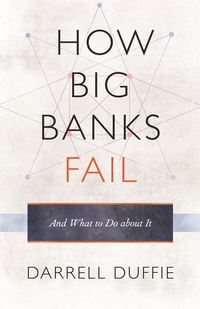
How Big Banks Fail and What to Do about It
1st Edition
Published on 18. October 2010
112 pages
978-1-4008-3699-4 (ISBN)
Description

A leading finance expert explains how and why big banks fail-and what can be done to prevent it
Dealer banks-that is, large banks that deal in securities and derivatives, such as J. P. Morgan and Goldman Sachs-are of a size and complexity that sharply distinguish them from typical commercial banks. When they fail, as we saw in the global financial crisis, they pose significant risks to our financial system and the world economy. How Big Banks Fail and What to Do about It examines how these banks collapse and how we can prevent the need to bail them out.
In sharp, clinical detail, Darrell Duffie walks readers step-by-step through the mechanics of large-bank failures. He identifies where the cracks first appear when a dealer bank is weakened by severe trading losses, and demonstrates how the bank's relationships with its customers and business partners abruptly change when its solvency is threatened. As others seek to reduce their exposure to the dealer bank, the bank is forced to signal its strength by using up its slim stock of remaining liquid capital. Duffie shows how the key mechanisms in a dealer bank's collapse-such as Lehman Brothers' failure in 2008-derive from special institutional frameworks and regulations that influence the flight of short-term secured creditors, hedge-fund clients, derivatives counterparties, and most devastatingly, the loss of clearing and settlement services.
How Big Banks Fail and What to Do about It reveals why today's regulatory and institutional frameworks for mitigating large-bank failures don't address the special risks to our financial system that are posed by dealer banks, and outlines the improvements in regulations and market institutions that are needed to address these systemic risks.
Dealer banks-that is, large banks that deal in securities and derivatives, such as J. P. Morgan and Goldman Sachs-are of a size and complexity that sharply distinguish them from typical commercial banks. When they fail, as we saw in the global financial crisis, they pose significant risks to our financial system and the world economy. How Big Banks Fail and What to Do about It examines how these banks collapse and how we can prevent the need to bail them out.
In sharp, clinical detail, Darrell Duffie walks readers step-by-step through the mechanics of large-bank failures. He identifies where the cracks first appear when a dealer bank is weakened by severe trading losses, and demonstrates how the bank's relationships with its customers and business partners abruptly change when its solvency is threatened. As others seek to reduce their exposure to the dealer bank, the bank is forced to signal its strength by using up its slim stock of remaining liquid capital. Duffie shows how the key mechanisms in a dealer bank's collapse-such as Lehman Brothers' failure in 2008-derive from special institutional frameworks and regulations that influence the flight of short-term secured creditors, hedge-fund clients, derivatives counterparties, and most devastatingly, the loss of clearing and settlement services.
How Big Banks Fail and What to Do about It reveals why today's regulatory and institutional frameworks for mitigating large-bank failures don't address the special risks to our financial system that are posed by dealer banks, and outlines the improvements in regulations and market institutions that are needed to address these systemic risks.
All prices
More details
Other editions
Additional editions
Darrell Duffie
How Big Banks Fail and What to Do about It
Book
11/2010
1st Edition
Princeton University Press
€49.60
Shipment within 10-20 days
Person
Darrell Duffie is the Dean Witter Distinguished Professor of Finance at Stanford University's Graduate School of Business. He is the author of Dynamic Asset Pricing Theory and the coauthor of Credit Risk: Pricing, Measurement, and Management (both Princeton).
Content
List of Figures and Tables ix
Preface xi
Chapter One: Introduction 1
Chapter Two: What Is a Dealer Bank? 9
Chapter Three: Failure Mechanisms 23
Chapter Four: Recapitalizing a Weak Bank 43
Chapter Five: Improving Regulations and Market Infrastructure 53
Appendix: Central Clearing of Derivatives 63
Notes 71
Bibliography 79
Index 87
Preface xi
Chapter One: Introduction 1
Chapter Two: What Is a Dealer Bank? 9
Chapter Three: Failure Mechanisms 23
Chapter Four: Recapitalizing a Weak Bank 43
Chapter Five: Improving Regulations and Market Infrastructure 53
Appendix: Central Clearing of Derivatives 63
Notes 71
Bibliography 79
Index 87

