

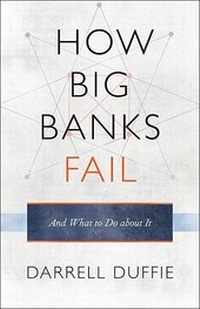
How Big Banks Fail and What to Do about It
1st Edition
Published on 7. November 2010
Book
Hardback
112 pages
978-0-691-14885-4 (ISBN)
Description
Dealer banks--that is, large banks that deal in securities and derivatives, such as J. P. Morgan and Goldman Sachs--are of a size and complexity that sharply distinguish them from typical commercial banks. When they fail, as we saw in the global financial crisis, they pose significant risks to our financial system and the world economy. How Big Banks Fail and What to Do about It examines how these banks collapse and how we can prevent the need to bail them out. In sharp, clinical detail, Darrell Duffie walks readers step-by-step through the mechanics of large-bank failures. He identifies where the cracks first appear when a dealer bank is weakened by severe trading losses, and demonstrates how the bank's relationships with its customers and business partners abruptly change when its solvency is threatened. As others seek to reduce their exposure to the dealer bank, the bank is forced to signal its strength by using up its slim stock of remaining liquid capital.
Duffie shows how the key mechanisms in a dealer bank's collapse--such as Lehman Brothers' failure in 2008--derive from special institutional frameworks and regulations that influence the flight of short-term secured creditors, hedge-fund clients, derivatives counterparties, and most devastatingly, the loss of clearing and settlement services. How Big Banks Fail and What to Do about It reveals why today's regulatory and institutional frameworks for mitigating large-bank failures don't address the special risks to our financial system that are posed by dealer banks, and outlines the improvements in regulations and market institutions that are needed to address these systemic risks.
Duffie shows how the key mechanisms in a dealer bank's collapse--such as Lehman Brothers' failure in 2008--derive from special institutional frameworks and regulations that influence the flight of short-term secured creditors, hedge-fund clients, derivatives counterparties, and most devastatingly, the loss of clearing and settlement services. How Big Banks Fail and What to Do about It reveals why today's regulatory and institutional frameworks for mitigating large-bank failures don't address the special risks to our financial system that are posed by dealer banks, and outlines the improvements in regulations and market institutions that are needed to address these systemic risks.
Reviews / Votes
"[T]his volume will give readers a deeper understanding of how modern banking works."--Choice "There are precious few manuals on global finance. To be sure, there are enough leaden textbooks and scholarly tomes to crush many a library, but there are few nuts-and-bolts guides. Darrell Duffie has performed a great service by attempting to explain in simple terms why and how major investment banks (what he calls 'dealer banks') collapse... How Big Banks Fail is ... a valuable addition to public literature on the global financial crisis."--Joel Campbell, International Affairs "This is a clear and readable account of the mechanisms and incentives at play."--Saxon Brettell, Business Economist "I highly recommend the book. I believe the text should be standard reading for anybody involved with regulating and supervising financial institutions as it offers valuable insights into the plumbing of financial markets and the mechanisms that can cause bank failures. The discussed mechanisms are thought provoking and can provide researchers and regulators with valuable ideas for future research on the financial system as well as banking regulation."--Jan Wrampelmeyer, Financial Markets and Portfolio ManagementMore details
Language
English
Place of publication
New Jersey
United States
Target group
College/higher education
Product notice
Trade binding
Illustrations
13 line illus. 2 tables.
Dimensions
Height: 203 mm
Width: 127 mm
Weight
255 gr
ISBN-13
978-0-691-14885-4 (9780691148854)
Copyright in bibliographic data and cover images is held by Nielsen Book Services Limited or by the publishers or by their respective licensors: all rights reserved.
Schweitzer Classification
Other editions
Additional editions
Darrell Duffie
How Big Banks Fail and What to Do about It
E-Book
10/2010
1st Edition
Princeton University Press
from
€40.59
Available for download
Person
Darrell Duffie is the Dean Witter Distinguished Professor of Finance at Stanford University's Graduate School of Business. He is the author of "Dynamic Asset Pricing Theory" and the coauthor of "Credit Risk: Pricing, Measurement, and Management" (both Princeton).
Content
List of Figures and Tables ix Preface xi Chapter One: Introduction 1 Chapter Two: What Is a Dealer Bank? 9 Chapter Three: Failure Mechanisms 23 Chapter Four: Recapitalizing a Weak Bank 43 Chapter Five: Improving Regulations and Market Infrastructure 53 Appendix: Central Clearing of Derivatives 63 Notes 71 Bibliography 79 Index 87