

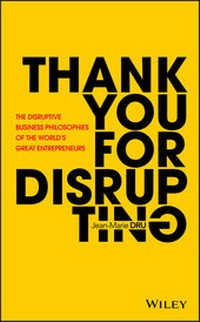
Thank You For Disrupting
Description

More details
Other editions
Additional editions
Content
Part One Disruptive Company Leadership 1
Chapter 1 Steve Jobs: On User Experience, Design and Timelessness 3
All in One 4
The Art of Reduction 7
Life Lessons 8
Chapter 2 Jeff Bezos: On Experimentation and Platforms 11
Experimentation as a Strategy 12
The Platform Economy 14
Chapter 3 Herb Kelleher: On Human Resources and Operational Quality 19
Employees First 20
The Art Is in the Implementation 24
Chapter 4 Bernard Arnault: On the Management of Creativity and Brand Building 27
Art and Commerce 28
The Luxury Industry as Model 31
Chapter 5 Zhang Ruimin: On Decentralization and Customer-Centricity 35
Everyone Is a CEO 38
Zero Distance with the Customer 41
Chapter 6 Jack Ma: On Chinese Business Models and Disruptive Management 45
A Contrarian Model 46
Embracing Change through Paradox 50
U.S. In, China Out 51
Part Two Disruptive Business Thinking 57
Chapter 7 Jim Collins: On the Search for Excellence and the Management of Alternatives 59
Good to Great 60
The Era of the And 63
Chapter 8 Clayton Christensen: On Disruptive Innovation 67
Bottom-up Disruption 69
The Disruption Controversy 71
Chapter 9 Jedidiah Yueh: On the Behaviors of Companies of the New Economy 75
Lessons from an Entrepreneur 78
Category of One 87
Part Three Disruptive Corporate Culture 91
Chapter 10 Sergey Brin and Larry Page: On Recruitment Policies and Core Values 95
HR as a Science 96
A Fertile Environment 98
Chapter 11 Patty McCord: On Employee Empowerment and Talent Management 101
Disruptive HR Practices 103
A Contrasting Culture 104
Chapter 12 The Disruption Company: On Corporate Culture Components and Disruption 107
Vision, Values, Practices 108
People, Story, Place 110
The Disruption Methodology 112
Part Four Disruptive Brand Building 115
Chapter 13 Marc Pritchard: On Transparency, Accountability, and Creativity 119
Leading Change in the Marketing World 121
Making Brands Serve a Higher Purpose 125
Chapter 14 Brian Chesky: On Brand Building and Disruptive Data 131
Shaping an Iconic Brand 132
The Single Disruptive Data 135
Chapter 15 Lee Clow: On the Power of Great Advertising 139
Big Brand Ideas 140
Creativity, the Advertiser's Best Bet 143
Chapter 16 Oprah Winfrey: On Building a One-Person Brand 147
The Ultimate Celebrity Brand 148
The One-Person Businesses 152
Chapter 17 Arianna Huffington: On Digital Journalism and Women's Empowerment 157
The Consecration of Online Journalism 158
Women in Business 161
Part Five Disruptive Social Purpose 165
Chapter 18 Paul Polman: On Complete CSR and Corporate Activism 173
A Force for Good 174
CEO Activism 177
Chapter 19 Emmanuel Faber: On Social Purpose and the Bottom of the Pyramid 183
Side Roads 184
The Bottom of the Pyramid 187
Chapter 20 Marc Benioff and Suzanne DiBianca: On Scaling up Philanthropy 193
A Native Philanthropist 194
Pledge 1% 197
Conclusion: Disruption Ahead 201
Acknowledgments 203
Notes 205
Index 233
CHAPTER 1
STEVE JOBS
ON USER EXPERIENCE, DESIGN AND TIMELESSNESS
When Steve Jobs passed away, Bill Gates said that Jobs's influence would be felt for "many generations to come."1 Tim Cook, who succeeded Jobs at Apple, went even further, speaking of "thousands of years from now."2
History will remember Jobs for the seismic impact he had on the world of computers, especially in making them popular and accessible to all. What is also extraordinary is the way in which he was able to pivot his company several times. As Apple changed, so did its primary competitor: IBM, Microsoft, Samsung, in that order. Jobs's influence will mark the world forever, and his thinking will inspire hundreds of innovative business models.
In 1993, a book was published about Chiat\Day, the leading Californian agency that later became part of the TBWA network. It was entitled Inventing Desire.3 That's what Steve Jobs did. He invented tomorrow's desires.
All in One
When the iPod (and later the iPhone) came out, it was a real surprise not to find any instructions inside the package. Steve Jobs believed that users of his products should be able to use them instinctively. This might seem easy, but determining the most intuitive path requires a colossal amount of work. Jobs introduced what would be later called a "seamless user experience," known today as a "frictionless customer experience." Fluidity is the new norm.
At the launch of the Mac in 1984, Apple created an ad that referred to George Orwell's novel 1984. Using the line "you'll see why 1984 won't be like 1984 . . ."4 Apple introduced the concept that machines should adapt to humans, not the other way around. Today, the algorithm should adapt to the user. Technology should not be constraining, ergonomics must permit fluidity of interactions. This prefigures a future when we will be truly augmented, where our intimacy with a machine will be total. The result: a world without friction between man and machine.
From stores to products, from iPods to Macs, from iTunes downloads to iPad apps, Apple masters better than anyone what physicists call the science of reciprocal actions. Apple was the first to create an ecosystem where devices interact automatically with one another, where products work together "naturally." As we probably all remember, it started with the iPod. The iPod's initial pitch was very simple: "1,000 songs in your pocket," to quote the slogan on the billboards TBWA\Chiat\Day created for Apple. The offer was the combination of iTunes, the iTunes Store, and the iPod. Photos, games, and apps came later, as users progressively adopted the platform.
Many companies around the world are now looking to create their own proprietary ecosystems, business models with elaborate architectures. Those in China are no exception. For example, hundreds of millions of Chinese have WeChat and Alipay. They use these all-in-one apps constantly to contact friends, pay bills, order taxis, reserve hotels and plane tickets, catch up on the news, or schedule appointments. In a Fast Company article about multifaceted "super apps," Albert Liu, EVP of Corporate Development at Veriphone declared, "The advantage of super lifestyle apps like Alipay or WeChat is they've connected incrementally more data than an app that's just focused on a single area. . . . There is no comparison with anything in the U.S."5 WeChat is used on average more than 10 times a day for other things than chatting. It's been described as the "one app to rule them all." This all-in-one thinking is not so far from the mindset we inherited from Steve Jobs. And this approach is now driving the smartphone explosion in China.
Back in 1983, at the International Design Conference in Aspen, Colorado, Steve Jobs had already identified the huge potential of applications. A grand visionary, he predicted a future when each user would have "an incredibly great computer in a book that you can carry around with you and learn how to use in 20 minutes."6 In 2007, the launch of the iPhone made all previous applications permanently outdated. Apps were presented for the first time as simple icons, accessible through a user-friendly tactile interface. In doing so, Steve Jobs created applications that were attractive and easy to use. Before then, no one could have thought that millions of apps would see the light of day in the next decade. Without the flair of Steve Jobs, and his drive to impose his vision of the future at all costs, Uber and Airbnb would probably never have existed. At least, they wouldn't exist in their current forms.
It was also in the early eighties that Steve Jobs pursued an idea that a number of his competitors disputed. As he put it, "More and more, software is getting integrated into the hardware. . . . Yesterday's software is today's hardware. Those two things are merging. And the line between hardware and software is going to get finer and finer and finer."7 I remember some observers at the time castigating Steve Jobs for his desire to make Apple a company that integrated both hardware and software. In his critics' view, this would condemn the brand to a niche market. For a while, the naysayers' arguments were reinforced by the success of the seemingly absolute compatibility of Microsoft Windows. It's true that, at the beginning, Apple was the brand for a small core of believers, often from creative industries. These passionate brand advocates allowed Apple to carry on until the tipping point of 2001, which was when the iPod launched. That year Steve Jobs changed the world, opening up a new era for design.
Apple was an early adopter of what was already known as "design thinking," a both analytical and intuitive approach that leads to a deeper understanding of the user experience. Apple accelerated its emergence.
Today, all tech companies follow in the footsteps of Steve Jobs. Programmers are interested in not only what machines can do, but more importantly, how they are used. Fulfilling Jobs's predictions, the interaction between software and hardware has become the distinctive sign of business.
In the Financial Times, John Gapper commented on Google's project to make an entire platform-software and hardware-for driverless cars. He said, "Without the iPhone revolution, it is hard to imagine a technology company entering the transport industry, or designing a device that can steer cars around while receiving and transmitting streams of data."8 The iPhone has provided tech companies with a new and unlimited world of opportunities. It was a pioneering product, helping people find ways to develop seamless hardware and software solutions that drive innovation into new spaces.
Only when hardware and software work perfectly together, can the user experience be optimized. And what is a strategy today if not to constantly seek to improve the user experience? That's why, little by little, as underlined by the Harvard Business Review, "Firms started treating corporate strategy as an exercise in design."9 This approach facilitates the resolution of more and more complicated issues, addressing large-scale problems with multistep processes. Design helps cut through complexity.
For Steve Jobs, design was not so much a physical process as a way of thinking. This was the single-minded vision that drove his company. As a result, Apple took an end-to-end responsibility for the user experience years before the phrase "design thinking" became popular-and decades before the concept imposed itself on the business world as a whole.
The Art of Reduction
I would like now to talk not so much about design thinking, but of design in the usual meaning of the word. Jonathan Ive, who has for years been Apple's head of design, always adopted a minimalist approach. In our agency, we call this quest for simplicity "the art of reduction."
One of the key elements of minimalism resides in the dualism of simplicity and richness, the fact that clean forms allow the essential to be revealed. In search of immediate readability, minimalist art advocates no distance between the object and its purpose. Apple is a paragon of this philosophy. Any superfluous ornament or element is removed. Apple aims to show the object as an idea. This approach is the foundation of minimalist art.
Steve Jobs turned computers into objects of desire, making design matter. He educated billions of peoples' eyes. He made machines friendly and beautiful, brightening offices. By bringing beauty to a field where it was scarcely expected, Apple has raised our aesthetic expectations-forever, no matter the product category.
People talk about strong design like they talk about great art. Also like art, design leaves a lasting impression. Apple devices are art. Steve Jobs often said that he wanted Apple to be at the intersection of humanity and science. In almost every keynote presentation he made for the launch of a new product, he ended with a slide that showed two road signs at the intersection of Liberal Arts Street and Technology Street. It was his way of underlining how much he wanted...
