

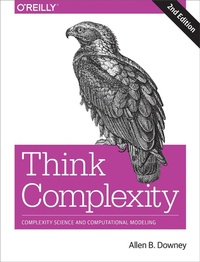
Think Complexity
Complexity Science and Computational Modeling
Published on 11. July 2018
200 pages
978-1-4920-4017-0 (ISBN)
Description

Complexity science uses computation to explore the physical and social sciences. In Think Complexity, you'll use graphs, cellular automata, and agent-based models to study topics in physics, biology, and economics.
Whether you're an intermediate-level Python programmer or a student of computational modeling, you'll delve into examples of complex systems through a series of worked examples, exercises, case studies, and easy-to-understand explanations.
In this updated second edition, you will:
- Work with NumPy arrays and SciPy methods, including basic signal processing and Fast Fourier Transform
- Study abstract models of complex physical systems, including power laws, fractals and pink noise, and Turing machines
- Get Jupyter notebooks filled with starter code and solutions to help you re-implement and extend original experiments in complexity; and models of computation like Turmites, Turing machines, and cellular automata
- Explore the philosophy of science, including the nature of scientific laws, theory choice, and realism and instrumentalism
Ideal as a text for a course on computational modeling in Python, Think Complexity also helps self-learners gain valuable experience with topics and ideas they might not encounter otherwise.
More details
Other editions
Additional editions
Book
07/2018
2nd Edition
O'Reilly
€50.00
Shipment within 15-20 days
Content
- Intro
- Copyright
- Table of Contents
- Preface
- Who Is This Book For?
- Changes from the First Edition
- Using the Code
- Conventions Used in This Book
- O'Reilly Safari
- How to Contact Us
- Contributor List
- Chapter 1. Complexity Science
- The Changing Criteria of Science
- The Axes of Scientific Models
- Different Models for Different Purposes
- Complexity Engineering
- Complexity Thinking
- Chapter 2. Graphs
- What Is a Graph?
- NetworkX
- Random Graphs
- Generating Graphs
- Connected Graphs
- Generating ER Graphs
- Probability of Connectivity
- Analysis of Graph Algorithms
- Exercises
- Chapter 3. Small World Graphs
- Stanley Milgram
- Watts and Strogatz
- Ring Lattice
- WS Graphs
- Clustering
- Shortest Path Lengths
- The WS Experiment
- What Kind of Explanation Is That?
- Breadth-First Search
- Dijkstra's Algorithm
- Exercises
- Chapter 4. Scale-Free Networks
- Social Network Data
- WS Model
- Degree
- Heavy-Tailed Distributions
- Barabási-Albert Model
- Generating BA Graphs
- Cumulative Distributions
- Explanatory Models
- Exercises
- Chapter 5. Cellular Automatons
- A Simple CA
- Wolfram's Experiment
- Classifying CAs
- Randomness
- Determinism
- Spaceships
- Universality
- Falsifiability
- What Is This a Model Of?
- Implementing CAs
- Cross-Correlation
- CA Tables
- Exercises
- Chapter 6. Game of Life
- Conway's GoL
- Life Patterns
- Conway's Conjecture
- Realism
- Instrumentalism
- Implementing Life
- Exercises
- Chapter 7. Physical Modeling
- Diffusion
- Reaction-Diffusion
- Percolation
- Phase Change
- Fractals
- Fractals and Percolation Models
- Exercises
- Chapter 8. Self-Organized Criticality
- Critical Systems
- Sand Piles
- Implementing the Sand Pile
- Heavy-Tailed Distributions
- Fractals
- Pink Noise
- The Sound of Sand
- Reductionism and Holism
- SOC, Causation, and Prediction
- Exercises
- Chapter 9. Agent-Based Models
- Schelling's Model
- Implementation of Schelling's Model
- Segregation
- Sugarscape
- Wealth Inequality
- Implementing Sugarscape
- Migration and Wave Behavior
- Emergence
- Exercises
- Chapter 10. Herds, Flocks, and Traffic Jams
- Traffic Jams
- Random Perturbation
- Boids
- The Boid Algorithm
- Arbitration
- Emergence and Free Will
- Exercises
- Chapter 11. Evolution
- Simulating Evolution
- Fitness Landscape
- Agents
- Simulation
- No Differentiation
- Evidence of Evolution
- Differential Survival
- Mutation
- Speciation
- Summary
- Exercises
- Chapter 12. Evolution of Cooperation
- Prisoner's Dilemma
- The Problem of Nice
- Prisoner's Dilemma Tournaments
- Simulating Evolution of Cooperation
- The Tournament
- The Simulation
- Results
- Conclusions
- Exercises
- Appendix A. Reading List
- Index
- About the Author
- Colophon
