

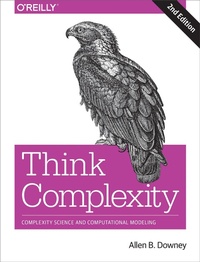
Think Complexity
Complexity Science and Computational Modeling
2nd Edition
Published on 31. July 2018
Book
Paperback/Softback
230 pages
978-1-4920-4020-0 (ISBN)
Description
Complexity science uses computation to explore the physical and social sciences. In Think Complexity, you'll use graphs, cellular automata, and agent-based models to study topics in physics, biology, and economics.
Whether you're an intermediate-level Python programmer or a student of computational modeling, you'll delve into examples of complex systems through a series of worked examples, exercises, case studies, and easy-to-understand explanations.
In this updated second edition, you will:
Work with NumPy arrays and SciPy methods, including basic signal processing and Fast Fourier Transform
Study abstract models of complex physical systems, including power laws, fractals and pink noise, and Turing machines
Get Jupyter notebooks filled with starter code and solutions to help you re-implement and extend original experiments in complexity; and models of computation like Turmites, Turing machines, and cellular automata
Explore the philosophy of science, including the nature of scientific laws, theory choice, and realism and instrumentalism
Ideal as a text for a course on computational modeling in Python, Think Complexity also helps self-learners gain valuable experience with topics and ideas they might not encounter otherwise.
Whether you're an intermediate-level Python programmer or a student of computational modeling, you'll delve into examples of complex systems through a series of worked examples, exercises, case studies, and easy-to-understand explanations.
In this updated second edition, you will:
Work with NumPy arrays and SciPy methods, including basic signal processing and Fast Fourier Transform
Study abstract models of complex physical systems, including power laws, fractals and pink noise, and Turing machines
Get Jupyter notebooks filled with starter code and solutions to help you re-implement and extend original experiments in complexity; and models of computation like Turmites, Turing machines, and cellular automata
Explore the philosophy of science, including the nature of scientific laws, theory choice, and realism and instrumentalism
Ideal as a text for a course on computational modeling in Python, Think Complexity also helps self-learners gain valuable experience with topics and ideas they might not encounter otherwise.
More details
Edition
2nd Revised edition
Language
English
Place of publication
Sebastopol
United States
Target group
Professional and scholarly
Edition type
Revised edition
Dimensions
Height: 233 mm
Width: 179 mm
Thickness: 13 mm
Weight
372 gr
ISBN-13
978-1-4920-4020-0 (9781492040200)
Copyright in bibliographic data and cover images is held by Nielsen Book Services Limited or by the publishers or by their respective licensors: all rights reserved.
Schweitzer Classification
Other editions
Additional editions
E-Book
07/2018
O'Reilly
€42.49
Available for download
E-Book
07/2018
O'Reilly
€42.49
Available for download
Previous edition
Book
03/2012
1st Edition
O'Reilly
€32.00
Article exhausted; check for reprint
Person
Allen Downey is a professor of Computer Science at Olin College and the author of a series of free, open-source textbooks related to software and data science, including Think Python, Think Bayes, and Think Complexity, published by O'Reilly Media. His blog, Probably Overthinking It, features articles on Bayesian probability and statistics. He holds a Ph.D. in computer science from U.C. Berkeley, and M.S. and B.S. degrees from MIT. He lives near Boston, MA with his wife and two daughters.