

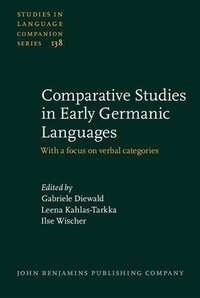
Comparative Studies in Early Germanic Languages
With a focus on verbal categories
1st Edition
Published on 10. October 2013
VI, 318 pages
978-90-272-7145-7 (ISBN)
Description

This volume offers a coherent and detailed picture of the diachronic development of verbal categories of Old English, Old High German, and other Germanic languages. Starting from the observation that German and English show diverging paths in the development of verbal categories, even though they descended from a common ancestor language, the contributions present in-depth, empirically founded studies on the stages and directions of these changes combining historical comparative methods with grammaticalisation theory. This collection of papers provides the reader with an indispensable source of information on the early traces of distinct developments, thus laying the foundation for a broad-scale scenario of the grammaticalisation of verbal categories. The volume will be of particular interest to scholars of language change, grammaticalisation, and diachronic sociolinguistics; it offers important new insights for typologists and for everybody interested in the make-up of verbal categories.
More details
Other editions
Additional editions
Gabriele Diewald | Leena Kahlas-Tarkka | Ilse Wischer
Comparative Studies in Early Germanic Languages
With a focus on verbal categories
Book
10/2013
John Benjamins Publishing Co
€104.94
Shipment within 10-15 days
Persons
Content
- Comparative Studies in Early Germanic Languages
- Editorial page
- Title page
- LCC page
- Table of contents
- Introduction
- 1. Verbal categories and their diachronic development in Old English and Old High German
- 2. Grammaticalisation, comparative diachronic linguistics and socio-cultural/philological aspects
- 3. Historical comparative corpus studies
- 4. The verbal categories studied in this volume
- 5. Summary and outlook
- References
- *haitan in Gothic and Old English
- 1. Introduction
- 2. Methodology
- 2.1 Corpora and data collection
- 3. Results
- 3.1 Functions of Gothic haitan and Old English hatan
- 3.1.1 Gothic
- 3.1.2 Early Old English
- 3.1.3 Late Old English
- 3.1.4 Comparison of Gothic and Early and Late Old English
- 3.2 Competitors of haitan in Gothic
- 4. Discussion and conclusion
- Appendix
- Early Old English Texts
- Late Old English Texts
- References
- Incipient Grammaticalisation
- 1. Introduction
- 2. Problems with the traditional view of an Old High German and Old English passive
- 2.1 Old High German
- 2.2 Old English
- 3. Theoretical considerations for the interpretation of constructions with the past participle in English and German
- 3.1 The copulas: OHG sin/wesan and werdan, OE s-copula and weorðan
- 3.2 Past participle
- 3.3 Constructions with the past participle
- 3.3.1 Constructions with stative copula: Sin/wesan, s-copula plus past participle
- 3.2.2 Constructions with inchoative copula: Werdan/weorðan plus past participle
- 4. Considerations about different incipient stages of grammaticalisation of "passive" constructions in Late Old English and Old High German
- 5. Conclusion and further research
- References
- Passive auxiliaries in English and German
- 1. Introduction
- 2. Previous studies
- 2.1 Old English
- 2.2 Old High German
- 3. A different approach: Constructional environments
- 4. Bounded and unbounded language use
- 4.1 Status in Present Day English and New High German
- 4.2 The bounded system of Old English and its breakdown
- 4.3 The bounded system of German and its grammaticalisation
- 5. Convergence and divergence in the development of the English and German passive
- 5.1 Introduction
- 5.2 Corpora and data
- 5.3 Clause type
- 5.4 Time adverbs
- 5.5 Word order
- 6. Conclusion
- Refernces
- Causative habban in Old English
- 1. Introduction
- 1.1 The structure of the paper
- 1.2 The construction
- 1.3 The corpus studied
- 1.4 The causative habban instances
- 1.5 Previous studies
- 2. Discussion
- 2.1 Diachronic and dialectal breakdown
- 2.2 Syntactic properties of causative habban constructions
- 2.3 Semantic properties of causative habban constructions
- 2.4 An analysis of the OE instances listed as causative in Section 1.3
- 2.5 A hypothesis concerning the rise of causative habban
- 2.6 The triggering of the grammaticalisation process: the rise of causative habban in the light of Diewald's context-sensitive grammaticalisation scenario
- 3. Final remarks
- References
- Remembering (?ge)munan
- 1. Introduction
- 2. Re(-)membering (?ge)munan: A semantic analysis of OE (ge)munan
- 3. The rising modality of munen in the post-OE periods
- 3.1 mun/mon in Middle English
- 3.2 mun/man in Early Modern English
- 3.3 mun/man/maun in northern dialects
- 3.4 Summary: The auxiliaryhood of mun/man/maun
- 4. The grammaticalisation of mun/man
- 5. The decline of modal mun/man
- 6. Conclusion
- References
- The emergence of modal meanings from haben with zu-infinitives in Old High German
- 1. Introduction
- 2. Different uses of ?'haben + zu-infinitive' in late Old High German
- 3. Modes of expression in Latin
- 4. Old High German 'sein + zu-infinitive'
- 5. Summary
- Sources
- References
- Markers of Futurity in Old High German and Old English
- 1. Introduction
- 2. Theoretical background
- 3. Empirical analysis (methodology)
- 4. The data: Source lexemes in OHG and OE: Distribution and frequency
- 5. Discussion
- 5.1 The high degree of auxiliarisation of the OE modals
- 5.2 Semantic and constructional aspects of the source items
- 5.2.1 Modal futures
- 5.2.2 'Be, become' futures
- 6. Summary
- Sources
- References
- The Verb to be in the West Saxon Gospels and the Lindisfarne Gospels
- 1. Introduction
- 2. The present indicative
- 2.1 Distribution
- 2.2 Time reference
- 2.3 Differences between the gospel versions
- 2.4 Aspectual references
- 2.4.1 Durative and iterative references
- 2.4.2 Habitual and generic references
- 3. The present subjunctive
- 3.1 Distribution
- 3.2 Time reference
- 3.3 Differences between the gospel versions
- 4. Conclusion
- References
- Aspectual properties of the verbal prefix a- in Old English with reference to Gothic
- 1. Introduction
- 2. Hypothesis and theoretical framework
- 3. Data
- 4. Previous research
- 5. Etymology
- 6. Aspect in early Germanic
- 7. Semantics of the prefix a-
- 8. Co-existence of prefixes and particles
- 9. Contrastive analysis
- 10. Conclusion
- References
- Þæ¯r wæs vs. thâr was
- 1. Introduction
- 2. Theoretical framework: Constructions and grammaticalisation
- 3. ModE and ModHG existential constructions in isolating contexts
- 4. Development in Old English
- 4.1 Untypical contexts in OE
- 4.2 Critical contexts in OE
- 4.3 Frequency of OE existential þ?r-constructions
- 5. Development in OHG
- 5.1 Untypical contexts in OHG
- 5.2 Critical contexts in OHG
- 5.3 Frequency of OHG existential thâr-constructions
- 6. Conclusion
- Sources
- References
- On gain and loss of verbal categories in language contact
- 1. Introduction
- 2. Shared inherited categories
- 3. Shared innovated categories
- 4. Differential innovated categories
- 4.1 Two copulas
- 4.1.1 Two copulas in Old English
- 4.1.2 Two copulas in Celtic
- 4.2 Other categorial differences
- 5. Conclusion
- References
- Index
