

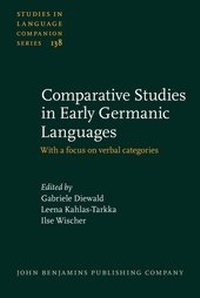
Comparative Studies in Early Germanic Languages
With a focus on verbal categories
Published on 10. October 2013
Book
Hardback
318 pages
978-90-272-0605-3 (ISBN)
Description
This volume offers a coherent and detailed picture of the diachronic development of verbal categories of Old English, Old High German, and other Germanic languages. Starting from the observation that German and English show diverging paths in the development of verbal categories, even though they descended from a common ancestor language, the contributions present in-depth, empirically founded studies on the stages and directions of these changes combining historical comparative methods with grammaticalisation theory. This collection of papers provides the reader with an indispensable source of information on the early traces of distinct developments, thus laying the foundation for a broad-scale scenario of the grammaticalisation of verbal categories. The volume will be of particular interest to scholars of language change, grammaticalisation, and diachronic sociolinguistics; it offers important new insights for typologists and for everybody interested in the make-up of verbal categories.
More details
Series
Language
English
Place of publication
Amsterdam
Netherlands
Target group
Professional and scholarly
Illustrations
+ index
Weight
750 gr
ISBN-13
978-90-272-0605-3 (9789027206053)
Copyright in bibliographic data and cover images is held by Nielsen Book Services Limited or by the publishers or by their respective licensors: all rights reserved.
Schweitzer Classification
Other editions
Additional editions
Gabriele Diewald | Leena Kahlas-Tarkka | Ilse Wischer
Comparative Studies in Early Germanic Languages
With a focus on verbal categories
E-Book
10/2013
1st Edition
John Benjamins Publishing Company
€123.99
Available for download
Persons
Content
1. Introduction (by Diewald, Gabriele); 2. *haitan in Gothic and Old English (by Cloutier, Robert); 3. Incipient Grammaticalisation: Sources of passive constructions in Old High German and Old English (by Mailhammer, Robert); 4. Passive auxiliaries in English and German: Decline versus grammaticalisation of bounded language use (by Petre, Peter); 5. Causative habban in Old English: Tracing the Development of a Budding Construction (by Kilpio, Matti); 6. Remembering ( ge)munan: The rise and decline of a potential modal (by Eitelmann, Matthias); 7. The emergence of modal meanings from haben with zu-infinitives in Old High German (by Jager, Anne); 8. Hearsay and lexical evidentials in Old Germanic languages, with focus on Old English (by Timofeeva, Olga); 9. Markers of Futurity in Old High German and Old English: A Comparative Corpus-Based Study (by Diewald, Gabriele); 10. The Verb to be in the West Saxon Gospels and the Lindisfarne Gospels (by Bolze, Christine); 11. Aspectual properties of the verbal prefix a- in Old English with reference to Gothic (by Broz, Vlatko); 12. Paer waes vs. thar was: Old English and Old High German existential constructions with adverbs of place (by Pfenninger, Simone E.); 13. On gain and loss of verbal categories in language contact: Old English vs. Old High German (by Vennemann, Theo); 14. Index