

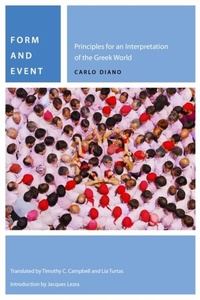
Form and Event
Principles for an Interpretation of the Greek World
Published on 7. July 2020
144 pages
978-0-8232-8794-9 (ISBN)
Description

Carlo Diano's Form and Event has long been known in Europe as a major work not only for classical studies but even more for contemporary philosophy. Already available in Italian, French, Spanish, and Greek, it appears here in English for the first time, with a substantial Introduction by Jacques Lezra that situates the book in the genealogy of modern political philosophy.
Form and Event reads the two classical categories of its title phenomenologically across Aristotle, the Stoics, and especially Homer. By aligning Achilles with form and Odysseus with event, Diano links event to embodied and situated subjective experience that simultaneously finds its expression in a form that objectifies that experience. Form and event do not exist other than as abstractions for Diano but they do come together in an intermingling that Diano refers to as the "eventic form." On Diano's reading, eventic forms interweave subjectively situated and embodied experiences, observable in all domains of human and nonhuman life.
A stunning interpretation of Greek antiquity that continues to resonate since its publication in 1952, Form and Event anticipates the work of such French and Italian post-war thinkers as Gilles Deleuze, Alain Badiou, Roberto Esposito, and Giorgio Agamben.
Form and Event reads the two classical categories of its title phenomenologically across Aristotle, the Stoics, and especially Homer. By aligning Achilles with form and Odysseus with event, Diano links event to embodied and situated subjective experience that simultaneously finds its expression in a form that objectifies that experience. Form and event do not exist other than as abstractions for Diano but they do come together in an intermingling that Diano refers to as the "eventic form." On Diano's reading, eventic forms interweave subjectively situated and embodied experiences, observable in all domains of human and nonhuman life.
A stunning interpretation of Greek antiquity that continues to resonate since its publication in 1952, Form and Event anticipates the work of such French and Italian post-war thinkers as Gilles Deleuze, Alain Badiou, Roberto Esposito, and Giorgio Agamben.
More details
Series
Edition
New edition
Language
English
Place of publication
NY
United States
Target group
Professional and scholarly
Edition type
New edition
Illustrations
11
11
File size
8,75 MB
ISBN-13
978-0-8232-8794-9 (9780823287949)
Copyright in bibliographic data and cover images is held by Nielsen Book Services Limited or by the publishers or by their respective licensors: all rights reserved.
Schweitzer Classification
Other editions
Additional editions
Book
07/2020
Fordham University Press
€92.70
Shipment within 10-20 days
Persons
Carlo Diano (Author)
Carlo Diano (1902- 1974) was one of the most important Hellenists and philologists of the twentieth century. In addition to his numerous translations, he is also the author of Linee per una fenomenologia dell'arte.
Jacques Lezra (Introducer)
Jacques Lezra is professor and chair of Hispanic studies at the University of California, Riverside. His books include Untranslating Machines: A Genealogy for the Ends of Global Thought; Wild Materialism: The Ethic of Terror and the Modern Republic (translated into Spanish and Chinese); and Unspeakable Subjects: The Genealogy of the Event in Early Modern Europe. With Emily Apter and Michael Wood, he is the coeditor of Barbara Cassin's Dictionary of Untranslatables.
Timothy C. Campbell (Translator)
Timothy C. Campbell is professor of Italian at Cornell University. In addition to his translations of Roberto Esposito's Bios: Biopolitics and Philosophy and Communitas: The Origin and Destiny of Community, he is most recently the author of The Techne of Giving: Cinema and the Generous Form of Life (2017) from Fordham University Press.
Lia Turtas (Translator)
Lia Turtas recently received her PhD in Romance studies at Cornell University. Her current research centers on reading the figure of automatism across key moments of Italian cinema by drawing upon posthumanism, film theory, and Italian thought.
Carlo Diano (1902- 1974) was one of the most important Hellenists and philologists of the twentieth century. In addition to his numerous translations, he is also the author of Linee per una fenomenologia dell'arte.
Jacques Lezra (Introducer)
Jacques Lezra is professor and chair of Hispanic studies at the University of California, Riverside. His books include Untranslating Machines: A Genealogy for the Ends of Global Thought; Wild Materialism: The Ethic of Terror and the Modern Republic (translated into Spanish and Chinese); and Unspeakable Subjects: The Genealogy of the Event in Early Modern Europe. With Emily Apter and Michael Wood, he is the coeditor of Barbara Cassin's Dictionary of Untranslatables.
Timothy C. Campbell (Translator)
Timothy C. Campbell is professor of Italian at Cornell University. In addition to his translations of Roberto Esposito's Bios: Biopolitics and Philosophy and Communitas: The Origin and Destiny of Community, he is most recently the author of The Techne of Giving: Cinema and the Generous Form of Life (2017) from Fordham University Press.
Lia Turtas (Translator)
Lia Turtas recently received her PhD in Romance studies at Cornell University. Her current research centers on reading the figure of automatism across key moments of Italian cinema by drawing upon posthumanism, film theory, and Italian thought.
Content
Introduction by Jacques Lezra 1
Form and Event 27
Illustrations 105
Notes 115
Form and Event 27
Illustrations 105
Notes 115
