

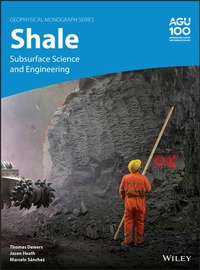
Shale
Description

Shale is the dominant rock in the sedimentary record. It is also the subject of increased interest because of the growing contribution of shale oil and gas to energy supplies, as well as the potential use of shale formations for carbon dioxide sequestration and nuclear waste storage.
Shale: Subsurface Science and Engineering brings together geoscience and engineering to present the latest models, methods and applications for understanding and exploiting shale formations.
Volume highlights include:
* Review of current knowledge on shale geology
* Latest shale engineering methods such as horizontal drilling
* Reservoir management practices for optimized oil and gas field development
* Examples of economically and environmentally viable methods of hydrocarbon extraction from shale
* Discussion of issues relating to hydraulic fracking, carbon sequestration, and nuclear waste storage
Book Review: I. D. Sasowsky, University of Akron, Ohio, September 2020 issue of CHOICE, CHOICE connect, A publication of the Association of College and Research Libraries, A division of the American Library Association, Connecticut, USA
Shale has a long history of use as construction fill and a ceramic precursor. In recent years, its potential as a petroleum reservoir has generated renewed interest and intense scientific investigation. Such work has been significantly aided by the development of instrumentation capable of examining and imaging these very fine-grained materials. This timely multliauthor volume brings together 15 studies covering many facets of the related science. The book is presented in two sections: an overview and a second section emphasizing unconventional oil and gas. Topics covered include shale chemistry, metals content, rock mechanics, borehole stability, modeling, and fluid flow, to name only a few. The introductory chapter (24 pages) is useful and extensively referenced. The lead chapter to the second half of the book, "Characterization of Unconventional Resource Shales," provides a notably detailed analysis supporting a comprehensive production workflow. The book is richly illustrated in full color, featuring high-quality images, graphs, and charts. The extensive index provides depth of access to the volume. This work will be of special interest to a diverse group of investigators moving forward with understanding this fascinating group of rocks.
Summing Up: Recommended. Upper-division undergraduates through faculty and professionals.
More details
Other editions
Additional editions
Persons
Thomas Dewers' research interests and experience range from theoretical coupled thermal-mechanical-hydrological-chemical modeling, high temperature-high pressure and rock mechanics experimental methods, field investigations for geomicrobiology and hydrogeology, induced seismicity, and digital geologic mapping. Following graduation with PhD from Indiana University where he worked in the Department of Chemistry, he was a post-doc in the Center for Tectonophysics at Texas A&M. He then was appointed as a tenure-track and tenured professor at the University of Oklahoma School of Geology and Geophysics for thirteen years. After a short stint as a hydrogeologist for the State of New Mexico working on mining-related water quality issues, he joined Sandia National Laboratories as a Material Scientist and Principal Member of the Technical Staff, where he has worked since 2007. Current research at Sandia examines elasto-plasticity of pressure sensitive materials, acoustic tomography, aspects of subsurface carbon storage, multiphase flow, laser microscopy, coupled thermal-mechanical-hydrological-chemical model code development, and all things mudstone. Professional affiliations include the American Geophysical Union, the Society of Petroleum Engineers, and the Geochemical Society.
Jason E. Heath has M.S. and Ph.D. degrees in geology and hydrology, respectively, from Utah State University (2004) and New Mexico Tech (2010). He started working for Sandia National Laboratories (SNL) as a student intern in 2008 and converted to senior member of the technical staff in 2010. His research interests include the combination of shale geology, multiphase flow and transport, and natural isotopic tracers. He has authored papers on geologic CO2 sequestration, including pore-scale effects and large-scale storage capacity, and the impact of pore types on capillary breakthrough and sealing behavior of shale caprock. Current research includes using natural tracers, such as helium, to characterize hydraulically-fractured shale oil and gas systems and forecast production decline. Professional affiliations include the American Geophysical Union, the Society of Petroleum Engineers, and the Rocky Mountain Association of Geologists.
Marcelo Sanchez was appointed as an Associated Professor in the Zachry Department of Civil Engineering at Texas A&M in September 2009. He obtained his first degree in Civil Engineering from Universidad Nacional de San Juan (Argentina). His Master (1996) and Ph.D. (2004) degrees are from the Universidad Politecnica de Catalunya (UPC, Barcelona, Spain). His expertise lies in the analysis of Thermo-Hydro-Mechanical and Chemical (THMC) coupled problems in geological media. His effort focuses on advanced geomechanics, considering engineering problems involving mechanical, hydraulic, thermal, and geochemical couplings. Specific challenges include: design of high level nuclear waste disposals; behavior of hydrate bearing sediments, design of compressed air energy storage (CAES) systems; hydraulic fracturing; CO2 sequestration, desiccation cracks in soils; and the design of energy piles. He is the chairman of the Technical Committee TC308 on Energy Geotechnics of the International Society of Soil Mechanics and Geotechnical Engineering (ISSMGE).
Content
Contributors vii
Preface ix
Acknowledgments xi
Part I: Shale and Clay Overview
1. Mudrock Components and the Genesis of Bulk Rock Properties: Review of Current Advances and Challenges 3
Kitty L. Milliken and Nicholas W. Hayman
2. Chemical Composition of Formation Water in Shale and Tight Reservoirs: A Basin-Scale Perspective 27
Yousif Kharaka, Kathleen Gans, Elisabeth Rowan, James Thordsen, Christopher Conaway, Madalyn Blondes, and Mark Engle
3. From Nanofluidics to Basin-Scale Flow in Shale: Tracer Investigations 45
Yifeng Wang
4. Metals in Oil and Gas-Bearing Shales: Are They Potential (Future) Ore Deposits? 59
Mark J. Rigali and James L. Krumhansl
5. Coupled Thermal-Hydraulic-Mechanical and Chemical Modeling of Clayed Rocks 69
Leonardo do N. Guimarães, Antonio Gens, and Marcelo Sánchez
6. Thermo-Hydro-Mechanical Testing of Shales 83
Alessio Ferrari and Enrique Romero Morales
7. Geomechanics of Shale Repositories: Mechanical Behavior and Modeling 99
Miguel A. Mánica, Daniel F. Ruiz, Jean Vaunat, and Antonio Gens
8. Generation and Self-Sealing of the Excavation-Damaged Zone (EDZ) Around a Subsurface Excavation in a Claystone 125
Paul Bossart, Christophe Nussbaum, and Kristof Schuster
9. Shale and Wellbore Integrity 145
J. William Carey and Malin Torsæter
Part II: Unconventional Oil and Gas
10. Characterization of Unconventional Resource Shales (Mudstones): The Necessity of Multiscale Scientific Integration 163
Roger M. Slatt
11. Wellbore Mechanics and Stability in Shale 197
Amin Mehrabian, Vinh X. Nguyen, and Younane N. Abousleiman
12. Modeling Hydraulic Fracturing of Unconventional Reservoirs 213
Ahmad Ghassemi and Zhennan Zhang
13. Flow of Gas and Liquid in Natural Media Containing Nanoporous Regions 235
Timothy J. Kneafsey and Sharon Borglin
14. Factors Affecting Hydrocarbon and Water Mobility in Shales 255
Charles Bryan and Pat Brady
15. Dynamics of Matrix-Fracture Coupling During Shale Gas Production 273
I. Yucel Akkutlu and Asana Wasaki
Index 287
1
Mudrock Components and the Genesis of Bulk Rock Properties: Review of Current Advances and Challenges
Kitty L. Milliken1 and Nicholas W. Hayman2
1 John A. and Katherine G. Jackson School of Geosciences, Bureau of Economic Geology, The University of Texas at Austin, Austin, TX, USA
2 John A. and Katherine G. Jackson School of Geosciences, Institute for Geophysics, The University of Texas at Austin, Austin, TX, USA
ABSTRACT
Fine-grained sediment (mud) and lithified equivalents (mudrock, mudstone, and shale) contain components similar to ones in coarser sedimentary materials, albeit of such small size that high-resolution imaging is required to observe them. Such imaging reveals that fine-grained sedimentary rocks display diversities of grains, pores, and diagenetic features that actually exceed the variations of components in common sandstones and limestones. Mudrock diversity reflects the extraordinary range of grain and pore sizes, which extend from detrital grains and authigenic crystals in the <1-100?µm fraction to the nanomaterials (crystals and pores) in the matrix surrounding the silt-size fraction. Prediction of bulk-property evolution in fine-grained materials lags current process understanding in coarse materials but a view is emerging that while there are similarities, there are also contrasts between the responses of coarse and fine materials to changing conditions in the subsurface. Mechanical and chemical processes that operate on submicrometer pores and crystals very likely proceed to different limits, at different rates, and even by entirely different mechanisms than do comparable processes in coarser materials. This paper reviews current knowledge about mudrock components, and explores some of the gaps that exist in our understanding of microscale properties and processes in Earth's most abundant sedimentary material.
1.1. INTRODUCTION
Mudrocks, the overall class of fine-grained sedimentary rocks, contain grain assemblages composed by weight or volume of >50% particles that are <62.5?µm. Mudrocks include fissile shales, nonfissile mudstones, siltstones, and even claystones; bulk mineralogies of mudrocks span nearly the entire range of compositions displayed by sandstones and limestones. At the scale of a core or a hand specimen, it is easy to gain the impression that many mudrocks are homogeneous and uniform (Fig. 1.1). Data at both small and large scales challenge this view (e.g., Ilgen et al., 2017; Milliken and Curtis, 2016). For example, permeability in shale varies over 13-15 orders of magnitude, perhaps the largest range of any measured natural property (Bryant, 2002; Dewhurst et al., 1999). Mechanical behavior in fine-grained sediments also varies tremendously as the combined effects of compaction and cementation drive lithification of mud to mudstone (Storvoll and Bjorlykke, 2004; Storvoll et al., 2005), ultimately producing rocks with bulk mechanical properties that approach those of solid crystals of quartz or feldspar (Kumar et al., 2015). The wide range of mudrock properties is expressed in the spatial and temporal complexity of hydrocarbon production from them; 30-year economic tiers in the Barnett Shale of the Fort Worth Basin vary around eightfold in production and more productive wells show strong spatial clustering (Gulen et al., 2013).
Figure 1.1 Homogeneous black shale. Although subtle variations in texture and color can be discerned in this short section of black shale, describing cores of this type from visual description alone is challenging.
Microscopic examination of mudrocks readily shows that their profound heterogeneities are rooted in large variations in the abundance and sizes of basic mudrock components such as grains, cements, and pores. Imaging based on field-emission scanning electron microscopy, for example, including high-resolution secondary electron imaging, elemental X-ray mapping, and scanned cathdoluminescence imaging have expanded the scale at which mudrock components can be imaged well into the submicrometer range, opening new potentials for both qualitative and quantitative characterization. Newer methods for the preparation of flat surfaces with minimal mechanical damage (specifically ion-milling, by broad-beam and focused-beam methodologies) have figured prominently in imaging advances (Curtis et al., 2011; Desbois et al., 2009; Loucks et al., 2009; Milliken and Curtis, 2016). Several advances have also had significant impact on the examination of mudrock components at the submicron scale. These include: (i) advances in SEM automation (Goergen et al., 2014; Saif et al., 2017), (ii) imaging with X-ray tomography (Dewers et al., 2012), (iii) and neutron scattering (Radlinski et al., 2004a), (iv) novel applications of rock-mechanics experimentation and porosity and permeability analysis (Bhandari et al., 2015; Daigle et al., 2017; Yang et al., 2017), and (v) machine learning (Hutton, 1994; Jianhua et al., 2015; Mlynarczuk and Skiba, 2017; Petrelli and Perugini, 2016; Xiao and Daigle, 2018).
In the following sections, we describe some of the component arrangements (fabrics) documented at the micro to nanometer scale in mudrocks. Components are the basic categories of solids and pores that compose mudrocks at the microscale, and thus we take this systematic "component" approach to provide a useful review of basic mudrock fabrics for the community of researchers who do not routinely make use of petrographic inspection in their workflows. Geophysicists, petrophysicists, and flow modelers are among the groups who increasingly seek to link bulk properties to the fundamental causes of mudrock heterogeneity. This paper illustrates for nonpetrographers the general realities of mudrock heterogeneity at the scale of grains and pores and describes some of the petrographic insights on small-scale processes that control the evolution of properties such as porosity, permeability, seismic velocity, and mechanical moduli. This paper also is relevant to those who study pelitic metamorphic rock systems, as the diagenetic evolution that mudrocks undergo up to burial depths and temperatures amenable to petroleum production (to around 200?°C) set the stage for higher-grade processes during metamorphism.
1.2. COMPONENTS IN MUDROCKS
Table 1.1 summarizes 18 mudrock units we have studied and notes age, tectonic setting, and grain assemblage composition. Mudrock components are broadly similar to component categories known in sandstones and limestones (Table 1.2). A key point is that particular minerals (e.g., quartz and clays), and also the organic and other nonsolid rock components (pores), may appear in multiple component categories, for example, silt grains, clay-size matrix grains, cements, and grain replacements, in any given rock. Note that we use the term "grain" as synonymous with a "particle" that existed in the sedimentary environment. Such primary particles include polycrystalline and polymineralogic aggregates and lithic grains and also submicron particles that are challenging to image. At the highest magnifications it is not trivial to determine if a solid component is a grain. The multiscale, multicomponent nature of mudrocks means that they cannot be fully assessed by bulk analytical methods; petrographic inspection is required. Fortunately, atlas resources are available that provide instruction on petrographic identification of sedimentary rock components, including muds and mudstones (Adams and MacKenzie, 1998; Marsaglia et al., 2013, 2015; Milliken and Choh, 2011; Milliken et al., 2007b; Scholle, 1979; Scholle and Ulmer-Scholle, 2003; Ulmer-Scholle et al., 2014). We describe some broad characterizations of mudrock components below.
Table 1.1 List of Mudrock Units Studied by the Authors.
Location Unit Age Depositional Setting Mudstone Compositiona References Indian Ocean Nicobar Fan Pleistocene passive margin Tarl McNeil et al. (2017) Nankai Margin, Japan Unnamed, subsurface Pleistocene to Miocene Forearc basin, slope basin, and accretionary prism Tarl, argillaceous sarl Milliken and Reed (2010), Nole et al. (2016), Kinoshita et al. (2009), and Strasser et al. (2014) Iberia Margin, Portugal Unnamed, subsurface Pleistocene to Creteaceous Passive margin Tarl Sawyer et al. (1994) North-central, Italy Various Miocene-Eocene Foreland basin, suprathrust Tarl, argillaceous carl Milliken (this study) shale samples related to McBride et al. (1995), and Milliken et al. (1998) Gulf of Mexico Basin Unnamed, subsurface Miocene Passive margin Tarl Milliken and Land (1993) Gulf of Mexico...