

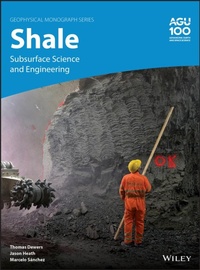
Subsurface Science and Engineering of Shale
1st Edition
Published on 16. October 2019
Book
Hardback
336 pages
978-1-119-06668-2 (ISBN)
Description
Advances in theories, methods and applications for shale resource use
Shale is the dominant rock in the sedimentary record. It is also the subject of increased interest because of the growing contribution of shale oil and gas to energy supplies, as well as the potential use of shale formations for carbon dioxide sequestration and nuclear waste storage.
Shale: Subsurface Science and Engineering brings together geoscience and engineering to present the latest models, methods and applications for understanding and exploiting shale formations.
Volume highlights include:
* Review of current knowledge on shale geology
* Latest shale engineering methods such as horizontal drilling
* Reservoir management practices for optimized oil and gas field development
* Examples of economically and environmentally viable methods of hydrocarbon extraction from shale
* Discussion of issues relating to hydraulic fracking, carbon sequestration, and nuclear waste storage
More details
Other editions
Additional editions

E-Book
10/2019
1st Edition
Wiley
€179.99
Available for download

E-Book
09/2019
1st Edition
Wiley
€174.99
Available for download
Person
Thomas Dewers, Sandia National Laboratories, USA
Jason Heath, Sandia National Laboratories, USA Marcelo Sánchez, Texas A&M University, USA
Content
Foreword by Professor Mark Zoback, Stanford U.
Acknowledgements
I. Science of Shale Composition and Heterogeneity
Sedimentology and Diagenetic Controls on Multiscale Heterogeneity of Shale Lithofacies
Sequence Stratigraphy and Hydrocarbon Resources in Shales
Shale Pore Types and Topology
Rare Earth Element Resources and Reserves in Shales
II. Science of Coupled Processes in Shales
Water, Clay, and Organic Surface Interactions in Shales
Flow of Gas and Liquid in Nanopore Networks
Sonic Velocity of Mudstones from Core to Seismic Scales
Measuring and Modeling Local-to-Basin-Scale Fluid Flow and Overpressure
Fracture-Matrix Interactions
Coupled Thermal-Hydrological-Mechanical-Chemical Modeling
III. Repository Science and Engineering
Generation and Fate of Engineered Disturbed Zones Around Subsurface Excavations
Role of Engineered Clay Barriers
Geomechanics of Shale Repositories
Performance Assessment for Shale Repositories
IV. Subsurface Carbon Storage
Multiphase Effects with Brine and Supercritical CO2
Geomechanics, Storage Efficiency, and Performance
Fault Sealing and Leakage Pathways Through Shale Caprock
Predicting and Mitigating Wellbore Leakage
V. Shale Oil and Gas
Drilling in Shales and Formation Damage
Natural and Hydraulic Fracture Complexity and Production
Hydraulic Fracturing and Shale Gas "Sweet Spots"
Models for Hydrofracturing
Seismic Interpretation of Shale Lithofacies and Coupled Processes
V.The Future of Research and Development for Shale Science and Engineering
Conclusions and New Directions IN Shale Science and Engineering