

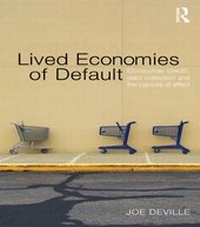
Lived Economies of Default
Consumer Credit, Debt Collection and the Capture of Affect
1st Edition
Published on 11. February 2015
230 pages
978-1-134-08771-6 (ISBN)
Description

Consumer credit borrowing - using credit cards, store cards and personal loans - is an important and routine part of many of our lives. But what happens when these everyday forms of borrowing go 'bad', when people start to default on their loans and when they cannot, or will not, repay? It is this poorly understood, controversial, but central part of both the consumer credit industry and the lived experiences of an increasing number of people that this book explores.
Drawing on research from the interior of the debt collections industry, as well as debtors' own accounts and historical research into technologies of lending and collection, it examines precisely how this ever more sophisticated, globally connected market functions. It focuses on the highly intimate techniques used to try and recoup defaulting debts from borrowers, as well as on the collection industry's relationship with lenders. Joe Deville follows a journey of default, from debtors' borrowing practices, to the intrusion of collections technologies into their homes and everyday lives, to the collections organisation, to attempts by debtors to seek outside help. In the process he shows how to understand this particular market, we need to understand the central role played within it by emotion and affect.
By opening up for scrutiny an area of the economy which is often hidden from view, this book makes a major contribution both to understanding the relationship between emotion and calculation in markets and the role of consumer credit in our societies and economies. This book will be of interest to students, teachers and researchers in a range of fields, including sociology, anthropology, cultural studies, economics and social psychology.
Drawing on research from the interior of the debt collections industry, as well as debtors' own accounts and historical research into technologies of lending and collection, it examines precisely how this ever more sophisticated, globally connected market functions. It focuses on the highly intimate techniques used to try and recoup defaulting debts from borrowers, as well as on the collection industry's relationship with lenders. Joe Deville follows a journey of default, from debtors' borrowing practices, to the intrusion of collections technologies into their homes and everyday lives, to the collections organisation, to attempts by debtors to seek outside help. In the process he shows how to understand this particular market, we need to understand the central role played within it by emotion and affect.
By opening up for scrutiny an area of the economy which is often hidden from view, this book makes a major contribution both to understanding the relationship between emotion and calculation in markets and the role of consumer credit in our societies and economies. This book will be of interest to students, teachers and researchers in a range of fields, including sociology, anthropology, cultural studies, economics and social psychology.
Reviews / Votes
In this unique and trenchant study, Joe Deville explains how the debt collection industry emerged, how it is evolving, and how it is ever more dependent on both data analytics and emotional labor. Deville illuminates the quotidian work of debt collection agencies and their tools-telephone scripts, collection letters-as well as the intra- and intercorporate and personal relations that make debt collection an affective as well as a political (and profitable) enterprise. The book is nothing less than a theoretically astute reflection on the character of obligation, the making of markets and the character of affect in the entanglements of debt today.Bill Maurer, Dean of the School of Social Sciences and Professor of Anthropology, University of California, Irvine
Debt, it turns out, is not the only thing that is intimate and impersonal, cumulative and disintegrative, charged and discharged. By following out the ways that affect routes though the bodies of debtors and the modulating assemblages of debt collectors, Joe Deville offers a vivid account of consumer default that pulses with everyday intensities and calculative capturings. Immensely readable and deftly argued, Deville displays an astonishing agility for moving among the moods and modes of histories, case-studies, technologies, and theories at precisely the right moment, revealing what folds and unfolds at the fraught materialities of the economic and the affective.
Gregory J. Seigworth, Professor of Communication Studies, Millersville University
Lived Economies of Default is a striking achievement, essential reading for students and researchers in the social studies of finance, economic sociology and cultural economy. Not only does Deville provide the first book-length analysis of consumer debt collection in the UK for over forty years, he also charts a new course for the study of the materialities, affects and intimacies of contemporary market lives.
More details
Series
Language
English
Place of publication
London
United Kingdom
Publishing group
Taylor & Francis Ltd
Target group
College/higher education
Illustrations
12 s/w Abbildungen, 1 s/w Tabelle, 8 s/w Photographien bzw. Rasterbilder, 12 s/w Zeichnungen
1 Tables, black and white; 12 Line drawings, black and white; 8 Halftones, black and white; 12 Illustrations, black and white
File size
7,46 MB
ISBN-13
978-1-134-08771-6 (9781134087716)
Copyright in bibliographic data and cover images is held by Nielsen Book Services Limited or by the publishers or by their respective licensors: all rights reserved.
Schweitzer Classification
Other editions
Additional editions

Book
12/2019
1st Edition
Routledge
€68.70
Shipment within 15-20 days

Book
02/2015
1st Edition
Routledge
€231.60
Shipment within 15-20 days
Person
Joe Deville is a researcher at Goldsmiths, University of London, based jointly at the Centre for the Study of Invention and Social Process and the Political Economy Research Centre. He is also the co-founder of the Charisma research network and an editor at Journal of Cultural Economy.
?
?
Content
Introduction: Lived economies of default 1. 'A Curious and Sort of Subconscious Temptation': The lure of consumer credit 2. In the Fold of Default: Living with market attachments 3. The Discovery and Capture of Affect: A history of debt collection 4. The Strategic Management of Affect: Venturing inside the collections company 5. The Amplification of Calculative Opacity: The creditor, the collector, the collections letter Conclusion: Bringing affect to markets
