

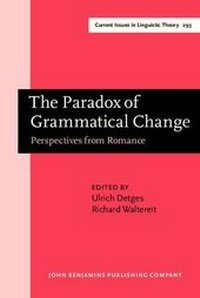
The Paradox of Grammatical Change
Perspectives from Romance
1st Edition
Published on 6. February 2008
VI, 252 pages
978-90-272-9163-9 (ISBN)
Description

Recent years have seen intense debates between formal (generative) and functional linguists, particularly with respect to the relation between grammar and usage. This debate is directly relevant to diachronic linguistics, where one and the same phenomenon of language change can be explained from various theoretical perspectives. In this, a close look at the divergent and/or convergent evolution of a richly documented language family such as Romance promises to be useful. The basic problem for any approach to language change is what Eugenio Coseriu has termed the paradox of change: if synchronically, languages can be viewed as perfectly running systems, then there is no reason why they should change in the first place. And yet, as everyone knows, languages are changing constantly. In nine case studies, a number of renowned scholars of Romance linguistics address the explanation of grammatical change either within a broadly generative or a functional framework.
More details
Other editions
Additional editions
Book
02/2008
John Benjamins Publishing Co
€116.60
Shipment within 10-15 days
Persons
Content
- The Paradox of Grammatical Change
- Editorial page
- Title page
- LCC data
- CONTENTS
- ACKNOWLEDGMENTS
- INTRODUCTION
- REFERENCES
- SYNTACTIC CHANGE FROM WITHIN AND FROM WITHOUT SYNTAX
- 1. The problem: The locus of syntactic change
- 2. The rise of French est-ce que as an interrogative particle: a pragmatically motivated syntactic change
- 3. Shift of grammatical function in Spanish presentational constructions: a syntactic change caused by syntactic factors
- 4. Conclusion
- REFERENCES
- Secondary Literature
- Old French Texts
- ON EXPLAINING THE RISE OF C'EST-CLEFTS IN FRENCH
- 1. Introduction
- 2. The grammar of c'est-clefts in French
- 3. On the alleged trade-off between clefting and focus in situ
- 3.1 Clefts in speech and in writing
- 3.2 Implications for diachrony
- 4. Syntactic motivations for the rise of c'est-clefts in French
- 4.1 Discourse-governed constituent order from Latin to Modern French
- 4.2 Corpus evidence
- 5. On explaining clefting 'beyond necessity'
- REFERENCES
- Corpora
- Further References
- THE ROLE OF THE PLURAL SYSTEM IN ROMANCE
- 1. Introduction: Different systems of indefinite nominal determiners in Romance nominals as results of language change
- 2. A functional 'explanation': Romance indefinite determiners as 'classification devices'
- 3. A formal account of Romance indefinite nominals
- 3.1 'Manufacturing plurality'
- 3.2 Romance languages: gender, number and 'classification'
- 4. From Latin to Romance: what happened in the structure?
- 5. Conclusion
- REFERENCES
- MORPHOLOGICAL DEVELOPMENTS AFFECTING SYNTACTIC CHANGE
- 1. Introduction
- 2. The development of the Latin ACI
- 3. The evolution of French infinitives
- 4. Explaining grammatical change
- REFERENCES
- Latin texts
- French texts
- Spanish text
- Italian texts
- Secondary literature
- GRAMMATICALISATION WITHIN THE IP-DOMAIN
- 1. Introduction
- 2. The Data
- 2.1 Stylistic Fronting
- 2.2 Clitic Distribution
- 3. Connecting and explaining the phenomena
- 4. Explaining Syntactic Change
- 4.1 Language change within the generative tradition
- 4.2 Grammaticalisation within minimalism
- 5. Loss of stylistic fronting and postverbal clitics in Romance
- REFERENCES
- IMPERFECT SYSTEMS AND DIACHRONIC CHANGE
- 1. The si construction in Modern Italian
- 1.1 Passive si
- 1.2 Impersonal si
- 2. Old Italian
- 2.1 Passive si
- 2.2 *Impersonal si
- 3. Intermediate stages
- 3.1 Stage I
- 3.2 Stage II
- 3.3 Stage III
- 4. Conclusions
- REFERENCES
- FROM TEMPORAL TO MODAL
- 1. A puzzle
- 2. The historical situation in Old Spanish
- 3. The pluperfect as the starting point for the development of irrealis readings
- 4. The developments in Portuguese
- 5. The turning-point in Spanish: from condition-based irreality to generalised counterfactuality
- 6. The third stage: from counterfactual (irrealis) to subjunctive II
- 7. Interpretation and conclusions
- REFERENCES
- Primary texts
- Latin
- Spanish
- Portuguese
- NON-LEXICAL CORE-ARGUMENTS IN BASQUE, GERMAN AND ROMANCE
- 1. Introduction
- 2. The Realisation of non-lexical arguments in Basque
- 2.1 Basque, one argument (intransitive, Nor)
- 2.2. Basque, two arguments S-DO (transitive, Nor-Nork)
- 2.3. Basque, three arguments S-IO-DO (transitive, Nor-Nori-Nork)
- 3. The typological parameter head-marking vs. dependent marking
- 4. The other end of the hierarchy: German
- 5. The Romance languages - problematic intermediate cases
- 6. Language change: intermediary stages of a change from dependent-marking towards head-marking
- 7. Conclusion
- 8. Closing remarks: no "object-conjugation" in Romance (or elsewhere)!
- REFERENCES
- TOWARDS A COMPREHENSIVE VIEW OF LANGUAGE CHANGE
- 1. Introduction
- 2. Language and biology: Three positions
- 3. Main orientations and key elements of evolutionary accounts
- 3.1. Adaptive views: Adaptation and optimization
- 3.2. Critique
- 3.3. Interim Summary I
- 3.4. Two-level views: Innovation and propagation
- 3.5. Critique
- 3.6. Interim Summary II
- 4. Two-level views and traditional approaches to language change
- 5. A revised explanation scheme of language change
- 6. Conclusions
- REFERENCES
- SUBJECT INDEX
- The series CURRENT ISSUES IN LINGUISTIC THEORY
