

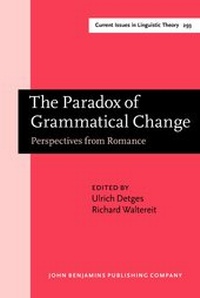
The Paradox of Grammatical Change
Perspectives from Romance
Published on 6. February 2008
Book
Hardback
252 pages
978-90-272-4808-4 (ISBN)
Description
Recent years have seen intense debates between formal (generative) and functional linguists, particularly with respect to the relation between grammar and usage. This debate is directly relevant to diachronic linguistics, where one and the same phenomenon of language change can be explained from various theoretical perspectives. In this, a close look at the divergent and/or convergent evolution of a richly documented language family such as Romance promises to be useful. The basic problem for any approach to language change is what Eugenio Coseriu has termed the paradox of change: if synchronically, languages can be viewed as perfectly running systems, then there is no reason why they should change in the first place. And yet, as everyone knows, languages are changing constantly. In nine case studies, a number of renowned scholars of Romance linguistics address the explanation of grammatical change either within a broadly generative or a functional framework.
More details
Series
Language
English
Place of publication
Amsterdam
Netherlands
Target group
College/higher education
Professional and scholarly
Dimensions
Height: 245 mm
Width: 164 mm
Weight
635 gr
ISBN-13
978-90-272-4808-4 (9789027248084)
Copyright in bibliographic data and cover images is held by Nielsen Book Services Limited or by the publishers or by their respective licensors: all rights reserved.
Schweitzer Classification
Other editions
Additional editions
E-Book
02/2008
1st Edition
John Benjamins Publishing Company
€136.99
Available for download
Persons
Content
1. Introduction (by Detges, Ulrich); 2. Syntactic change from within and from without syntax: A usage-based analysis (by Waltereit, Richard); 3. On explaining the rise of c'est-clefts in French (by Dufter, Andreas); 4. The role of the plural system in Romance (by Stark, Elisabeth); 5. Morphological developments affecting syntactic change (by Goldbach, Maria); 6. Grammaticalisation within the IP-domain (by Fischer, Susann); 7. Imperfect systems and diachronic change (by Salvi, Giampaolo); 8. From temporal to modal: Divergent fates of the Latin synthetic pluperfect in Spanish and Portuguese (by Becker, Martin); 9. Non-lexical core-arguments in Basque, Romance and German: How (and why) Spanish syntax is shifting towards clausal headmarking and morphological cross-reference (by Radatz, Hans-Ingo); 10. Towards a comprehensive view of language change: Three recent evolutionary approaches (by Winter-Froemel, Esme); 11. Subject Index