

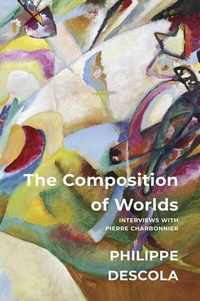
The Composition of Worlds
Description

A student of Lévi-Strauss, Descola conducted ethnographic research among the Achuar of the upper Amazon in the late 1970s, focusing on how native societies relate to their environment. In this book he sheds fresh light on the evolution of his thinking from structuralism to an anthropology beyond the human, on the critique of the modern separation between nature and society, and above all on the genesis and scope of his major work Beyond Nature and Culture. This synthesis of the ways in which humans view their relationships with non-humans proposes four schemas for the 'composition of worlds' (animism, naturalism, totemism, analogism) that characterize our ways of inhabiting the earth.
Presented in the form of an extended conversation with Pierre Charbonnier, this book is both a lucid introduction to the work of one of the most original anthropologists writing today and an impassioned plea for ontologies that are more accommodating of the diversity of beings.
More details
Other editions
Additional editions
Person
Content
Foreword to the English edition
Intellectual autobiography is a rather banal genre in the anglophone world, though less so in the dialogical form that it takes here. This calls for a few words of explanation to introduce this book, first published in French in 2014, to its new anglophone readership. When I agreed to engage in a book-long series of interviews with Pierre Charbonnier, as initially suggested by my publisher Flammarion, I had in mind an illustrious predecessor: the interviews of Claude Lévi-Strauss with Georges Charbonnier (no relation to Pierre!), recorded in 1959 for a radio broadcast and published two years later in book form. In these conversations, Lévi-Strauss candidly discussed both classic themes from his work-the status of anthropologists in their own society, the origins of language, the shift from nature to culture-and more contemporary topics of general interest such as modern art, the political responsibility of the scholar, and the ambiguity of progress. Without drawing too strong a parallel between the present book and those earlier interviews of Lévi-Strauss, his example convinced me that this format offered an ideal way to reach beyond the usual readership of scholarly books and to address, in an easy conversational style, both aspects of my contributions to anthropology that I had in mind to clarify and more general reflections on our present that are inspired by the theoretical positions I have taken over the years.
In contrast with the Lévi-Strauss interviews, however, these are more autobiographical. This is not due to any particular inclination to confide, but rather to the desire, shared by Pierre Charbonnier, to locate my anthropological arguments within a broader genealogy, namely within the intellectual, social, and political landscape in which they took shape. This kind of contextualization is often neglected in social science writing. Despite the concern for reflexivity that characterizes these disciplines, despite the recognized need to indicate the historical conditions that inform their conceptual orientations, despite the care taken by scholars to position their work in relation to that of predecessors and contemporaries, it is often the case that readers give in to the illusion of presentism, taking books and articles that were conceived and written decades earlier as if they were works of the current moment. So it is in order to dispel this kind of amnesia, to which even the most gifted students are not always immune, that I agreed to engage in this series of interviews. I have nonetheless removed from the English version all the lengthy passages on the academic institutions with which I have been affiliated throughout my career and on figures who have supported and influenced me at various points in my life, yet are little known outside France. I am confident that any anglophone readers who are interested in these more detailed aspects of the history of ideas will be able to find the relevant information in the French edition.
But this interview between a middle-aged anthropologist and a young philosopher does not deal with a bygone moment of anthropology-far from it. On the contrary, its intention is to show anthropology in the making, and especially that anthropology to which I have contributed during the past few decades. Under the paradoxical rubric "anthropology of nature"-paradoxical because it has resulted in the provincialization of the concept of nature itself-it seeks to incorporate nonhumans into the analysis of social life: not as productive forces, ecological constraints, foundations of symbolic systems, or backdrops to human action but as autonomous agents that provide greater depth and diversity to the kinds of relations that develop between humans and the various elements that compose their worlds. Countless non-European civilizations have invited us to perform such a decentering, and yet it took a long time for anthropology, and for the social sciences as a whole, to draw the full conclusions. This book seeks to highlight the circumstances that gave rise to the intuitions that allowed nonhumans to be brought back into the study of human praxis. Those intuitions were born of the intellectual and political tumult of 1970s and 1980s France, further kindled by ethnographic fieldwork-which was every bit as stimulating-in native Amazonia, whose enigmatic character our generation of anthropologists was just discovering, even while trying to give it intelligible form.
It is a tragic paradox that the very civilization that invented the idea of nature also became, as its values spread across a large part of the world, the instrument of the destruction of what that idea is meant to represent. For it is in the West, around the Mediterranean basin to begin with, and then in Western Europe, that this extraordinary idea first emerges: that all living beings and the inorganic surroundings in which their existence takes shape form an autonomous whole, from which humans have removed themselves. This idea did not emerge all at once. Ancient Greek sages, philosophers, and physicians had already developed the notion that the cosmos could be explained separately from the decrees of the gods and the effects of human action. They had objectivized, with Aristotle, a field that is made up of all beings that display an order and obey laws. Yet their version of nature was not as comprehensive as that of the moderns. For the advent of modern nature, there had to be a second separation, humans had to become external and superior to nature. It was Christianity that performed this second mutation, imposing, as it spread across Europe, the dual idea of the transcendence of the human being and of a universe extracted from nothingness by divine will. From this, humans derive the right and duty to administer the earth, God having formed them in order to exert control over creation, to organize and arrange it according to his needs. The final stage in the invention of nature took place in seventeenth-century Europe, resulting from a complex process that combined changes in aesthetic sensibilities and pictorial techniques, the discovery of other continents, progress in the mechanical arts, and the greater mastery it afforded over certain environments. The transformations in geometry, mathematical physics, optics, taxonomy, and the theory of the sign emerged from a reorganization of humankind's relationship with the world and the tools that made it possible, rather than from accumulated discoveries and improved skills. The scientific revolution of the age of reason thus legitimized the idea of a mechanical nature, in which laws accounted both for the behavior of each element in a whole considered to be the sum of its parts and for the interactions between these elements.
The rest is well known. The withdrawal of humans from the world of which they had hitherto been part, and the transformation of that deserted world into a field of investigation and experimentation, into a system of resources and-later and only for a part of it-into a site of aesthetic delectation, all this only consolidated the initial divorce between the human and the nonhuman. The form that this divorce took was a very particular cosmology, naturalism, which has developed in Europe over the past three centuries and, characteristically, affirms the absolute singularity of humans as regards their cognitive and moral attributes-they alone have a soul-and connects them to other beings only where physical attributes are concerned: they are subject to the same material laws. This gave rise to an unprecedented expansion of science and technical know-how, to the pageant of progress that it engendered, and to the unbridled exploitation of nature whose catastrophic consequences are now plain for all to see. This double movement was made possible by the external position that humans had acquired in relation to plants, animals, minerals, rivers, and mountains-now considered soulless objects and factors of production to be exploited. Other civilizations did not experience the same history; and it has been less than a century since some of them adopted the unrestrained mode of development induced by naturalism. It is not that these other cultures had been unaware of the fact that there may be differences and resemblances between the human and the nonhuman, but they did not locate them in the same way as westerners and went on thinking of nature, to borrow the poet Fernando Pessoa's formulation, as "parts without a whole."1 A large part of my life as an anthropologist has been devoted to studying and trying to understand forms of worlding that are based on schemas through which certain peoples have identified and systematized continuities and discontinuities between the human and the nonhuman and have thus sought to compose distinct worlds. This book offers a glimpse into the results of these endeavors and the circumstances that have enabled them.
Hence it also has a political dimension. It would surely be absurd to claim that naturalist ontology alone is responsible for global warming, for the massive extinction of species, for the pollution of land, air, and sea-in short, for the accelerated degradation of that portion of the world whose autonomous existence it promoted. Yet it must be admitted that other civilizations, which did not imagine that the fate of humans was separate from that of nonhumans, have a lot to teach us about how we might extricate ourselves from our exorbitant anthropocentrism and mend our severed ties with the many kinds of inhabitants our planet hosts. Joined by the lucid minds who, from within the West...
