

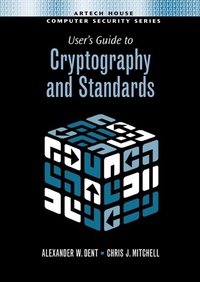
User's Guide to Cryptography and Standards
1st Edition
Published on 1. January 2004
402 pages
978-1-58053-956-2 (ISBN)
Description

With the scope and frequency of attacks on valuable corporate data growing enormously in recent years, a solid understanding of cryptography is essential for anyone working in the computer/network security field. This timely book delivers the hands-on knowledge you need, offering comprehensive coverage on the latest and most-important standardized cryptographic techniques to help you protect your data and computing resources to the fullest. Rather than focusing on theory like other books on the market, this unique resource describes cryptography from an end-user perspective, presenting in-depth, highly practical comparisons of standards and techniques.
More details
Other editions
Additional editions
Alexander Dent | Chris Mitchell
User's Guide to Cryptography and Standards
Book
11/2005
Artech House Publishers
€101.71
Shipment within 10-20 days
Content
- Users Guide to Cryptography and Standards
- Contents
- Acknowledgements
- 1 Introduction
- 1.1 Scope and purpose
- 1.2 Structure of the book
- 1.3 Terminology
- 1.4 Modular arithmetic
- 1.5 Notes
- References
- 2 Standard and the Standardization Process
- 2.1 Why bother with standards?
- 2.2 International standardization organizations
- 2.3 National standardization organizations
- 2.4 Industrialized standardization organizations
- 2.5 Cryptographic evaluation bodies
- 2.6 Notes
- References
- 3 Security Mechanism and Security Services
- 3.1 Introduction
- 3.2 Security standards
- 3.3 A model for security
- 3.4 Security services
- 3.5 Security mechanisms
- 3.6 Relating services to mechanisms
- 3.7 Service and protocol layers
- 3.8 Security management
- 3.9 Security frameworks
- 3.10 Notes
- References
- 4 Encryption
- 4.1 Definitions and basic properties
- 4.2 Block ciphers
- 4.3 Stream ciphers
- 4.4 Asymmetric ciphers
- 4.5 Notes
- References
- 5 Modes of Operation for Block Ciphers
- 5.1 Definitions and basic properties
- 5.2 Standards for modes of operation
- 5.3 Padding methods
- 5.4 ECB mode
- 5.5 Cipher block chaining (CBC) mode
- 5.6 CTR mode
- 5.7 OFB mode
- 5.8 CFB mode
- 5.9 Choosing a mode of operation
- 5.10 Other modes
- 5.11 Notes
- References
- 6 Cryptographic Hash Functions
- 6.1 Definitions and basic properties
- 6.2 Standards for hash functions
- 6.3 Hash Functions based on block ciphers
- 6.4 Dedicated hash functions
- 6.5 Hash functions based on modular arithmetic
- 6.6 Choosing a hash function
- 6.7 Notes
- References
- 7 Message Authentication Codes (MACs)
- 7.1 Definitions and basic properties
- 7.2 Standards for MACs
- 7.3 CBC-MACs
- 7.4 MACs based on hash functions
- 7.5 Other MAC functions
- 7.6 Notes
- References
- 8 Digital Signatures
- 8.1 Definitions and basic properties
- 8.2 Standards for digitial signatures
- 8.3 The Digital Signature Algorithm (DSA)
- 8.4 RSA-based signature schemes
- 8.5 Digital signatures and the law
- 8.6 Choosing a digital signature scheme
- 8.7 Notes
- References
- 9 Non-Repudiation Mechanisms
- 9.1 Introduction
- 9.2 Standars for non-repudiation
- 9.3 Non-repudiation model and services
- 9.4 Non-repudiation using symmetic cryptography
- 9.5 Non-repudiation using asymmetric cryptography
- 9.6 Time-stamping and non-repudiation
- 9.7 Notes
- References
- 10 Authentication Protocols
- 10.1 Introduction
- 10.2 Standards for entity authentication protocols
- 10.3 Cryptographic mechanisms
- 10.4 Timelines checking mechanisms
- 10.5 Authentication using symmetric cryptography
- 10.6 Authentication using asymmetric cryptography
- 10.7 Manual authentication protocols
- 10.8 Choosing an authentication protocol
- 10.9 Notes
- References
- 11 Key Management Frameworks
- 11.1 Standards for key management
- 11.2 Definitions and basic properties
- 11.3 The general framework
- 11.4 The ANSI X9.24 framework
- 11.5 Notes
- References
- 12 Key Establishment Mechanisms
- 12.1 Definitions and basic properties
- 12.2 Standards for key establishment
- 12.3 Physical mechanisms
- 12.4 Mechanisms using symmetric cryptography
- 12.5 Mechanisms using asymmetric cryptography
- 12.6 Key establishment based on weak secrets
- 12.7 Key establishment for mobile networks
- 12.8 Choosing a key establishment scheme
- 12.9 Notes
- References
- 13 Public Key Infrastructures
- 13.1 What is a PKI?
- 13.2 PKI standards
- 13.3 Certificate formats
- 13.4 Certificate management
- 13.5 Certificate storage and retrieval
- 13.6 Certificate status discovery
- 13.7 Certificate policies and certification practice statements
- 13.8 Notes
- References
- 14 Trusted Third Parties
- 14.1 Definitions and basic properties
- 14.2 Standards for managing TTPs
- 14.3 TTP requirements
- 14.4 TTP architectures
- 14.5 Time-stamping authorities
- 14.6 Digital archiving authorities
- 14.7 Notes
- References
- 15 Cryptographic APIs
- 15.1 Introduction
- 15.2 Standards for crypto APIs
- 15.3 GSS-API
- 15.4 PKCS #11
- 15.5 Security issues
- 15.6 Notes
- References
- 16 Other Standards.
- 16.1 Random bit generation
- 16.2 Prime number generation
- 16.3 Authenticated encryption
- 16.4 Security modules
- 16.5 Standards for the use of biometric techniques
- 16.6 Information security management
- 16.7 Notes
- References
- 17 Standards: The Future
- Appendix A: Table of Standards
- A.1 3GPP standards
- A.2 ANSI standards
- A.3 BSI standards
- A.4 ETSI standards
- A.5 IEEE standards
- A.6 IETF requests for comments (RFCs)
- A.7 ISO standards
- A.8 ITU-T Recommendations
- A.9 NIST FIPS
- A.10 RSA PKCS
- A.11 SECG standards
- About the Authors
- Index
