

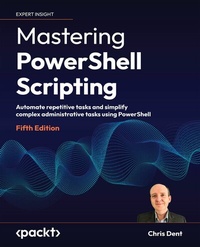
Mastering PowerShell Scripting
Description

Key Features
Build practical scripts to automate system tasks, manage files, users, and services, and optimize daily operations
Leverage PowerShell's advanced features for error handling, modular scripting, and secure automation
Apply best practices to create reusable, maintainable, and production-ready automation workflows
Book DescriptionMastering PowerShell Scripting, Fifth Edition, is your comprehensive guide to harnessing PowerShell's full potential. This edition introduces new chapters on debugging, troubleshooting, and creating GUIs while covering the latest enhancements in PowerShell 7.3, including parameters, objects, and .NET classes. The book takes you from foundational concepts to advanced techniques, covering asynchronous processing, desired state configuration, and managing large datasets. You'll explore PowerShell's automation features, error-handling strategies, and integration with external services. Additionally, this guide provides practical insights into working with regular expressions, Windows Management Instrumentation, and complex scripting methods. By the end of this book, you'll have the skills to efficiently automate tasks, troubleshoot scripts, and leverage PowerShell's advanced capabilities for real-world scenarios. Be sure to explore the online bonus chapters 8, 9, and 20, where we dive into Strings, Numbers, and Dates, Regular Expressions, and Building Modules.What you will learn
Create scripts that run across systems for automation
Extend PowerShell by integrating it with other languages
Use PowerShell's command-line interface for efficient operations
Develop reusable scripts and functions to streamline tasks
Apply PowerShell for administration, automation, and data processing
Integrate with .NET, COM, and WMI for advanced functionality
Work with XML, JSON, and CSV for structured data handling
Build custom modules and cmdlets to enhance scripting
Who this book is forThis book is for system administrators who want to automate and speed up their processes using PowerShell and Windows PowerShell. You'll need to know the basics of operating systems, but beginners with no prior experience with PowerShell will have no trouble following along.
All prices
More details
Other editions
Additional editions
Previous edition
Person
Chris Dent is an automation specialist with deep expertise in the PowerShell language. Chris is often found answering questions about PowerShell in both the UK and virtual PowerShell user groups. Chris has been developing in PowerShell since 2007 and has released several modules over the years.
Content
Introduction to PowerShell
Modules
Variables, Arrays, and Hashtables
Working with Objects in PowerShell
Operators
Conditional Statements and Loops
Working with .NET
Files, Folders, and the Registry
Windows Management Instrumentation
Working with HTML, XML, and JSON
Web Requests and Web Services
Remoting and Remote Management
Asynchronous Processing
Graphical User Interfaces
Scripts, Functions, and Script Blocks
Parameters, Validation, and Dynamic Parameters
Classes and Enumerations
Testing
Error Handling
Debugging
Preface
PowerShell is an object-oriented scripting language aimed at systems administrators that was invented by Jeffrey Snover. PowerShell was first conceived as far back as 2002 and entered mainstream use in 2006. Exchange 2007 was one of the first major systems to adopt it as an administration language.
PowerShell has come a long way over the years. PowerShell 7 smooths over a lot of the rough edges in the original releases of the cross-platform PowerShell Core (PowerShell 6).
Like any good scripting language, PowerShell is the glue that ties automated processes together. It is a vital part of the Microsoft ecosystem and is great in heterogeneous environments.
Who this book is for
This book is for PowerShell developers, system administrators, and script authors, new and old, who wish to explore the capabilities and possibilities of the language.
What this book covers
PowerShell fundamentals are explored in the first five chapters:
Chapter 1, Introduction to PowerShell, introduces you to editors, the help system, command naming, and more.
Chapter 2, Modules, explores finding, installing, and using modules in PowerShell. Snap-ins are not part of PowerShell 7 but are briefly explored as a legacy feature of PowerShell 5.
Chapter 3, Variables, Arrays, and Hashtables, covers an important topic in PowerShell. The chapter explores the use of variables, as well as the capabilities of collections.
Chapter 4, Working with Objects in PowerShell, looks at the concept of objects in PowerShell and the generic commands available for selecting, filtering, and manipulating values.
Chapter 5, Operators, explores the large variety of operators available in PowerShell.
Then, we move on to working with data in PowerShell:
Chapter 6, Conditional Statements and Loops, covers the tools used to make decisions in scripts in PowerShell. This chapter explores keywords like If, and the different loop styles available.
Chapter 7, Working with .NET, dives into .NET, which was used to create the PowerShell language and is available within PowerShell.
Chapter 8, Strings, Numbers, and Dates, covers a vital part of any scripting language, and PowerShell is no exception. This chapter explores the different techniques available for working with such values. This chapter can be accessed using https://static.packt-cdn.com/downloads/9781805120278_Chapter_8_and_9.pdf.
Chapter 9, Regular Expressions, discusses regular expressions, which are an incredibly useful inclusion in PowerShell. You can use regular expressions to make short work of string parsing tasks. The chapter ends by walking through several practical parsing examples. This chapter can be accessed using https://static.packt-cdn.com/downloads/9781805120278_Chapter_8_and_9.pdf.
Chapter 10, File, Folders, and the Registry, explores the use of providers in PowerShell, which are mostly used to access the file system and, in Windows, the registry.
Chapter 11, Windows Management Instrumentation, explores WMI in PowerShell, a significant part of the Windows operating system since Windows NT.
Chapter 12, Working with HTML, XML, and JSON, looks at the PowerShell commands and .NET types that you can use to work with these different text-based formats.
Chapter 13, Web Requests and Web Services, explores basic web requests before diving into using PowerShell to work with REST APIs, using the API for GitHub as an example. Support for SOAP in PowerShell 7 is less complete than in PowerShell 5.1. SOAP is explored by way of a web service project via Visual Studio.
Chapters 14 to 16 explores automating with PowerShell:
Chapter 14, Remoting and Remote Management, examines the configuration and use of PowerShell Remoting in both Windows and Linux.
Chapter 15, Asynchronous Processing, dives into the realm of background jobs in PowerShell before exploring .NET events in PowerShell. The chapter ends with a look at runspaces and runspace pools.
Chapter 16, Graphical User Interfaces, shows you how to implement responsive user interfaces in PowerShell.
For the rest of the book, we learn how to extend PowerShell by adding and implementing new functionalities:
Chapter 17, Scripts, Functions, and Script Blocks, explores the building blocks of larger scripts and modules. The chapter looks at how to define parameters, work in a pipeline, and manage output.
Chapter 18, Parameters, Validation, and Dynamic Parameters, looks at the many options available for defining parameters and validating input in PowerShell.
Chapter 19, Classes and Enumerations, shows off the capabilities of the class and enum keywords, which were introduced with PowerShell 5. The chapter includes an exploration of class inheritance and implementing .NET interfaces. This chapter includes a brief look at writing class-based DSC resources.
Chapter 20, Building Modules, explores the key concepts of creating a module in PowerShell using PowerShell code. The chapter shows off some of the common approaches available to module authors. This chapter can be accessed using https://static.packt-cdn.com/downloads/9781805120278_Chapter_20.pdf.
Chapter 21, Testing, explores static analysis using PSScriptAnalyzer as well as acceptance and unit testing using the Pester framework.
Chapter 22, Error Handling, looks at the complex topic of handling errors in PowerShell, including an exploration of both terminating and non-terminating errors.
Chapter 23, Debugging, uses the built-in debugger in PowerShell and Visual Studio to delve into some of the common problems encountered when debugging scripts.
To get the most out of this book
- Some familiarity with operating systems would be beneficial
- Visual Studio Code (https://code.visualstudio.com/) is used a few times in the book and is a useful tool to have available throughout
Download the example code files
The code bundle for the book is hosted on GitHub at https://github.com/PacktPublishing/Mastering-PowerShell-Scripting-5E/. We also have other code bundles from our rich catalog of books and videos available at https://github.com/PacktPublishing/. Check them out!
Download the color images
We also provide a PDF file that has color images of the screenshots/diagrams used in this book. You can download it here: https://packt.link/gbp/9781805120278.
Conventions used
There are a number of text conventions used throughout this book.
CodeInText: Indicates code words in text, database table names, folder names, filenames, file extensions, pathnames, dummy URLs, user input, and Twitter handles. For example: "By default, Save-Help (and Update-Help) will not download help content more often than once every 24 hours."
A block of code is set as follows:
Get-Process | Select-Object Name, ID -First 1 When we wish to draw your attention to a particular part of a code block, the relevant lines or items are set in bold:
Get-Process | Select-Object Name, ID Any command-line input or output is written as follows:
PS> Get-Process | Select-Object Name, ID -First 1 Name Id ---- -- Pwsh 5068 Bold: Indicates a new term, an important word, or words that you see on the screen. For instance, words in menus or dialog boxes appear in the text like this. For example: "Select System info from the Administration panel."
Warnings or important notes appear like this.
Tips and tricks appear like this.
Get in touch
Feedback from our readers is always welcome.
General feedback: Email feedback@packtpub.com and mention the book's title in the subject of your message. If you have questions about any aspect of this book, please email us at questions@packtpub.com.
Errata: Although we have taken every care to ensure the accuracy of our content, mistakes do happen. If you have found a mistake in this book, we would be grateful if you reported this to us. Please visit http://www.packtpub.com/submit-errata, click Submit Errata, and fill in the form.
Piracy: If you come across any illegal copies of our works in any form on the internet, we would be grateful if you would provide us with the location address or website name. Please contact us at copyright@packtpub.com with a link to the material.
If you are interested in becoming an author: If there is a topic that you have expertise in and you are interested in either writing or...
