

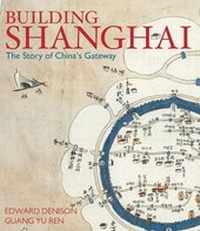
Building Shanghai
Description

More details
Other editions
Additional editions

Persons
Guang Yu Ren is an architect and independent consultant.Having practised in China for several years, she moved to Australiato augment her design education. Since then, she has worked withinternational agencies in Africa and the UK to conserve and promotearchitectural heritage. Her latest project has brought her back toShanghai, where she was born and raised, and where she now works toencourage heritage conservation in education and practice, and tobuild links between China with the rest of the world in thisfield.
Content
Chapter One: The Origins of Shaghai.
Chapter Two: Establishing and Legalishg the ForeignSetttlements.
Chapter Three: Constructing Shanghai, 1843-1899.
Chapter Four: Becoming a City, 1900-1920.
Chapter Five: Rise and Fall, 1921-1941.
Chapter Six: Anti-Design.
Chapter Seven: The Giant Awakes.
Chapter Eight: Shanghai's Future.
Notes and References.
Bibliography.
Photo Credits.
Statistics.
Index.
Chapter One
The Origins of Shanghai
The Yuyuan gardens and teahouse
[The native city] is traversed by lanes or streets which might better be termed fetid tunnels, seething with filth and teeming with miserable and vicious looking humanity. Odours are suffocating and the eyes can find nothing attractive or beautiful to rest upon: squalor, indigence, misery, slush, stench, depravity, dilapidation, and decay prevail everywhere. One almost fears to enter a place of so many repugnant scenes.
J Ricalton, China through the Stereoscope, 1901, p 77
The story of Shanghai and its environs, contrary to many early settler accounts, does not start with a desolate swamp formed by the Yangtze's eternal effluent, or with a nondescript fishing village struggling to survive on China's coast. It begins with a settlement formed many hundreds of years ago that evolved into an illustrious merchant community and a unique Chinese city. Early foreign descriptions rarely allude to this; instead, they disparage the nature of the land and people they encountered, so exalting their own contribution. The 'waste land without houses',1 from which foreigners built the settlements that became the 'stronghold of civilisation in the Far East',2 was actually a clearly defined area, highly regarded by local Chinese and subject to strict land ownership for centuries. The foreigner did not transform a 'sedgy swamp'3 into a magnificent city through self-ordained civilising brilliance, but invaded the gateway to China and exploited a well-established mercantile community by exposing it to international trade. The consequent growth of a settlement from this fusion of two disparate trading groups in such a prime location was inevitable.
Location and meaning
Shanghai stands 15 miles south of the mouth of the Yangtze River-the backbone of China that divides the country almost equally and has an estimated 400 million people living in its catchment. The former walled city sat close to the intersection of two important waterways, the Huangpu River and the Woosung River, which provide access to the sea and the hinterland respectively. Few cities on earth are so advantageously located for the pursuit of domestic and international trade.
The topography of the surrounding area is central to Shanghai's eminence. The traditionally affluent neighbouring provinces of Jiangsu and Zhejiang include the wealthy Yangtze Triangle, an area containing the prosperous silk and tea region of the Hang-Jia-Hu Plain.4 This area alone has made China famous throughout the world for those two primary exports, and at the start of the 21st century, with 6 per cent of China's population, accounts for 18 per cent of the country's production. Despite appalling if sporadic incidence of flooding and famine that have caused untold misery, over the centuries the normally auspicious conditions have created a region that, characterised by abundant agricultural activity, has been described as the Garden of China.
Many diverse accounts attest to the etymology of Shanghai. In Chinese, 'Shanghai' is made up of two characters, Shang and Hai, the former meaning 'up', 'upper', or 'above', and the latter meaning 'sea'. The name Shanghai therefore has various possible interpretations. Two straightforward suggestions are derived from the city being 'up from the sea' or 'above the sea'. Another possibility arises from the location relative to an area called Xia Hai Pu, Xia being the opposite to Shang and Pu meaning 'by the water', often referring to a river bank. Historical records suggest that two of the Woosung River's tributaries were called Shang Hai Pu, or 'Upper Sea', and Xia Hai Pu, or 'Lower Sea'. Shang Hai Pu once flowed into the area of Pudong, across the Huangpu from Shanghai, while on the opposite bank Xia Hai Pu flowed into what later became Shanghai's northern suburb of Hongkou. It is believed that the ruins of the temple of Xia Hai existed up until the mid-20th century.
Administrative map of the Shanghai region in the 1700s
Shanghai is also referred to as Hu and Shen. Hu originates from a 4th-century settlement called Hu Tu Lei, located approximately one mile north of the old city of Shanghai. The Hu derives from a method of tidal fishing with nets strung on bamboo poles that was very common on the waterways around the region. Tu refers to a single stream leading to the sea, while Lei refers to a mound, in this case a fortification. The name Shen derives from the title, Chuen Shen, given to Huang Xie, who was awarded this land during the reign of the Kingdom of Chu in the 4th century BC.
The Shanghai region
The earliest records of the region around Shanghai date from the era of Chinese history called 'Spring and Autumn'(Chun Qiu) between 770 BC and 476 BC which was named after one of the five Confucian Classics written in this period. Together with the 'Warring States' period, this disunited and turbulent time was considered the golden age of Chinese philosophy, which also saw the establishment of the doctrines of Taoism. The Shanghai region was then a dominion of the Wu Kingdom, whose people frequently fought with their neigh-bours, the Yue Kingdom. To afford protection to his kingdom, the king of Wu built a city in his own name, He Lu, between 514 BC and 494 BC on the banks of the Woosong River a few miles from present-day Shanghai.
The boundaries of the Yue and the Wu Kingdoms varied constantly during the Warring States, or Zhan Guo, period of Chinese history (between 475 BC and 221 BC), which ended when China was united under the famous Emperor Qin Shi Huang, who built much of the Great Wall and the Terracotta Army. In the turmoil characterising this period, the administration of the Shanghai region shifted from Wu to Yue, then in 355 BC to the Chu Kingdom, under whose rule the region became known as Lou from 207 BC.
Later, in the epoch known as 'Three Kingdoms' (AD 220-80), the first phase of an era of bitter disunity in China that lasted until the 7th century AD and is often compared to Europe's Dark Ages, the primary settlement in the Shanghai region was a town called Qin Long, or 'Blue Dragon'. This city acquired its name when Sun Quan, the emperor of one of the Three Kingdoms, built a warship on the banks of the Woosung and called the ship Qin Long. Qin Long, 25 miles up the Woosung from present-day Shanghai, was used by the emper-or as a military port and the site of the customs office, serving as the region's gateway for goods into and out of the interior.
During the Eastern Jin Dynasty (AD 317-420), a settlement called Hu Tu Lei was established a few miles east of Qin Long on the bank of the Woosong River, close to the former settlement of He Lu. Hu Tu Lei comprised two separate fortifications near the site of the British Consulate in the British Settlement which was formed over one and a half thousand years later. These sites, being so close to the future foreign settlements in Shanghai, assume an important role in the ancient history of Shanghai. In the 1850s it was suggested that the new foreign settlement in Shanghai should be called Lu Zi Cheng ('City of Reeds'), after an ancient settlement constructed close to the forts of Hu Tu Lei, but the name was not adopted.
The regional administration around Shanghai altered considerably from the 6th century. In AD 507, the region of Lou was renamed Xin Yi, which itself was subdivided in AD 535. Present-day Shanghai was located in the southern portion of this subdivision, named Kun Shan, part of which was absorbed in AD 751 into a new administration called Hua Ting. Shanghai evolved in the region of Hua Ting, and became administratively independent by the end of the Song Dynasty (AD 960-1279) between AD 1265 and 1267.
The first recorded mention of the name 'Shanghai' remains ambiguous. There is a trend for later records to quote earlier dates, while older records quote later ones. Records from the Ming Dynasty (AD 1368-1644) suggest that Shanghai was formed in the late Song Dynasty (AD 1127-1279), but records from the later Qing Dynasty (AD 1644-1911) claim Shanghai was established in the early Song Dynasty (AD 960-1127).5 Foreign interpretations veer towards the date AD 1074, perhaps because the first mention of this in an English language publication appears in AD 1850,6 which itself is likely to have derived from a Chinese record of AD 1814.
Regional map of Shanghai before foreign settlement
Despite the numerous discrepancies, most authorities concur that Shanghai was founded in the Song Dynasty, but more important is its independence from the region of Hua Ting. Shanghai's illustrious recent history began in AD 1291,7 when it became a 'Xian' or district administration, making it an important centre administratively, culturally and commercially. Its eminence as a port was boosted by the relocation of the local customs office to Shanghai from Qin Long, which had silted up and become unnavigable for large ships.
The city of Shanghai
After becoming a Xian, Shanghai's institutions were augmented significantly in keeping with its new status. Four years after its...
