

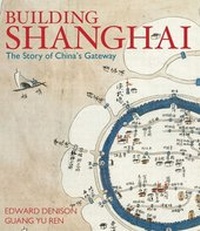
Building Shanghai
The Story of China's Gateway
1st Edition
Published on 13. April 2006
Book
Hardback
258 pages
978-0-470-01637-4 (ISBN)
Description
As we embark on the 21st century, Shanghai, the economic engine of China, is posed to challenge the established global economic order with its newfound supremacy. Despite the city's recent ascendancy, scant recognition has been paid to the causes of its giddy rise - history is not so much in the making, as being repeated. In Building Shanghai, the remarkably turbulent and compelling story of this illustrious trading city is revealed for the first time through its architecture, character, form and urban development. Extensively researched and illustrated, with both previously unseen archive material and new photography, the book draws together a comprehensive narrative of Shanghai's history. Stretching back to its ancient origins, it charts the impact of foreign occupation in the 19th and early 20th centuries and then the subsequent decades of virtual isolation under communism, as well as the background to the present burgeoning economy.
The central character in this story is not Shanghai's bewildered present or it fantastical future. It is the city's incomparable and extraordinary past: the Opium Wars that led to Shanghai's occupation by foreigners; China's bitter civil wars and the founding of the Republic; the insularity and greed of foreign settlers; its decadent heyday of the 1920s and 30s when sex, drugs and alcohol underpinned the city's social life; the rise of Communism in China; the Cultural Revolution; and the awakening of potentially the world's largest economy. All of these events, and many more, are etched into the urban landscape and manifested through a fascinating architectural ensemble. This has until now received no systematic scrutiny from abroad. What is, however, demonstrated here is just how extraordinary Shanghai's architecture is in terms of its variety and the interweaving of international styles and design movements.
The central character in this story is not Shanghai's bewildered present or it fantastical future. It is the city's incomparable and extraordinary past: the Opium Wars that led to Shanghai's occupation by foreigners; China's bitter civil wars and the founding of the Republic; the insularity and greed of foreign settlers; its decadent heyday of the 1920s and 30s when sex, drugs and alcohol underpinned the city's social life; the rise of Communism in China; the Cultural Revolution; and the awakening of potentially the world's largest economy. All of these events, and many more, are etched into the urban landscape and manifested through a fascinating architectural ensemble. This has until now received no systematic scrutiny from abroad. What is, however, demonstrated here is just how extraordinary Shanghai's architecture is in terms of its variety and the interweaving of international styles and design movements.
Reviews / Votes
"...a breathtaking case study...riveting book..." (The Guardian, June 2006) "...beautifully illustrated..." (Building Design, June 2006)"...expertly captioned images..." (World of Interiors, August 2006)
"...thick with historical detail." (Architectural Review, October 2006)
"..their sharp criticisms of contemporary planning are a useful anecdote." (Financial Times Magazine, November 2006)
More details
Other editions
Additional editions
E-Book
12/2013
Academy Press
€59.99
Available for download
E-Book
12/2013
Academy Press
€59.99
Available for download

Book
11/2008
Wiley
€32.90
The article will not be published
Previous edition
Alan Balfour | Zheng Shiling
Shanghai
Book
04/2002
1st Edition
Wiley
€139.00
Article exhausted; check for reprint
Persons
Edward Denison is a design consultant, writer and photographer, whose work focuses on preservation and regeneration in the built environment. Bridging academic and practical disciplines, his work in Africa, Asia and Europe includes consulting for international agencies in heritage conservation, authoritative books on design and architecture, and internationally published architectural photography and writing.
Guang Yu Ren is an architect and independent consultant. Having practised in China for several years, she moved to Australia to augment her design education. Since then, she has worked with international agencies in Africa and the UK to conserve and promote architectural heritage. Her latest project has brought her back to Shanghai, where she was born and raised, and where she now works to encourage heritage conservation in education and practice, and to build links between China with the rest of the world in this field.
Guang Yu Ren is an architect and independent consultant. Having practised in China for several years, she moved to Australia to augment her design education. Since then, she has worked with international agencies in Africa and the UK to conserve and promote architectural heritage. Her latest project has brought her back to Shanghai, where she was born and raised, and where she now works to encourage heritage conservation in education and practice, and to build links between China with the rest of the world in this field.
Content
Introduction.
Chapter One: The Origins of Shaghai.
Chapter Two: Establishing and Legalishg the Foreign Setttlements.
Chapter Three: Constructing Shanghai, 1843-1899.
Chapter Four: Becoming a City, 1900-1920.
Chapter Five: Rise and Fall, 1921-1941.
Chapter Six: Anti-Design.
Chapter Seven: The Giant Awakes.
Chapter Eight: Shanghai's Future.
Notes and References.
Bibliography.
Photo Credits.
Statistics.
Index.
Chapter One: The Origins of Shaghai.
Chapter Two: Establishing and Legalishg the Foreign Setttlements.
Chapter Three: Constructing Shanghai, 1843-1899.
Chapter Four: Becoming a City, 1900-1920.
Chapter Five: Rise and Fall, 1921-1941.
Chapter Six: Anti-Design.
Chapter Seven: The Giant Awakes.
Chapter Eight: Shanghai's Future.
Notes and References.
Bibliography.
Photo Credits.
Statistics.
Index.