

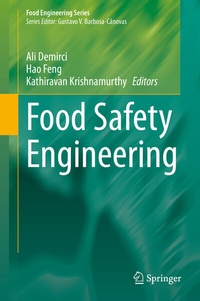
Food Safety Engineering
Description

Food Safety Engineering is the first reference work to provide up-to-date coverage of the advanced technologies and strategies for the engineering of safe foods. Researchers, laboratory staff and food industry professionals with an interest in food engineering safety will find a singular source containing all of the needed information required to understand this rapidly advancing topic. The text lays a solid foundation for solving microbial food safety problems, developing advanced thermal and non-thermal technologies, designing food safety preventive control processes and sustainable operation of the food safety preventive control processes.
The first section of chapters presents a comprehensive overview of food microbiology from foodborne pathogens to detection methods. The next section focuses on preventative practices, detailing all of the major manufacturing processes assuring the safety of foods including Good Manufacturing Practices (GMP), Hazard Analysis and Critical Control Points (HACCP), Hazard Analysis and Risk-Based Preventive Controls (HARPC), food traceability, and recalls. Further sections provide insights into plant layout and equipment design, and maintenance. Modeling and process design are covered in depth. Conventional and novel preventive controls for food safety include the current and emerging food processing technologies. Further sections focus on such important aspects as aseptic packaging and post-packaging technologies.
With its comprehensive scope of up-to-date technologies and manufacturing processes, this is a useful and first-of-its kind text for the next generation food safety engineering professionals.
More details
Other editions
Additional editions
Persons
Ali Demirci is a Professor in the Department of Agricultural and Biological Engineering at The Pennsylvania State University in University Park, Pennsylvania.
Hao Feng is a Professor in the Department of Food Science and Human Nutrition at University of Illinois in Urbana, Illinois.
Kathiravan Krishnamurthy is a Clinical Assistant Professor in the Department of Food Science and Nutrition at Illinois Institute of Technology in Bedford Park, Illinois.
Content
Introduction., Part 1. Overview of Food Microbiology., Intrinsic and extrinsic parameters affecting microbial growth.- Foodborne pathogens.- Microbial toxins.- Conventional and novel detection/enumeration methods.- Interactions of microorganisms with food matrix.- Part 2. Preventive practices.- Good manufacturing practices (GMP).- Sanitary standard operating procedures (SSOP).- Hazard analysis and critical control points (HACCP).- Hazard Analysis and Risk-Based Preventive Controls (HARPC).- Monitoring transportation, storage, and retail display.- Recall plans.- Part 3. Plant layout, equipment design, maintenance, energy reduction, and waste management.- Plant layout.- Equipment design (construction materials, fabrication, monitoring, and inspection).- Equipment cleaning, sanitation, and maintenance.- Energy reduction and waste management.- Modeling and process design.- Microbial growth models.- Microbial inactivation models for thermal processes.- Microbial inactivation models for non-thermal processes.- Part 5. Conventional and novel preventive controls for food safety.- Chemical treatments including ozone, dense CO2, and ClO2.- Conventional thermal treatments and advanced thermal treatments (Microwave, radio-frequency, infrared, and ohmic heating).- Irradiation (gamma irradiation, e-beam, and X-rays).- Light based technologies (UV, LED, and pulsed UV light).- High hydrostatic pressure.- Pulsed electric field.- Ultrasound.- Non-thermal plasma.- Hurdle technologies.- Part 6. Aseptic processing and post-packaging technologies.- Aseptic processing.- Modified atmosphere packaging.- Advancements in post-packaging technologies.- Part 7. Consumer acceptance and traceability.- Consumer acceptance of new foods and/or processes.- Food traceability
