

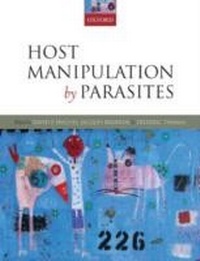
Host Manipulation by Parasites
1st Edition
Published on 7. June 2012
247 pages
978-0-19-163164-1 (ISBN)
Description

Parasites that manipulate the behaviour of their hosts represent striking examples of adaptation by natural selection. This innovative text provides an up-to-date, authoritative, and challenging review of host manipulation by parasites that assesses the current state of developments in the field and lays out a framework for future research.
More details
Other editions
Additional editions
Richard Dawkins | David P. Hughes | Jacques Brodeur
Host Manipulation by Parasites
Book
06/2012
Oxford University Press
€96.72
Shipment within 15-20 days
Content
- Cover
- Contents
- List of contributors
- Foreword
- 1 A history of parasites and hosts, science and fashion
- 1.1 Introduction
- 1.2 The days before cool
- 1.3 Becoming cool
- 1.4 Beyond manipulation
- 1.5 Conclusion
- Afterword
- 2 Evolutionary routes leading to host manipulation by parasites
- 2.1 Introduction
- 2.2 The origins of host manipulation
- 2.2.1 Manipulation sensu stricto
- 2.2.2 Complex parasitic cycles: the cause or the consequence of parasite manipulation?
- 2.2.3 Host-driven scenarios of manipulation
- 2.2.4 Exaptation?
- 2.3 The evolution of manipulation after its emergence
- 2.3.1 Genetically based variation in phenotypic alterations
- 2.3.2 Other sources of variation
- 2.4 Multidimensional manipulations: evidence of evolution or a syndrome?
- 2.4.1 Why do multidimensional manipulations evolve?
- 2.4.2 Simultaneous versus sequential multidimensional manipulations
- 2.4.3 How did multidimensional manipulations evolve?
- 2.4.4 Proximate aspects of multidimensionality
- 2.5 Concluding remarks
- Afterword
- 3 The strings of the puppet master: how parasites change host behavior
- 3.1 Introduction
- 3.2 How do parasites alter host behavior? Vertebrate examples
- 3.2.1 Toxoplasma gondii
- 3.2.2 Neuroviruses
- 3.3 Invertebrate examples
- 3.3.1 Gammarids-don't go into the light!
- 3.3.2 Suicidal crickets
- 3.4 How might parasites manipulate host behavior?
- 3.5 How can parasitic infections produce specific changes in host behavior without neuroanatomical specificity?
- Afterword
- 4 Parasites discover behavioral ecology: how to manage one's host in a complex world
- 4.1 Introduction
- 4.2 The problem
- 4.2.1 A healthy caterpillar
- 4.2.2 A parasitized caterpillar
- 4.3 Discussion
- Afterword
- 5 Manipulation of plant phenotypes by insects and insect-borne pathogens
- 5.1 Introduction
- 5.2 Plant manipulation by insect herbivores
- 5.2.1 Gall-inducing insects
- 5.2.2 Structural modification of host plants
- 5.2.3 Green islands
- 5.2.4 Manipulation of phytohormones
- 5.3 Plant manipulation by insect-borne pathogens
- 5.3.1 Manipulation of plant-pollinator interactions by fungal parasites
- 5.3.2 Pathogen manipulation of plant-herbivore interactions
- 5.4 Conclusion
- Afterword
- 6 Visual trickery in avian brood parasites
- 6.1 Introduction
- 6.2 Accessing host nests
- 6.3 The egg stage
- 6.4 The nestling stage
- 6.5 Visual trickery to elicit parental care
- 6.6 Mimicry in generalist versus specialist parasites
- 6.7 Conclusions
- Afterword
- 7 Endosymbiotic microbes as adaptive manipulators of arthropod behavior and natural driving sources of host speciation
- 7.1 Introduction
- 7.2 Wolbachia: the multidimensional manipulator of arthropods
- 7.2.1 Reproductive parasitism triggered by Wolbachia
- 7.2.2 Wolbachia's repertoire of inducing non-reproductive, adaptive phenotypes
- 7.3 Symbiont-directed adaptive manipulation of host sexual behavior
- 7.3.1 Feminization-the transformation of genetic males into functional females
- 7.3.2 Manipulating sexual mating behavior
- 7.4 Conclusions
- Afterword
- 8 Parasites and the superorganism
- 8.1 Introduction
- 8.2 The extended phenotype and the unitary organism
- 8.3 The behavior of social insects
- 8.4 Behavior of the superorganism
- 8.5 Parasites divide the interests of superorganism
- 8.6 Behaviorally modifying parasites of social insects
- 8.7 Manipulating the whole colony
- 8.7.1 Parasitizing social resources
- 8.7.2 Cheating the mutualism
- 8.7.3 Panicking the crowd
- 8.7.4 Shifting foraging ecology
- 8.8 Future directions and tests
- Afterword
- 9 Ecological consequences of manipulative parasites
- 9.1 Introduction
- 9.2 What makes a manipulator important ecologically?
- 9.3 Parasitic castrators and parasitoids as host behavior manipulators
- 9.3.1 Nematomorphs, endangered charr, and crickets in Japanese streams
- 9.4 Trophically transmitted parasites as host behavior manipulators
- 9.4.1 Tapeworms, wolves, moose, and forests on Isle Royale
- 9.4.2 Trematodes, cockles, limpets and anemones in New Zealand mudflats
- 9.5 The ecological reach of host behavior manipulators
- 9.6 Testing for the ecological effects of manipulative parasites
- 9.7 Conclusions
- Afterword
- 10 Applied aspects of host manipulation by parasites
- 10.1 Introduction
- 10.2 Manipulative parasites, biological invasions, and conservation
- 10.3 Manipulative parasites in agriculture and aquaculture
- 10.4 Parasite manipulation of disease vectors
- 10.4.1 Leishmaniasis
- 10.4.2 African sleeping sickness
- 10.4.3 Malaria
- 10.5 Parasite manipulation in humans: the case of Toxoplasma gondii
- 10.6 Conclusion
- Afterword
- 11 Behavioral manipulation outside the world of parasites
- 11.1 Introduction
- 11.2 A categorization of manipulation
- 11.2.1 Deceit through sensory exploitation
- 11.2.2 Exploitation of compensatory mechanisms
- 11.2.3 Coercive exploitation
- 11.2.4 Manipulation of information
- 11.2.5 Neuroendocrine manipulation
- 11.3 A brief critique of the "manipulation" concept
- 11.4 Manipulation inside and outside the world of parasites: convergence and divergence
- Afterword
- Index
- A
- B
- C
- D
- E
- F
- G
- H
- I
- J
- K
- L
- M
- N
- O
- P
- Q
- R
- S
- T
- U
- V
- W
- X
- Y
- Z
