

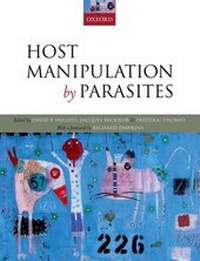
Host Manipulation by Parasites
Published on 7. June 2012
Book
Paperback/Softback
240 pages
978-0-19-964224-3 (ISBN)
Description
Parasites that manipulate the behaviour of their hosts represent striking examples of adaptation by natural selection. This field of study is now moving beyond its descriptive phase and into more exciting areas where the processes and patterns of such dramatic adaptations can be better understood. This innovative text provides an up-to-date, authoritative, and challenging review of host manipulation by parasites that assesses the current state of developments in the field and lays out a framework for future research. It also promotes a greater integration of behavioral ecology with studies of host manipulation (behavioral ecology has tended to concentrate mainly on behaviour expressed by free living organisms and is far less focused on the role of parasites in shaping behaviour). To help achieve this, the editors adopt a novel approach of having a prominent expert on behavioral ecology (but who does not work directly on parasites) to provide an afterword to each chapter.
Reviews / Votes
This book gives a stimulating review of host manipulation by parasites. It does so by actually going beyond the natural history to address its evolutionary significance and evolutionary consequences. * TREE *More details
Language
English
Place of publication
Oxford
United Kingdom
Target group
College/higher education
Professional and scholarly
Graduate level students as well as professional researchers in parasitology, evolutionary biology, and behavioural ecology. It will also be of relevance and use to a broader audience of epidemiologists and ecologists.
Illustrations
40 illustrations, plus an 8 page colour plate section
Dimensions
Height: 246 mm
Width: 191 mm
Thickness: 13 mm
Weight
560 gr
ISBN-13
978-0-19-964224-3 (9780199642243)
Copyright in bibliographic data and cover images is held by Nielsen Book Services Limited or by the publishers or by their respective licensors: all rights reserved.
Schweitzer Classification
Other editions
Additional editions
Richard Dawkins | Jacques Brodeur Frederic Thomas David P. Hughes
Host Manipulation by Parasites
E-Book
06/2012
1st Edition
OUP Oxford
€75.29
Available for download
Preface by Richard Dawkins, University of Oxford, UK | David P. Hughes | Jacques Brodeur
Host Manipulation by Parasites
Book
06/2012
Oxford University Press
€191.89
Shipment within 15-20 days
Richard Dawkins | David P. Hughes | Jacques Brodeur
Host Manipulation by Parasites
E-Book
06/2012
1st Edition
OUP eBook
€72.49
Available for download
Persons
David Hughes is Assistant Professor at Penn State University (dual appointment to the Department of Entomology and the Department of Biology). His work has mostly focused on the behavior of social insects (wasps and ants) when infected by parasites. He has also collaborated extensively with Fred Thomas on the Hairworms system of cricket manipulation. He has published more than 32 papers in leading international journals including: Nature, TREE, Current Biology, American Naturalist, Biology Letters, Behavioral Ecology and Sociobiology. In 2008 he edited a book for OUP with Patrizia D'Ettorre (P. D'Ettorre & D.P. Hughes (2008) Sociobiology of Communication. Oxford University Press).
Trained as experimental and theoretical ecologist, Jacques Brodeur is a full professor at the University of Montreal, Institut de Recherche en Biologie Vegetale, and holds the Canada Research Chair in Biocontrol. For the past 18 years, he has studied the biology and ecology of natural enemies used for biological control of arthropod pests. A long-term goal of his research is to identify the governing ecological principles and mechanisms of multispecies interactions within arthropod communities, and to apply these principles to develop reliable and predictive strategies to best take advantage of biological control agents. He has published a large number of papers on host-parasitoid relationships, including host manipulation.
Frederic Thomas is Directeur de Recherche at CNRS with a well established expertise in the field of host-parasite interactions, and especially host manipulation. He is leading a team entitled "Parasitically modified organisms". He has published more than 140 articles in international peer reviewed journals (1995-present), including Nature, Evolution, Trends in Ecology and Evolution, Ecology Letters, Ecology, American Naturalist, Proceedings of the Royal Society, Plos pathogen, Proteomics and also edited five books (two at Oxford University Press).
Trained as experimental and theoretical ecologist, Jacques Brodeur is a full professor at the University of Montreal, Institut de Recherche en Biologie Vegetale, and holds the Canada Research Chair in Biocontrol. For the past 18 years, he has studied the biology and ecology of natural enemies used for biological control of arthropod pests. A long-term goal of his research is to identify the governing ecological principles and mechanisms of multispecies interactions within arthropod communities, and to apply these principles to develop reliable and predictive strategies to best take advantage of biological control agents. He has published a large number of papers on host-parasitoid relationships, including host manipulation.
Frederic Thomas is Directeur de Recherche at CNRS with a well established expertise in the field of host-parasite interactions, and especially host manipulation. He is leading a team entitled "Parasitically modified organisms". He has published more than 140 articles in international peer reviewed journals (1995-present), including Nature, Evolution, Trends in Ecology and Evolution, Ecology Letters, Ecology, American Naturalist, Proceedings of the Royal Society, Plos pathogen, Proteomics and also edited five books (two at Oxford University Press).
Content
PREFACE: RICHARD DAWKINS