

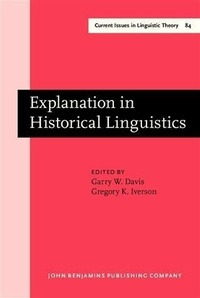
Explanation in Historical Linguistics
1st Edition
Published on 15. October 1992
XIV, 238 pages
978-90-272-7750-3 (ISBN)
Description

This is the first of two volumes deriving from papers presented at the Nineteenth Annual UVM Linguistics Symposium held in Milwaukee in April 1990. The contributions in this volume investigate the general question of what constitutes an explanation of diachronic change, and illustrate their proposals in the context of various specific problems in historical linguistics. The present volume also includes a solicited paper by Eric P. Hamp ("On remote reconstruction") that addresses the validity of distant reconstructions like those of Nostratic and Proto-World.
More details
Other editions
Additional editions
Garry W. Davis | Gregory Iverson
Explanation in Historical Linguistics
Book
10/1992
John Benjamins Publishing Co
€116.60
Shipment within 10-15 days
Persons
Content
- EXPLANATION IN HISTORICAL LINGUISTICS
- Editorial page
- Title page
- Copyright page
- Table of contents
- Preface
- Event structure accounting for the emerging periphrastic tenses and the passive voice in German
- 1. Setting the task
- 2. The early periphrastic passive: Old High German (OHG)
- 3. The periphrastic perfect
- 4. The periphrastic future in Middle High German with werden: a novelty and an outsider in Germanic
- 5. Dative passive
- 6. The Upper German "double periphrasis
- 7. Generalization on the auxiliarization from full lexicals
- Notes
- References
- Historical explanation and historical linguistics
- Setting the current scene
- Logic of the situation
- Logic and the primacy of history
- Logic of action
- Re-enactment
- The semiotic perspective
- The collective aspect of action
- The universality of philology
- Notes
- References
- Elements of resistance in contact-induced language change
- Abstract
- 1. Introduction
- 2. Background to the origin of Korlai Portuguese
- 2.1.1. Religion
- 2.1.2. Caste System
- 3. The subsequent development of Korlai
- 4. Aspectual distinctions in Korlai: an element of resistance to linguistic accommodation and homogeneity
- 4. Conclusion
- Notes
- References
- Articulatory variability, categorical perception, and the inevitability of sound change
- Notes
- References
- On the historical development of marked forms
- 0. Introduction
- 1. Markedness relations
- 2. The role of children and adults in language change
- 3. Sources of marked forms
- 3.1. Borrowing
- 3.2 Other sources of marked forms
- 3.2.1 Bleaching
- 3.2.2 Rapid speech
- 4. Conclusion
- Notes
- References
- On misusing similarity
- Notes
- Reconstruction and syntactic typology: a plea for a different approach
- Notes
- References
- Diachronic explanation: Putting speakers back into the picture
- 1. Introduction
- 2. Methodological flaws tied to the failure to recognize the role of speakers
- 3. Still further evidence - what speakers do versus what linguists do
- 4. Conclusion
- Notes
- References
- Grammatical prototypes and competing motivations in a theory of linguistic change
- 1. Grammatical prototypes
- 2. Middle voice
- 3. Diachrony
- 4. Competing functional motivations governing change
- 5. Conclusion
- Notes
- References
- Understanding standards
- 1. Reference to women's occupations
- 2. Third-person clitic reference
- Conclusion
- Notes
- References
- Rules and analogy
- The structuralist approach
- The generative approach
- Psycholinguistic approaches
- Analogy and productivity: an experiment
- METHOD
- RESULTS
- Factors affecting productivity
- DISCUSSION
- References
- The development of perfect reduplication in Indo-European
- 0. The problem
- 1. Typological evidence
- 2. Indo-European perfect reduplication
- Notes
- References
- A look at the data for a global etymology: *tik 'finger'
- 0. Introduction
- 1. The etymological basis for Proto-World *tik 'finger'
- 2. Additional data for *tik
- 3. Some methodological considerations
- 4. Another account of the data
- 5. Conclusion
- Notes
- References
- Author index
- Subject index
- Language index
