

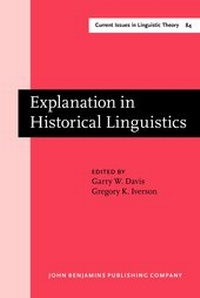
Explanation in Historical Linguistics
Published on 15. October 1992
Book
Hardback
238 pages
978-90-272-3581-7 (ISBN)
Description
This is the first of two volumes deriving from papers presented at the Nineteenth Annual UVM Linguistics Symposium held in Milwaukee in April 1990. The contributions in this volume investigate the general question of what constitutes an explanation of diachronic change, and illustrate their proposals in the context of various specific problems in historical linguistics. The present volume also includes a solicited paper by Eric P. Hamp ("On remote reconstruction") that addresses the validity of distant reconstructions like those of Nostratic and Proto-World.
More details
Series
Language
English
Place of publication
Amsterdam
Netherlands
Target group
Professional and scholarly
Dimensions
Height: 245 mm
Width: 164 mm
Weight
460 gr
ISBN-13
978-90-272-3581-7 (9789027235817)
Copyright in bibliographic data and cover images is held by Nielsen Book Services Limited or by the publishers or by their respective licensors: all rights reserved.
Schweitzer Classification
Other editions
Additional editions
Garry W. Davis | Gregory Iverson
Explanation in Historical Linguistics
E-Book
10/1992
1st Edition
John Benjamins Publishing Company
€136.99
Available for download
Persons
Content
1. Preface (by Davis, Garry W.); 2. Event structure accounting for the emerging periphrastic tenses and the passive voice in German (by Abraham, Werner); 3. Historical explanation and historical linguistics (by Anttila, Raimo); 4. Elements of resistance in contact-induced language change (by Clements, J. Clancy); 5. Articulatory variability, categorical perception, and the inevitability of sound change (by Faber, Alice); 6. On the historical development of marked forms (by Forner, Monika); 7. On misusing similarity (by Hamp, Eric P.); 8. Reconstruction and syntactic typology: A plea for a different approach (by Hock, Hans Henrich); 9. Diachronic explanation: putting speakers back into the picture (by Joseph, Brian D.); 10. Grammatical prototypes and competing motivations in a theory of linguistic change (by Kemmer, Suzanne); 11. Understanding standards (by Klein-Andreu, Flora); 12. Rules and analogy (by Moder, Carol Lynn); 13. The development of perfect reduplication in Indo-European (by Niepokuj, Mary K.); 14. A look at the data for a global etymology: *tik 'finger' (by Salmons, Joseph C.); 15. Author index; 16. Subject index; 17. Language index