

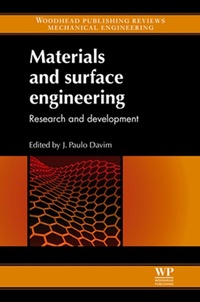
Materials and Surface Engineering
Research and Development
Published on 17. February 2012
308 pages
978-0-85709-603-6 (ISBN)
Description

This book, the second in the Woodhead Publishing Reviews: Mechanical Engineering Series, is a collection of high quality articles (full research articles, review articles, and cases studies) with a special emphasis on research and development materials and surface engineering and its applications. Surface engineering techniques are being used in the automotive, aircraft, aerospace, missile, electronic, biomedical, textile, petrochemical, chemical, moulds and dies, machine tools, and construction industries. Materials science is an interdisciplinary field involving the micro and nano-structure, processing, properties of materials and its applications to various areas of engineering, technology and industry. This book addresses all types of materials, including metals and alloys, polymers, ceramics and glasses, composites, nano-materials, biomaterials, etc. The relationship between micro and nano-structure, processing, properties of materials is discussed. Surface engineering is a truly interdisciplinary topic in materials science that deals with the surface of solid matter.
- Written by a highly knowledgeable and well-respected experts in the field
- The diversity of the subjects of this book present a range of views based on international expertise
More details
Other editions
Additional editions
Book
02/2012
Woodhead Publishing Ltd
€236.60
Shipment within 10-15 days
Content
List of figures
List of tables
Preface
About the contributors
Chapter 1: Scratch resistance of modified polymethylmethacrylate nanocomposites
Abstract:
1.1 Introduction
1.2 Experimental data
1.3 Scratch resistance
1.4 Wear mechanisms
1.5 Conclusions and future work
1.6 Acknowledgements
Chapter 2: Nanomechanical properties and nanoscale deformation of engineering metals and alloys
Abstract:
2.1 Introduction
2.2 Experimental data
2.3 Results and discussion
2.4 Conclusions
Chapter 3: Analysis of large-strain microindentation of crystalline polymers
Abstract:
3.1 Introduction
3.2 Experimental data
3.3 Analysis of large-strain microindentation deformation
3.4 Estimates of plastic properties of crystalline polymers by large-strain indentation
3.5 Conclusions
Chapter 4: Nanocomposite coatings: A review
Abstract:
4.1 What are nanocomposite coatings?
4.2 Main synthesis methods
4.3 Coating properties and characterization
4.4 Nanocomposite polymer coatings
4.5 Recent developments and industrial applications
4.6 Future trends
Chapter 5: Thermal sprayed WC-Co coatings for tribological application
Abstract:
5.1 Introduction
5.2 Thermal spray techniques
5.3 Characteristics of WC-Co coatings
5.4 Tribological performances of WC-Co coatings
5.5 Applications of WC-Co coatings
5.6 Future trends
Chapter 6: Tribological performance of electroless Ni-P coatings
Abstract:
6.1 Introduction
6.2 Friction behavior of electroless Ni-P coatings
6.3 Wear behavior of electroless Ni-P coatings
6.4 Electroless nickel bath characteristics and role of individual components
6.5 Optimization of tribological performance of electroless Ni-P coatings
6.6 Conclusions
Chapter 7: Tribological response of materials during sliding against various surface textures
Abstract:
7.1 Introduction
7.2 Experimental details
7.3 Results
7.4 Discussion
7.5 Conclusions
Chapter 8: Laser straight cutting of Ti-6Al-4V alloy: Temperature and stress fields
Abstract:
8.1 Introduction
8.2 Heating and stress analysis
8.3 Experimental data
8.4 Results and discussion
8.5 Conclusions
8.6 Acknowledgements
Index
