

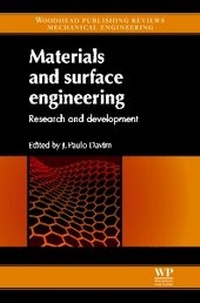
Materials and Surface Engineering
Research and Development
Published on 17. February 2012
Book
Hardback
308 pages
978-0-85709-151-2 (ISBN)
Description
This book, the second in the Woodhead Publishing Reviews: Mechanical Engineering Series, is a collection of high quality articles (full research articles, review articles, and cases studies) with a special emphasis on research and development materials and surface engineering and its applications. Surface engineering techniques are being used in the automotive, aircraft, aerospace, missile, electronic, biomedical, textile, petrochemical, chemical, moulds and dies, machine tools, and construction industries. Materials science is an interdisciplinary field involving the micro and nano-structure, processing, properties of materials and its applications to various areas of engineering, technology and industry. This book addresses all types of materials, including metals and alloys, polymers, ceramics and glasses, composites, nano-materials, biomaterials, etc. The relationship between micro and nano-structure, processing, properties of materials is discussed. Surface engineering is a truly interdisciplinary topic in materials science that deals with the surface of solid matter.
More details
Series
Language
English
Place of publication
Cambridge
United Kingdom
Publishing group
Elsevier Science & Technology
Target group
Professional and scholarly
Dimensions
Height: 234 mm
Width: 156 mm
Weight
620 gr
ISBN-13
978-0-85709-151-2 (9780857091512)
Copyright in bibliographic data and cover images is held by Nielsen Book Services Limited or by the publishers or by their respective licensors: all rights reserved.
Schweitzer Classification
Other editions
Additional editions
Book
10/2018
Woodhead Publishing Ltd
€173.61
The article will not be published
E-Book
02/2012
Woodhead Publishing
€175.00
Available for download
Person
Prof. (Dr.) J. Paulo Davim is a Full Professor at the University of Aveiro, Portugal, with over 35 years of experience in Mechanical, Materials, and Industrial Engineering. He holds multiple distinguished academic titles, including a PhD in Mechanical Engineering and a DSc from London Metropolitan University. He has published over 300 books and 600 articles, with more than 36,500 citations. He is ranked among the world's top 2% scientists by Stanford University and holds leadership positions in numerous international journals, conferences, and research projects. J. Paulo Davim received the Ph.D. degree in Mechanical Engineering in 1997, the M.Sc. degree in Mechanical Engineering (materials and manufacturing processes) in 1991, the Mechanical Engineering degree (5 years) in 1986, from the University of Porto (FEUP), the Aggregate title (Full Habilitation) from the University of Coimbra in 2005 and the D.Sc. from London Metropolitan University in 2013. He is Eur Ing by FEANI-Brussels and Senior Chartered Engineer by the Portuguese Institution of Engineers with a MBA and Specialist title in Engineering and Industrial Management. Currently, he is Professor at the Department of Mechanical Engineering of the University of Aveiro, Portugal. He has more than 30 years of teaching and research experience in Manufacturing, Materials and Mechanical Engineering with special emphasis in Machining & Tribology. He has also interest in Management & Industrial Engineering and Higher Education for Sustainability & Engineering Education. He has guided large numbers of postdoc, Ph.D. and masters students as well as coordinated & participated in several research projects. He has received several scientific awards. He has worked as evaluator of projects for international research agencies as well as examiner of Ph.D. thesis for many universities. He is the Editor in Chief of several international journals, Guest Editor of journals, books Editor, book Series Editor and Scientific Advisory for many international journals and conferences. Presently, he is an Editorial Board member of 25 international journals and acts as reviewer for more than 80 prestigious Web of Science journals. In addition, he has also published as editor (and co-editor) more than 100 books and as author (and co-author) more than 10 books, 80 book chapters and 400 articles in journals and conferences (more than 200 articles in journals indexed in Web of Science core collection/h-index 45+/6000+ citations and SCOPUS/h-index 52+/8000+ citations).
Content
List of figures
List of tables
Preface
About the contributors
Chapter 1: Scratch resistance of modified polymethylmethacrylate nanocomposites
Abstract:
1.1 Introduction
1.2 Experimental data
1.3 Scratch resistance
1.4 Wear mechanisms
1.5 Conclusions and future work
1.6 Acknowledgements
Chapter 2: Nanomechanical properties and nanoscale deformation of engineering metals and alloys
Abstract:
2.1 Introduction
2.2 Experimental data
2.3 Results and discussion
2.4 Conclusions
Chapter 3: Analysis of large-strain microindentation of crystalline polymers
Abstract:
3.1 Introduction
3.2 Experimental data
3.3 Analysis of large-strain microindentation deformation
3.4 Estimates of plastic properties of crystalline polymers by large-strain indentation
3.5 Conclusions
Chapter 4: Nanocomposite coatings: A review
Abstract:
4.1 What are nanocomposite coatings?
4.2 Main synthesis methods
4.3 Coating properties and characterization
4.4 Nanocomposite polymer coatings
4.5 Recent developments and industrial applications
4.6 Future trends
Chapter 5: Thermal sprayed WC-Co coatings for tribological application
Abstract:
5.1 Introduction
5.2 Thermal spray techniques
5.3 Characteristics of WC-Co coatings
5.4 Tribological performances of WC-Co coatings
5.5 Applications of WC-Co coatings
5.6 Future trends
Chapter 6: Tribological performance of electroless Ni-P coatings
Abstract:
6.1 Introduction
6.2 Friction behavior of electroless Ni-P coatings
6.3 Wear behavior of electroless Ni-P coatings
6.4 Electroless nickel bath characteristics and role of individual components
6.5 Optimization of tribological performance of electroless Ni-P coatings
6.6 Conclusions
Chapter 7: Tribological response of materials during sliding against various surface textures
Abstract:
7.1 Introduction
7.2 Experimental details
7.3 Results
7.4 Discussion
7.5 Conclusions
Chapter 8: Laser straight cutting of Ti-6Al-4V alloy: Temperature and stress fields
Abstract:
8.1 Introduction
8.2 Heating and stress analysis
8.3 Experimental data
8.4 Results and discussion
8.5 Conclusions
8.6 Acknowledgements
Index
List of tables
Preface
About the contributors
Chapter 1: Scratch resistance of modified polymethylmethacrylate nanocomposites
Abstract:
1.1 Introduction
1.2 Experimental data
1.3 Scratch resistance
1.4 Wear mechanisms
1.5 Conclusions and future work
1.6 Acknowledgements
Chapter 2: Nanomechanical properties and nanoscale deformation of engineering metals and alloys
Abstract:
2.1 Introduction
2.2 Experimental data
2.3 Results and discussion
2.4 Conclusions
Chapter 3: Analysis of large-strain microindentation of crystalline polymers
Abstract:
3.1 Introduction
3.2 Experimental data
3.3 Analysis of large-strain microindentation deformation
3.4 Estimates of plastic properties of crystalline polymers by large-strain indentation
3.5 Conclusions
Chapter 4: Nanocomposite coatings: A review
Abstract:
4.1 What are nanocomposite coatings?
4.2 Main synthesis methods
4.3 Coating properties and characterization
4.4 Nanocomposite polymer coatings
4.5 Recent developments and industrial applications
4.6 Future trends
Chapter 5: Thermal sprayed WC-Co coatings for tribological application
Abstract:
5.1 Introduction
5.2 Thermal spray techniques
5.3 Characteristics of WC-Co coatings
5.4 Tribological performances of WC-Co coatings
5.5 Applications of WC-Co coatings
5.6 Future trends
Chapter 6: Tribological performance of electroless Ni-P coatings
Abstract:
6.1 Introduction
6.2 Friction behavior of electroless Ni-P coatings
6.3 Wear behavior of electroless Ni-P coatings
6.4 Electroless nickel bath characteristics and role of individual components
6.5 Optimization of tribological performance of electroless Ni-P coatings
6.6 Conclusions
Chapter 7: Tribological response of materials during sliding against various surface textures
Abstract:
7.1 Introduction
7.2 Experimental details
7.3 Results
7.4 Discussion
7.5 Conclusions
Chapter 8: Laser straight cutting of Ti-6Al-4V alloy: Temperature and stress fields
Abstract:
8.1 Introduction
8.2 Heating and stress analysis
8.3 Experimental data
8.4 Results and discussion
8.5 Conclusions
8.6 Acknowledgements
Index