

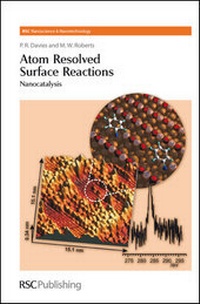
Atom Resolved Surface Reactions
Nanocatalysis
1st Edition
Published on 7. November 2007
240 pages
978-1-84755-799-5 (ISBN)
Description

This book offers a unique perspective of the impact of scanning probe microscopes on our understanding of the chemistry of the surface at the nanoscale. Research oriented, with the concepts gleaned from Scanning Tunnelling Microscopy being related to the more established and accepted views in surface chemistry and catalysis, the authors have addressed the question "How do the models based on classical spectroscopic and kinetic studies stand up to scrutiny at the atom-resolved level?". In taking this approach the reader, new to the field of surface chemistry, should be able to obtain a perspective on how the evidence from STM confirms or questions long standing tenets. An emphasis is given to "how did we get to where we are now" and a large number of figures from the literature are included along with suggestions for further reading. Topics discussed include: - the dynamics of oxygen chemisorption at metal surfaces - control of oxygen states and surface reconstruction - dissociative chemisorption of diatomic and hydrocarbon molecules - nanoparticles and chemical reactivity - STM at high pressures - structural studies of sulfur containing molecules and molecular templating This book will appeal to all those who wish to become familiar with the contribution Scanning Tunnelling Microscopy has made to the understanding of the field of surface chemistry and heterogeneous catalysis and also to those who are new to catalysis, a fascinating and important area of chemistry.
Reviews / Votes
"The authors of this book do an outstanding job...""Importantly, the authors do not simply summarize the workthat has been performed but rather evaluate it critically, givingit the unique perspective of those who have been working fora long time in this field. "!In summary, this insightful scholarly contribution gives aunique and timely overview of the atomic-level understandingof heterogeneous catalysis to which STM has contributed somuch. Not only is it a fascinating introduction to heterogeneouscatalysis for those new to the area, but also its individualchapters give excellent reviews on specific subtopics of the field." * Journal of the American Chemical Society *More details
Series
Edition
1. Auflage
Language
English
Place of publication
Cambridge
United Kingdom
Target group
College/higher education
Professional and scholarly
ISBN-13
978-1-84755-799-5 (9781847557995)
DOI
10.1039/9781847557995
Copyright in bibliographic data and cover images is held by Nielsen Book Services Limited or by the publishers or by their respective licensors: all rights reserved.
Schweitzer Classification
Other editions
Additional editions
Book
11/2007
Royal Society of Chemistry
€151.50
Article not available at the moment
Persons
Wyn Roberts, a student of the Amman Valley Grammar School, studied chemistry at University College Swansea where, after graduation, he pursued postgraduate studies investigating the role of sulphur as a catalyst in the formation of nickel carbonyl under the supervision of Keble Sykes. After being awarded his Ph.D he was first appointed to a United Kingdom Atomic Energy Research Fellowship at the Imperial College of Science and Technology, London, and then as a Senior Scientific Officer at the National Chemical Laboratory, Teddington. His first academic post was a lectureship at the Queen's University, Belfast before in 1966 being appointed to the Foundation Chair of Physical Chemistry at the University of Bradford, where he also had periods as Head of Department and Dean of Physical Science. In 1979 he moved to University College, Cardiff where he was Head of Department (1987 to 1997), a Deputy Principal (1990-1992) and is currently a Research Professor. He was invited to be World Bank Visiting Professor in China in 1985, a Visiting Professor at Berkeley and is an Honorary Fellow of the University of Wales, Swansea. He was the first Chairman of the Surface Reactivity and Catalysis Group (SURCAT) of the RSC. Phil Davies, a student of Blythe Bridge High School, Stoke-on-Trent, studied chemistry and mathematics in Southampton University. An undergraduate project on modelling of adsorption at fractal surfaces led to an interest in surface phenomena and after graduating with double honours in 1986 he moved to Cardiff to study reactions at surfaces with surface sensitive spectroscopy. After being awarded his PhD he was appointed to a lectureship in the department of chemistry at Cardiff. His main research interests are studying reaction mechanisms at surfaces primarily through the use of surface sensitive spectroscopy but he also spent a short period of time with Prof Rutger van Santen in Eindhoven studying adsorption and reaction using abinitio calculations on clusters. Since 1997 his interests have centred largely on the influence of local atomic structure on reaction mechanism studied with scanning probe microscopies. Between them Davies and Roberts have published over 400 scientific papers and a number of books.
Content
Chapter 1: Some Milestones in the Development of Surface Chemistry and Catalysis;
1 Introduction;
2 1926: Catalysis, Theory and Practice;
Rideal and Taylor;
3 1932: Adsorption of Gases by Solids;
Faraday Discussion, Oxford;
4 1940: Seventeenth Faraday Lecture;
Langmuir;
5 1950: Heterogeneous Catalysis;
Faraday Discussion, Liverpool;
6 1957: Advances in Catalysis;
International Congress on Catalysis, Philadelphia;
7 1963: Conference on Clean Surfaces with Supplement: Surface Phenomena in Semiconductors, New York;
8 1966: Faraday Discussion Meeting, Liverpool;
9 1967: The Emergence of Photoelectron Spectroscopy;
10 1968: Berkeley Meeting: Structure and Chemistry of Solid Surfaces;
11 1972: A Discussion on the Physics and Chemistry of Surfaces, London;
12 1987: Faraday Symposium, Bath Summary;
References;
Further Reading;
Chapter 2:Experimental Methods in Surface Science Relevant to STM;
1 Introduction;
2 Kinetic Methods;
3 Vibrational Spectroscopy;
4 Work Function;
5 Structural Studies;
6 Photoelectron Spectroscopy;
7 The Dynamics of Adsorption;
Summary;
References;
Further Reading;
Chapter 3: Scanning Tunnelling Microscopy: Theory and Experiment;
1 The Development of Ultramicroscopy;
2 The Theory of STM;
3 The Interpretation of STM Images;
4 Scanning Tunnelling Spectroscopy;
5 The STM Experiment;
6 The Scanner;
Sample Approach;
Adaptations of the Scanner for Specific Experiments;
7 Making STM Tips;
Tip Materials;
References;
Chapter 4: Dynamics of Surface Reactions and Oxygen Chemisorption;
1 Introduction;
2 Surface Reconstruction and "Oxide" Formation;
3 Oxygen States at Metal Surfaces;
4 Control of Oxygen States by Coadsorbates;
5 Adsorbate Interactions, Mobility and Residence Times;
6 Atom-tracking STM;
7 Hot Oxygen Adatoms: How Are They Formed?;
Summary;
References;
Further Reading;
Chapter 5: Catalytic Oxidation at Metal Surfaces: Atom Resolved Evidence;
1 Introduction;
2 Ammonia Oxidation;
Cu(110) Pre-exposed to Oxygen;
Coadsorption of Ammonia-Oxygen Mixtures at Cu(110);
Coadsorption of Ammonia-Oxygen Mixtures at Mg(0001);
Ni(110) Pre-exposed to Oxygen;
Ag(110) Pre-exposed to Oxygen;
3 Oxidation of Carbon Monoxide;
4 Oxidation of Hydrogen;
5 Oxidation of Hydrocarbons;
6 Oxidation of Hydrogen Sulfide and Sulfur Dioxide;
7 Theoretical Analysis of Activation by Oxygen;
Summary;
References;
Further Reading;
Chapter 6: Surface Modification by Alkali Metals;
1 Introduction;
2 Infrared Studies of CO at Cu(110)-Cs;
3 Structural Studies of the Alkali Metal-modified Cu(110) Surfaces;
Low-energy Electron Diffraction;
Scanning Tunnelling Microscopy;
Cu(110)-Cs System;
Oxygen Chemisorption at Cu(110)-Cs;
4 Reactivity of Cu(110)-Cs to NH3 and CO2;
5 Au(110)-K System;
6 Cu(100)-Li System;
Summary;
References;
Further Reading;
Chapter 7: STM at High Pressure;
1 Introduction;
2 Catalysis and Chemisorption at Metals at High Pressure;
Carbon Monoxide and Nitric Oxide;
Hydrogenation of Olefins;
3 Restructuring of the Pt(110)-(1 I 2) Surface by Carbon Monoxide;
4 Adsorption-induced Step Formation;
5 Gold Particles at FeO(111);
6 Hydrogen-Deuterium Exchange and Surface Poisoning;
Summary;
References;
Further Reading;
Chapter 8: Molecular and Dissociated States of Molecules: Biphasic Systems;
1 Introduction;
2 Nitric Oxide;
3 Nitrogen Adatoms: Surface Structure;
4 Carbon Monoxide;
5 Hydrogen;
6 Dissociative Chemisorption of HCl at Cu(110);
7 Chlorobenzene;
8 Hydrocarbon Dissociation: Carbide Formation;
9 Dissociative Chemisorption of Phenyl Iodide;
10 Chemisorption and Trimerization of Acetylene at Pt(111);
Summary;
References;
Further Reading;
Chapter 9: Nanoparticles and Chemical Reactivity;
1 Introduction;
2 Controlling Cluster Size on Surfaces;
3 Alloy Ensembles;
4 Nanoclusters at Oxide Surfaces;
5 Oxidation and Polymerisation at Pd Atoms Deposited on MgO Surfaces;
6 Clusters in Nanocatalysis;
7 Molybdenum Sulfide Nanoclusters and Catalytic Hydrodesulfurisation Reaction Pathways;
8 Nanoparticle Geometry at Oxide-supported Catalysts;
Summary;
References;
Further Reading;
Chapter 10: Studies of Sulfur and Thiols at Metal Surfaces;
1 Introduction;
2 Studies of Atomic Sulfur Adsorbed at Metal Surfaces;
Copper;
Nickel;
Gold and Silver;
Platinum, Rhodium, Ruthenium and Rhenium;
Alloy systems;
3 Sulfur-containing Molecules;
Summary;
References;
Further Reading;
Chapter 11: Surface Engineering at the Nanoscale;
1 Introduction;
2 "Bottom-up" Surface Engineering;
Van der Waals Forces;
Hydrogen Bonding;
Chiral Surfaces from Prochiral Adsorbates;
Covalently Bonded Systems;
3 Surface Engineering Using Diblock Copolymer Templates;
Summary;
References;
Further Reading;
Epilogue;
Catalysis and the Greenhouse Phenomenon;
Subject Index;
1 Introduction;
2 1926: Catalysis, Theory and Practice;
Rideal and Taylor;
3 1932: Adsorption of Gases by Solids;
Faraday Discussion, Oxford;
4 1940: Seventeenth Faraday Lecture;
Langmuir;
5 1950: Heterogeneous Catalysis;
Faraday Discussion, Liverpool;
6 1957: Advances in Catalysis;
International Congress on Catalysis, Philadelphia;
7 1963: Conference on Clean Surfaces with Supplement: Surface Phenomena in Semiconductors, New York;
8 1966: Faraday Discussion Meeting, Liverpool;
9 1967: The Emergence of Photoelectron Spectroscopy;
10 1968: Berkeley Meeting: Structure and Chemistry of Solid Surfaces;
11 1972: A Discussion on the Physics and Chemistry of Surfaces, London;
12 1987: Faraday Symposium, Bath Summary;
References;
Further Reading;
Chapter 2:Experimental Methods in Surface Science Relevant to STM;
1 Introduction;
2 Kinetic Methods;
3 Vibrational Spectroscopy;
4 Work Function;
5 Structural Studies;
6 Photoelectron Spectroscopy;
7 The Dynamics of Adsorption;
Summary;
References;
Further Reading;
Chapter 3: Scanning Tunnelling Microscopy: Theory and Experiment;
1 The Development of Ultramicroscopy;
2 The Theory of STM;
3 The Interpretation of STM Images;
4 Scanning Tunnelling Spectroscopy;
5 The STM Experiment;
6 The Scanner;
Sample Approach;
Adaptations of the Scanner for Specific Experiments;
7 Making STM Tips;
Tip Materials;
References;
Chapter 4: Dynamics of Surface Reactions and Oxygen Chemisorption;
1 Introduction;
2 Surface Reconstruction and "Oxide" Formation;
3 Oxygen States at Metal Surfaces;
4 Control of Oxygen States by Coadsorbates;
5 Adsorbate Interactions, Mobility and Residence Times;
6 Atom-tracking STM;
7 Hot Oxygen Adatoms: How Are They Formed?;
Summary;
References;
Further Reading;
Chapter 5: Catalytic Oxidation at Metal Surfaces: Atom Resolved Evidence;
1 Introduction;
2 Ammonia Oxidation;
Cu(110) Pre-exposed to Oxygen;
Coadsorption of Ammonia-Oxygen Mixtures at Cu(110);
Coadsorption of Ammonia-Oxygen Mixtures at Mg(0001);
Ni(110) Pre-exposed to Oxygen;
Ag(110) Pre-exposed to Oxygen;
3 Oxidation of Carbon Monoxide;
4 Oxidation of Hydrogen;
5 Oxidation of Hydrocarbons;
6 Oxidation of Hydrogen Sulfide and Sulfur Dioxide;
7 Theoretical Analysis of Activation by Oxygen;
Summary;
References;
Further Reading;
Chapter 6: Surface Modification by Alkali Metals;
1 Introduction;
2 Infrared Studies of CO at Cu(110)-Cs;
3 Structural Studies of the Alkali Metal-modified Cu(110) Surfaces;
Low-energy Electron Diffraction;
Scanning Tunnelling Microscopy;
Cu(110)-Cs System;
Oxygen Chemisorption at Cu(110)-Cs;
4 Reactivity of Cu(110)-Cs to NH3 and CO2;
5 Au(110)-K System;
6 Cu(100)-Li System;
Summary;
References;
Further Reading;
Chapter 7: STM at High Pressure;
1 Introduction;
2 Catalysis and Chemisorption at Metals at High Pressure;
Carbon Monoxide and Nitric Oxide;
Hydrogenation of Olefins;
3 Restructuring of the Pt(110)-(1 I 2) Surface by Carbon Monoxide;
4 Adsorption-induced Step Formation;
5 Gold Particles at FeO(111);
6 Hydrogen-Deuterium Exchange and Surface Poisoning;
Summary;
References;
Further Reading;
Chapter 8: Molecular and Dissociated States of Molecules: Biphasic Systems;
1 Introduction;
2 Nitric Oxide;
3 Nitrogen Adatoms: Surface Structure;
4 Carbon Monoxide;
5 Hydrogen;
6 Dissociative Chemisorption of HCl at Cu(110);
7 Chlorobenzene;
8 Hydrocarbon Dissociation: Carbide Formation;
9 Dissociative Chemisorption of Phenyl Iodide;
10 Chemisorption and Trimerization of Acetylene at Pt(111);
Summary;
References;
Further Reading;
Chapter 9: Nanoparticles and Chemical Reactivity;
1 Introduction;
2 Controlling Cluster Size on Surfaces;
3 Alloy Ensembles;
4 Nanoclusters at Oxide Surfaces;
5 Oxidation and Polymerisation at Pd Atoms Deposited on MgO Surfaces;
6 Clusters in Nanocatalysis;
7 Molybdenum Sulfide Nanoclusters and Catalytic Hydrodesulfurisation Reaction Pathways;
8 Nanoparticle Geometry at Oxide-supported Catalysts;
Summary;
References;
Further Reading;
Chapter 10: Studies of Sulfur and Thiols at Metal Surfaces;
1 Introduction;
2 Studies of Atomic Sulfur Adsorbed at Metal Surfaces;
Copper;
Nickel;
Gold and Silver;
Platinum, Rhodium, Ruthenium and Rhenium;
Alloy systems;
3 Sulfur-containing Molecules;
Summary;
References;
Further Reading;
Chapter 11: Surface Engineering at the Nanoscale;
1 Introduction;
2 "Bottom-up" Surface Engineering;
Van der Waals Forces;
Hydrogen Bonding;
Chiral Surfaces from Prochiral Adsorbates;
Covalently Bonded Systems;
3 Surface Engineering Using Diblock Copolymer Templates;
Summary;
References;
Further Reading;
Epilogue;
Catalysis and the Greenhouse Phenomenon;
Subject Index;
