

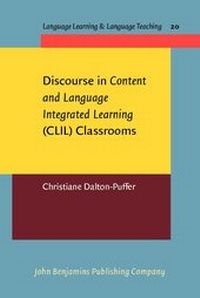
Discourse in Content and Language Integrated Learning (CLIL) Classrooms
1st Edition
Published on 27. September 2007
XII, 330 pages
978-90-272-9193-6 (ISBN)
Description

The label CLIL stands for classrooms where a foreign language (English) is used as a medium of instruction in content subjects. This book provides a first in-depth analysis of the kind of communicative abilities which are embodied in such CLIL classrooms. It examines teacher and student talk at secondary school level from different discourse-analytic angles, taking into account the interpersonal pragmatics of classroom discourse and how school subjects are talked into being during lessons. The analysis shows how CLIL classroom interaction is strongly shaped by its institutional context, which in turn conditions the ways in which students experience, use and learn the target language. The research presented here suggests that CLIL programmes require more explicit language learning goals in order to fully exploit their potential for furthering the learners' appropriation of a foreign language as a medium of learning.
More details
Other editions
Additional editions
Christiane Dalton-Puffer
Discourse in Content and Language Integrated Learning (CLIL) Classrooms
Book
09/2007
John Benjamins Publishing Co
€116.60
Shipment within 10-15 days
Person
Content
- Discourse in Content and Language Integrated Learning (CLIL) Classrooms
- Editorial page
- Title page
- LCC data
- Table of contents
- Acknowledgements
- Transcription conventions
- 1. Introduction
- 1.1 What CLIL is and why one should study it
- 1.2 The relationship of language and content
- 1.3 A constructivist and participatory understanding of learning
- 1.4 Research questions and goals of this study
- 2. The classroom as discourse space
- 2.1 School lessons: the speech event
- 2.2 Roles and scripts: ritual aspects of classroom talk
- 2.3 Classroom registers and activity types
- 2.4 Whole class interaction and the IRF-cycle
- 2.5 Classroom talk as conversation
- 2.6 Speech acts and the management of interpersonal relations
- 2.7 Genre aspects of classroom talk
- 2.8 A multi-perspectival approach
- 3. The study - setting, methods, data
- 3.1 The sociolinguistic and institutional context of CLIL in Austria: a sketch
- 3.2 Research concept
- 3.3 Methodological reflections: the researcher and the field in qualitative classroom-based research 11
- 4. Content teaching, meaning makingand the construction of knowledge
- 4.1 Introduction
- 4.2 Cornerstones in the analysis of knowledge construction
- 4.3 Classroom practices
- 4.4 Summary and conclusions
- 5. Questions in the CLIL classroom
- 5.1 Introduction
- 5.2 Typologies of classroom questions
- 5.3 Quantitative overview of findings
- 5.4 Classroom practices
- 5.5 Questions and the handling of communication breakdowns10
- 5.6 Discussion of findings
- 6. Academic language functions
- 6.1 Introduction
- 6.2 Definition
- 6.2.1 Defining definitions
- 6.2.2 Classroom practices
- 6.2.3 Discussion of findings on definitions
- 6.3 Explanation
- 6.3.1 Operationalizing explanations
- 6.3.2 Structural and functional characteristics of explanations
- 6.3.3 Classroom practices
- 6.3.4 Discussion of findings on explanations
- 6.4 Hypothesizing and predicting
- 6.4.1 Operationalizing hypothesizing and predicting
- 6.4.2 Classroom practices
- 6.4.3 Conclusions on hypothesizing
- 6.5 Conclusions on academic speech functions
- 7. Passages of politeness*
- 7.1 Introduction
- 7.2 Conceptual background of the analysis
- 7.2.1 Previous studies of classroom politeness and directives
- 7.2.2 A framework for analysis
- 7.3 Quantitative overview of the findings
- 7.4 Classroom practices
- 7.5 Discussion of findings
- 8. Conversationalists in the classroom?
- 8.1 Introduction
- 8.2 Conceptual framework
- 8.2.1 A sequential view of repair
- 8.2.2 Categories of repairables
- 8.2.3 Data, methods, research questions
- 8.3 Classroom practices
- 8.3.1 How frequent is repair in CLIL classrooms?
- 8.3.2 Frequency of repairable types
- 8.3.3 Sequential organization of repair - trajectory types
- 8.3.4 Links between repairable types and repair types
- 8.3.5 Realization of repair initiations by 'other'
- 8.4 The question of face threat and other factors in repair realization
- 8.5 Conclusions
- 9. The CLIL classroom as a language learning environment
- 9.1 Introduction
- 9.2 Theoretical approaches to second language learning
- 9.3 Stakeholder notions of SLL
- 9.4 Theory mapped onto practice: communicative competence in the CLIL lesson speech event
- 10. Conclusions, implications and prospects
- Notes
- References
- Index
- The series Language Learning & Language Teaching
