

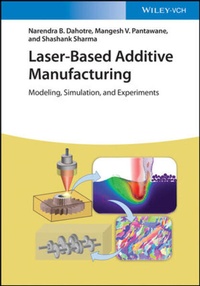
Laser-Based Additive Manufacturing
Description

More details
Other editions
Additional editions
Persons
Mangesh V. Pantawane is Research Assistant in the Department of Materials Science and Engineering at the University of North Texas, USA. He has been conducting research on the fundamental understanding of laser-material interactions for physical phenomena involved behind morphological, microstructural and chemical transitions in materials under non- or near-non-equilibrium thermodynamic and kinetic conditions, with a focus on the development of computational models of these transitions.
Content
1.1 Manufacturing Techniques
1.2 What is Additive Manufacturing (AM)?
1.3 Laser-based Additive Manufacturing (LAM)?
1.4 Advantages of AM over Conventional Manufacturing
1.5 Current Challenges Associated with AM
1.6 Importance of Computational Modeling in AM
1.7 References
2 COMPUTATIONAL MATERIALS SCIENCE
2.1 Introduction to Computational Materials Science
2.2 Length- and Time-Scale in Materials Modeling
2.3 Current State of Computational Modeling in LAM
2.4 References
3 LASER-MATERIAL INTERACTION IN LAM
3.1 Conversion of Light Energy to Heat
3.2 Modes of Heat Dissipation
3.3 Dynamics of the Melt-Pool
3.4 References
4 MICROSTRUCTURAL AND MECHANICAL ASPECTS IN LAM INTEGRATED WITH MODELING
4.1 Solidification
4.2 Microstructural Variation and its Prediction
4.3 Effects of Laser Parameters
4.4 Scanning Strategy and Texture Evolution in the Microstructure
4.5 Mechanical Properties
5 RESIDUAL STRESSES AND THREE-DIMENSIONAL DEFECTS IN LAM
5.1 Design of Precursors in LAM
5.2 Thermal Stress Modeling
5.3 Optimum Laser Parameters and Scanning Strategy Prediction by Modeling
5.4 References
6 SURFACE PHYSICAL TEXTURE IN LAM
6.1 Effect of Melt-Pool Dynamics on Surface Texture
6.2 Surface Physical Texture Variation in LAM
6.3 References
1
Introduction to Additive Manufacturing
Every human-made object around us has a unique history. This history is the evolution of raw materials that are extracted from the earth through human intervention and made into a usable form. The development of humankind has always been linked to modifying the history of raw material evolution into a usable product (manufacturing) in the pursuit of making it more efficient and flexible. Today, in the early decades of the twenty-first century, additive manufacturing (AM) is the most advanced and cutting-edge technique used in manufacturing. It entered the limelight as '3D printing' and has flipped the tables in research and development with a paradigm shift, gradually ushering in the fourth Industrial Revolution. However, we can only recognize the full worth of AM by understanding traditional manufacturing techniques and their evolution. This chapter first presents the history of manufacturing and the AM approach. It addresses the advantage of AM over conventional manufacturing while considering the challenges AM currently faces. The remainder of the chapter introduces laser-based AM, which is at the forefront of AM techniques. Overall, understanding the fundamental aspects of these techniques and their effects is the primary goal of this book.
1.1 Evolution of Manufacturing
Manufacturing is the process of forming a usable product out of raw materials using manual labor or mechanical machinery. The archaeological evidence for manufacturing dates back to the Stone Age, when Homo habilis produced the earliest tools carved out of stones [De la Torre, 2011]. This record suggests a subtractive manufacturing technique, where material is removed from a single piece to transform it into another usable form. Other techniques emerged progressively, including joining, machining, casting, and transformation (deformation) of materials. However, these processes were carried out by hand at a small scale to produce household commodities.
With the addition of machines, the scale of manufacturing surged dramatically during the first Industrial Revolution, which began in European countries in the eighteenth century and later spread to other parts of the world [Deane, and Deane, 1979]. This phase mainly centered around technologies that extracted metals (cast iron) from their natural forms (ores) and produced final products using industrial equipment. The improvement in the quality and characteristics of materials for the new types of applications and continuous production via conveyor equipment led to the second Industrial Revolution in the late nineteenth and early twentieth century [Popkova et al., 2019]. With the invention of techniques such as the Bessemer process to produce steel and electromagnetic rotary devices to electrify the technology, this phase was a technological revolution [Mokyr, 1998]. The second half of the twentieth century was driven mostly by renewable sources of energy and the emergence of digital technologies, constituting the third Industrial Revolution [Popkova et al., 2019]. The progress and features of the Industrial Revolutions are illustrated in Figure 1.1.
Today, in the early decades of the twenty-first century, AM is an integral part of the ongoing fourth Industrial Revolution. This new technological mode of manufacturing offers broad flexibility for materials science, process development, and structural design. Using AM, intricate and complex parts can be manufactured with the desired quality, which would be extremely challenging using earlier subtractive (machining) and formative (casting) manufacturing modes. Moreover, the inherent nature of AM is leading manufacturing toward fully automated digital manufacturing through robotic equipment. In contrast to earlier manufacturing techniques, which steadily evolved and advanced in response to challenges experienced by earlier versions, AM is an entirely new technique. Therefore, AM may be considered not an evolution but the dawn of a new manufacturing era. Before diving deep into the technical features and current status of AM, we examine its intriguing fundamental nature in the following section.
Figure 1.1 Timeline of the Industrial Revolutions.
1.2 Concept of AM
Although AM seems to be a new manufacturing mode in the twenty-first century, it existed silently as an auxiliary manufacturing technique for several decades in the previous century. The origin of all metallic AM types can be traced back and linked to welding and surface coating techniques. For instance, the friction stir AM technique evolved from friction stir welding and processing. These auxiliary manufacturing techniques were mature and only required a trigger to evolve into AM.
Eventually, AM was conceived as a fabrication method in the polymeric system in 1981 by Hideo Kodama, from Japan [Kodama, 1981]. He developed and demonstrated a prototype of the automatic fabrication of intricately shaped polymers, using layer-by-layer curing of the liquid and photo-hardening the polymer with ultraviolet rays. An intricate relief map of the mountain fabricated by Kodama using transparent polymer is presented in Figure 1.2. Charles Hull later advanced this technique and patented it as stereolithography (SLA) [Hull, 1984]. The concept of layer-upon-layer fabrication was then coupled with existing metallic welding and surface coating techniques, which led to the emergence of various metallic AM techniques.
The American Society for Testing and Materials (ASTM, an international standards organization primarily involved in developing and publishing voluntarily consensus technical standards for a broad range of materials, techniques, services, products, and systems), as per ISO/ASTM 52900:2015 (E), defines AM as "a process of joining materials to make parts from 3D model data, usually layer upon layer, as opposed to subtractive manufacturing and formative manufacturing methodologies" [ASTM Standard, 2015]. Any material in its pure continuum/bulk form is held together by atomic bonds; for example, metal/alloys are bonded by metallic bonds, polymers by covalent and Van der Waal bonds, ceramics by ionic or covalent bonds, and composites by any combinations of these bonds. AM involves joining the material using a distinct physical phenomenon associated with an energy source that leads to the formation of such primary atomic bonds. The energy source can be in any of multiple forms (laser beam, electron beam, ultrasound, or friction); it is transformed into heat or a combination of heat and mechanical energy that joins the material through a primary atomic bond. This joining takes place at a micro- to macro-dimensional scale, depending on the type of energy source and the size and shape of pieces of unjoined material. These pieces of material in a feedstock1 can be in forms such as powder (spherical particles), wires, rods, bars, and sheets. A moving interaction zone of energy and feedstock forms a single consolidated or joined track/line of material. The successive joining of such tracks in a single plane forms a fabricated layer of a given material. Eventually, this layer-upon-layer consolidation results in a three-dimensional component, and hence the name additive manufacturing was coined.
Figure 1.2 An early 3D fabrication via AM: a relief map of mountains using transparent polymer [Kodama, 1981].
AM allows the flexibility of fabricating any intricate shape that can be created with the aid of CAD (computer-aided design) software. A virtual model of the part to be fabricated is converted into an STL2 file format, which presents the geometry in a form the AM machines can understand to build the physical part. The STL file allows the AM machine to read the path of the interaction zone of energy and feedstock in a given layer as well as the dimensions and the number of layers to fabricate the geometry encrypted in the STL file. Given this path and the geometric dimensions, the machine allows the user to choose processing parameters such as power and the speed of the moving energy source. The feedstock provides additional flexibility depending on the material type, shape, and size distribution.
The various components of AM provide tremendous flexibility, and their combination can lead to multiple possible fabrication outcomes. These features of AM are as follows:
- Type of energy source
- Physical phenomenon
- Type of material (metal, ceramic, polymer, composite)
- Type of feedstock (shape, size, and distribution)
- Means of distributing the feedstock to interact with the energy source (already laid feedstock and simultaneous deposition of energy and feedstock)
- Combination of processing parameters (power of energy source, speed and path of energy-feedstock interaction zone, and feedstock input)
- Composition of material (alloy development)
Figure 1.3 Classification of various AM techniques.
Categorization-These features also provide multiple bases for classifying different AM processes. As per ASTM/ISO standards, AM processes have the following seven categories:
- Binder jetting
- Directed energy deposition
- Material extrusion
- Material jetting
- Powder bed fusion
- Sheet lamination
- Vat...
