

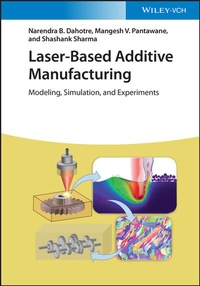
Laser-Based Additive Manufacturing
Modeling, Simulation and Experiments
1st Edition
Published on 31. August 2022
Book
Hardback
304 pages
978-3-527-34791-9 (ISBN)
Description
The book provides a framework for understanding materials processing during laser-based additive manufacturing by computational modeling and simulations. It thereby enables the users of this technique to improve the compositional, phase and microstructural evolution within the material and the subsequent mechanical, chemical, and functional properties of the manufactured components.
More details
Edition
1. Auflage
Language
English
Place of publication
Berlin
Germany
Target group
Professional and scholarly
Illustrations
15
4 s/w Abbildungen, 11 farbige Abbildungen
Dimensions
Height: 24.4 cm
Width: 17 cm
Thickness: 2.1 cm
Weight
728 gr
ISBN-13
978-3-527-34791-9 (9783527347919)
Schweitzer Classification
Other editions
Additional editions
Narendra B. Dahotre | Mangesh V. Pantawane | Shashank Sharma
Laser-Based Additive Manufacturing
Modeling, Simulation and Experiments
E-Book
08/2022
1st Edition
Wiley-VCH
€129.99
Available for download
Narendra B. Dahotre | Mangesh V. Pantawane | Shashank Sharma
Laser-Based Additive Manufacturing
Modeling, Simulation and Experiments
E-Book
08/2022
1st Edition
Wiley-VCH
€129.99
Available for download
Persons
Narendra B. Dahotre is Regents Professor in the Department of Materials Science and Engineering at the University of North Texas, USA. Prior to his current position, he held joint faculty appointments with Oak Ridge National Laboratory and the Department of Materials Science and Engineering of the University of Tennessee-Knoxville. He has been recognized for the pioneering contributions to fundamental understanding and engineering of laser materials interactions along with implementation of high-power lasers in materials processing and advanced manufacturing with primary emphasis on surface engineering, additive manufacturing, and machining.
Mangesh V. Pantawane is Research Assistant in the Department of Materials Science and Engineering at the University of North Texas, USA. He has been conducting research on the fundamental understanding of laser-material interactions for physical phenomena involved behind morphological, microstructural and chemical transitions in materials under non- or near-non-equilibrium thermodynamic and kinetic conditions, with a focus on the development of computational models of these transitions.
Mangesh V. Pantawane is Research Assistant in the Department of Materials Science and Engineering at the University of North Texas, USA. He has been conducting research on the fundamental understanding of laser-material interactions for physical phenomena involved behind morphological, microstructural and chemical transitions in materials under non- or near-non-equilibrium thermodynamic and kinetic conditions, with a focus on the development of computational models of these transitions.
Content
1 INTRODUCTION TO ADDITIVE MANUFACTURING
1.1 Manufacturing Techniques
1.2 What is Additive Manufacturing (AM)?
1.3 Laser-based Additive Manufacturing (LAM)?
1.4 Advantages of AM over Conventional Manufacturing
1.5 Current Challenges Associated with AM
1.6 Importance of Computational Modeling in AM
1.7 References
2 COMPUTATIONAL MATERIALS SCIENCE
2.1 Introduction to Computational Materials Science
2.2 Length- and Time-Scale in Materials Modeling
2.3 Current State of Computational Modeling in LAM
2.4 References
3 LASER-MATERIAL INTERACTION IN LAM
3.1 Conversion of Light Energy to Heat
3.2 Modes of Heat Dissipation
3.3 Dynamics of the Melt-Pool
3.4 References
4 MICROSTRUCTURAL AND MECHANICAL ASPECTS IN LAM INTEGRATED WITH MODELING
4.1 Solidification
4.2 Microstructural Variation and its Prediction
4.3 Effects of Laser Parameters
4.4 Scanning Strategy and Texture Evolution in the Microstructure
4.5 Mechanical Properties
5 RESIDUAL STRESSES AND THREE-DIMENSIONAL DEFECTS IN LAM
5.1 Design of Precursors in LAM
5.2 Thermal Stress Modeling
5.3 Optimum Laser Parameters and Scanning Strategy Prediction by Modeling
5.4 References
6 SURFACE PHYSICAL TEXTURE IN LAM
6.1 Effect of Melt-Pool Dynamics on Surface Texture
6.2 Surface Physical Texture Variation in LAM
6.3 References
1.1 Manufacturing Techniques
1.2 What is Additive Manufacturing (AM)?
1.3 Laser-based Additive Manufacturing (LAM)?
1.4 Advantages of AM over Conventional Manufacturing
1.5 Current Challenges Associated with AM
1.6 Importance of Computational Modeling in AM
1.7 References
2 COMPUTATIONAL MATERIALS SCIENCE
2.1 Introduction to Computational Materials Science
2.2 Length- and Time-Scale in Materials Modeling
2.3 Current State of Computational Modeling in LAM
2.4 References
3 LASER-MATERIAL INTERACTION IN LAM
3.1 Conversion of Light Energy to Heat
3.2 Modes of Heat Dissipation
3.3 Dynamics of the Melt-Pool
3.4 References
4 MICROSTRUCTURAL AND MECHANICAL ASPECTS IN LAM INTEGRATED WITH MODELING
4.1 Solidification
4.2 Microstructural Variation and its Prediction
4.3 Effects of Laser Parameters
4.4 Scanning Strategy and Texture Evolution in the Microstructure
4.5 Mechanical Properties
5 RESIDUAL STRESSES AND THREE-DIMENSIONAL DEFECTS IN LAM
5.1 Design of Precursors in LAM
5.2 Thermal Stress Modeling
5.3 Optimum Laser Parameters and Scanning Strategy Prediction by Modeling
5.4 References
6 SURFACE PHYSICAL TEXTURE IN LAM
6.1 Effect of Melt-Pool Dynamics on Surface Texture
6.2 Surface Physical Texture Variation in LAM
6.3 References