

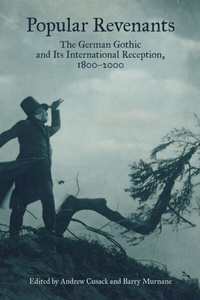
Popular Revenants
The German Gothic and Its International Reception, 1800-2000
1st Edition
Published on 25. June 2012
318 pages
978-1-57113-827-9 (ISBN)
Description

The first book in English on the German Gothic in over thirty years, consisting of new essays investigating the internationality of the Gothic mode.
More details
Other editions
Additional editions
Andrew Cusack | Barry Murnane
Popular Revenants
The German Gothic and Its International Reception, 1800-2000
Book
06/2012
Camden House Inc
€131.50
Shipment within 15-20 days
Persons
Cusack Andrew:
ANDREW CUSACK is Senior Lecturer in German at the University of St Andrews. He worked previously as an Assistant Professor in Dublin before taking a postdoctoral fellowship of the Alexander von Humboldt Foundation at the Humboldt-Universität zu Berlin. In 2012, he joined the University of St Andrews. He is the author of The Wanderer in Nineteenth-Century German Literature: Intellectual History and Cultural Criticism (2008). Together with Barry Murnane he co-edited the volume Popular Revenants: The German Gothic and Its International Reception, 1800-2000 (2012) and has recently co-edited (with Michael White) a volume entitled Der Fontane-Ton: Stil im Werk Theodor Fontanes (2021). He has published widely on a range of topics in the "long nineteenth century" including articles on Büchner, Fontane, Heine, Mörike, Schiller, and on Karl Philipp Moritz. His second monograph: Johannes Scherr: Mediating Culture in the German Nineteenth Century was published by Camden House in 2021.Cusack Andrew:
ANDREW CUSACK is Senior Lecturer in German at the University of St Andrews. He worked previously as an Assistant Professor in Dublin before taking a postdoctoral fellowship of the Alexander von Humboldt Foundation at the Humboldt-Universität zu Berlin. In 2012, he joined the University of St Andrews. He is the author of The Wanderer in Nineteenth-Century German Literature: Intellectual History and Cultural Criticism (2008). Together with Barry Murnane he co-edited the volume Popular Revenants: The German Gothic and Its International Reception, 1800-2000 (2012) and has recently co-edited (with Michael White) a volume entitled Der Fontane-Ton: Stil im Werk Theodor Fontanes (2021). He has published widely on a range of topics in the "long nineteenth century" including articles on Büchner, Fontane, Heine, Mörike, Schiller, and on Karl Philipp Moritz. His second monograph: Johannes Scherr: Mediating Culture in the German Nineteenth Century was published by Camden House in 2021.
ANDREW CUSACK is Senior Lecturer in German at the University of St Andrews. He worked previously as an Assistant Professor in Dublin before taking a postdoctoral fellowship of the Alexander von Humboldt Foundation at the Humboldt-Universität zu Berlin. In 2012, he joined the University of St Andrews. He is the author of The Wanderer in Nineteenth-Century German Literature: Intellectual History and Cultural Criticism (2008). Together with Barry Murnane he co-edited the volume Popular Revenants: The German Gothic and Its International Reception, 1800-2000 (2012) and has recently co-edited (with Michael White) a volume entitled Der Fontane-Ton: Stil im Werk Theodor Fontanes (2021). He has published widely on a range of topics in the "long nineteenth century" including articles on Büchner, Fontane, Heine, Mörike, Schiller, and on Karl Philipp Moritz. His second monograph: Johannes Scherr: Mediating Culture in the German Nineteenth Century was published by Camden House in 2021.Cusack Andrew:
ANDREW CUSACK is Senior Lecturer in German at the University of St Andrews. He worked previously as an Assistant Professor in Dublin before taking a postdoctoral fellowship of the Alexander von Humboldt Foundation at the Humboldt-Universität zu Berlin. In 2012, he joined the University of St Andrews. He is the author of The Wanderer in Nineteenth-Century German Literature: Intellectual History and Cultural Criticism (2008). Together with Barry Murnane he co-edited the volume Popular Revenants: The German Gothic and Its International Reception, 1800-2000 (2012) and has recently co-edited (with Michael White) a volume entitled Der Fontane-Ton: Stil im Werk Theodor Fontanes (2021). He has published widely on a range of topics in the "long nineteenth century" including articles on Büchner, Fontane, Heine, Mörike, Schiller, and on Karl Philipp Moritz. His second monograph: Johannes Scherr: Mediating Culture in the German Nineteenth Century was published by Camden House in 2021.
Content
Introduction - Andrew Cusack
Haunting (Literary) History: An Introduction toGerman Gothic - Barry Murnane
"The echo of the question, as if it had merely resoundedin a tomb": The Dark Anthropology of the Schauerroman in Schiller's Der Geisterseher - Jürgen Barkhoff
Blaming the Other: English Translations of Benedikte Naubert's Hermann von Unna (1788/1794) - Silke Arnold-de Simine
Scott, Hoffmann, and the Persistence of the Gothic - Victor Sage
Cultural Transfer in the Dublin University Magazine: James Clarence Mangan and the German Gothic - Andrew Cusack
In the Maelstrom of Interpretation: Reshaping Terror and Horror between 1798 and 1838 - Gleich, Hoffmann, Poe - Mario Grizelj
Popular Ghosts: Heinrich Heine on German Geistesgeschichteas Gothic Novel - Jorg Kreienbrock
The Spirit World of Art and Robert Schumann's Gothic Novel Project: The Impact of Gothic Literature onSchumann's Writings - Monika Schmitz-Emans
About Face: E. T. A. Hoffmann, Weimar Film, and theTechnological Afterlife of Gothic Physiognomy - Andrew J. Webber
Of Rats, Wolves, and Men: The Pied Piper as Gothic Revenantand Provenant in Wilhelm Raabe's Die Hämelschen Kinder - Peter Arnds
The Lady in White or the Laws of the Ghost in Theodor Fontane's Vor dem Sturm - Matthias Bickenbach
On Golems and Ghosts: Prague as a Site of Gothic Modernism - Barry Murnane
"Ein Gespenst geht um": Christa Wolf, Irina Liebmann, and the Post-Wall Gothic - Catherine Smale
Works Cited
Notes on Contributors
Index
Haunting (Literary) History: An Introduction toGerman Gothic - Barry Murnane
"The echo of the question, as if it had merely resoundedin a tomb": The Dark Anthropology of the Schauerroman in Schiller's Der Geisterseher - Jürgen Barkhoff
Blaming the Other: English Translations of Benedikte Naubert's Hermann von Unna (1788/1794) - Silke Arnold-de Simine
Scott, Hoffmann, and the Persistence of the Gothic - Victor Sage
Cultural Transfer in the Dublin University Magazine: James Clarence Mangan and the German Gothic - Andrew Cusack
In the Maelstrom of Interpretation: Reshaping Terror and Horror between 1798 and 1838 - Gleich, Hoffmann, Poe - Mario Grizelj
Popular Ghosts: Heinrich Heine on German Geistesgeschichteas Gothic Novel - Jorg Kreienbrock
The Spirit World of Art and Robert Schumann's Gothic Novel Project: The Impact of Gothic Literature onSchumann's Writings - Monika Schmitz-Emans
About Face: E. T. A. Hoffmann, Weimar Film, and theTechnological Afterlife of Gothic Physiognomy - Andrew J. Webber
Of Rats, Wolves, and Men: The Pied Piper as Gothic Revenantand Provenant in Wilhelm Raabe's Die Hämelschen Kinder - Peter Arnds
The Lady in White or the Laws of the Ghost in Theodor Fontane's Vor dem Sturm - Matthias Bickenbach
On Golems and Ghosts: Prague as a Site of Gothic Modernism - Barry Murnane
"Ein Gespenst geht um": Christa Wolf, Irina Liebmann, and the Post-Wall Gothic - Catherine Smale
Works Cited
Notes on Contributors
Index
