

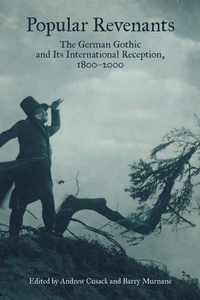
Popular Revenants
The German Gothic and Its International Reception, 1800-2000
Published on 25. June 2012
Book
Hardback
318 pages
978-1-57113-519-3 (ISBN)
Description
The first book in English on the German Gothic in over thirty years, consisting of new essays investigating the internationality of the Gothic mode.
The literary mode of the Gothic is well established in English Studies, and there is growing interest in its internationality. Gothic fiction is seen as transgressive, especially in the way it crosses borders, often illicitly -- for instance, in the form of plagiarized texts or pseudo-translations of nonexistent sources. In the 1790s, when the English Gothic novel was emerging, the real or ostensible source of many of these uncanny texts was Germany. Thisfirst book in English dedicated to the German Gothic in over thirty years is aimed at students and researchers in German Studies and English Studies, and redresses deficiencies in existing sources, which are outdated, piecemeal, or not sufficiently grounded in German Studies.
The book examines the international reception of German Gothic since the 1790s heyday of the Gothic novel in Britain and Germany; traces a line of Gothic writing in German to thepresent day; and inquires into the extraliterary impact of German Gothic. Thus the essays do full justice to the Gothic as a site of conflict and exchange -- both between cultures and between discourses.
Contributors:Peter Arnds, Silke Arnold-de Simine, Juergen Barkhoff, Matthias Bickenbach, Andrew Cusack, Mario Grizelj, Joerg Kreienbrock, Barry Murnane, Victor Sage, Monika Schmitz-Emans, Catherine Smale, Andrew Webber
Andrew Cusack is Alexander von Humboldt Research Fellow at the Institut fuer Kulturwissenschaft of the Humboldt-Universitaet Berlin. Barry Murnane is Assistant Professor of German and Comparative Literature at the Martin-Luther-Universitaet Halle-Wittenberg, Germany.
The literary mode of the Gothic is well established in English Studies, and there is growing interest in its internationality. Gothic fiction is seen as transgressive, especially in the way it crosses borders, often illicitly -- for instance, in the form of plagiarized texts or pseudo-translations of nonexistent sources. In the 1790s, when the English Gothic novel was emerging, the real or ostensible source of many of these uncanny texts was Germany. Thisfirst book in English dedicated to the German Gothic in over thirty years is aimed at students and researchers in German Studies and English Studies, and redresses deficiencies in existing sources, which are outdated, piecemeal, or not sufficiently grounded in German Studies.
The book examines the international reception of German Gothic since the 1790s heyday of the Gothic novel in Britain and Germany; traces a line of Gothic writing in German to thepresent day; and inquires into the extraliterary impact of German Gothic. Thus the essays do full justice to the Gothic as a site of conflict and exchange -- both between cultures and between discourses.
Contributors:Peter Arnds, Silke Arnold-de Simine, Juergen Barkhoff, Matthias Bickenbach, Andrew Cusack, Mario Grizelj, Joerg Kreienbrock, Barry Murnane, Victor Sage, Monika Schmitz-Emans, Catherine Smale, Andrew Webber
Andrew Cusack is Alexander von Humboldt Research Fellow at the Institut fuer Kulturwissenschaft of the Humboldt-Universitaet Berlin. Barry Murnane is Assistant Professor of German and Comparative Literature at the Martin-Luther-Universitaet Halle-Wittenberg, Germany.
Reviews / Votes
The collection as a whole points to the demand for a broader critical discourse on the Gothic within Germanistik and to some of the main questions that derive from here: how to trace the 'birth' of the German Gothic from the affect-based spirit of the late Enlightenment; how to chart its strategies of production and dissemination against terminological confusions, gaps, and silences in its international reception; and how to construct its diverse cultural genealogies beyond the framework of literary romanticism. * SEMINAR * [A] splendid collection of critical essays in the field of reception theory. . . . [A]n impressive assembly of critical voices, whose first-rate scholarly contribution is meant to last. * BRITISH ASSOCIATION FOR ROMANTIC STUDIES BULLETIN AND REVIEW * [T]he volume shows in a convincing and highly interesting way the legacy of the German Schauerroman, not only in other literatures but also in German from the early nineteenth century to the present. * YEAR'S WORK IN MODERN LANGUAGE STUDIES * [P]rovides concrete evidence of Slavoj Zizek's claim, in Paul A. Taylor's words, that 'a full understanding of what it is to experience reality as a human being requires acknowledgment that the spectral has a very real effect. -- Michael Minden * MODERN LANGUAGE REVIEW * [A] polished, cohesive body of work . . . . Overall Cusack and Murnane have succeeded in assembling an important volume that addresses a significant lack in German Studies scholarship. . . . With its useful methodology and rich body of research, Popular Revenants will hopefully pave the way for future studies into the influence of German gothic 'revenants' . . . . * JOURNAL OF EUROPEAN STUDIES * [The editors] gather 13 essays that plumb the production of writers like Schiller, Heine, Schumann, Poe, Walter Scott, Hoffmann, and Raabe. . . . A worthy reentry into a forgotten field, this study with its fine index, footnotes, and comprehensive bibliography fills an egregious lacuna. . . . Recommended. * CHOICE * [A]n indispensable, highly relevant guide that clearly shows the strong influence of the Germanic strain of horror on the genre we know today. * RUE MORGUE MAGAZINE *More details
Series
Language
English
Place of publication
Columbia, MD
United States
Publishing group
Boydell & Brewer Ltd
Target group
Professional and scholarly
Product notice
Cloth over boards
Dimensions
Height: 235 mm
Width: 158 mm
Thickness: 29 mm
Weight
646 gr
ISBN-13
978-1-57113-519-3 (9781571135193)
Copyright in bibliographic data and cover images is held by Nielsen Book Services Limited or by the publishers or by their respective licensors: all rights reserved.
Schweitzer Classification
Other editions
Additional editions
Andrew Cusack | Barry Murnane
Popular Revenants
The German Gothic and Its International Reception, 1800-2000
E-Book
06/2012
1st Edition
De Gruyter
€48.99
Available for download
Persons
ANDREW CUSACK is Senior Lecturer in German at the University of St Andrews, UK ANDREW CUSACK is Senior Lecturer in German at the University of St Andrews, UK
Content
Introduction - Andrew Cusack
Haunting (Literary) History: An Introduction toGerman Gothic - Barry Murnane
"The echo of the question, as if it had merely resoundedin a tomb": The Dark Anthropology of the Schauerroman in Schiller's Der Geisterseher - Juergen Barkhoff
Blaming the Other: English Translations of Benedikte Naubert's Hermann von Unna (1788/1794) - Silke Arnold-de Simine
Scott, Hoffmann, and the Persistence of the Gothic - Victor Sage
Cultural Transfer in the Dublin University Magazine: James Clarence Mangan and the German Gothic - Andrew Cusack
In the Maelstrom of Interpretation: Reshaping Terror and Horror between 1798 and 1838 - Gleich, Hoffmann, Poe - Mario Grizelj
Popular Ghosts: Heinrich Heine on German Geistesgeschichteas Gothic Novel - Jorg Kreienbrock
The Spirit World of Art and Robert Schumann's Gothic Novel Project: The Impact of Gothic Literature onSchumann's Writings - Monika Schmitz-Emans
About Face: E. T. A. Hoffmann, Weimar Film, and theTechnological Afterlife of Gothic Physiognomy - Andrew J. Webber
Of Rats, Wolves, and Men: The Pied Piper as Gothic Revenantand Provenant in Wilhelm Raabe's Die Haemelschen Kinder - Peter Arnds
The Lady in White or the Laws of the Ghost in Theodor Fontane's Vor dem Sturm - Matthias Bickenbach
On Golems and Ghosts: Prague as a Site of Gothic Modernism - Barry Murnane
"Ein Gespenst geht um": Christa Wolf, Irina Liebmann, and the Post-Wall Gothic - Catherine Smale
Works Cited
Notes on Contributors
Index
Haunting (Literary) History: An Introduction toGerman Gothic - Barry Murnane
"The echo of the question, as if it had merely resoundedin a tomb": The Dark Anthropology of the Schauerroman in Schiller's Der Geisterseher - Juergen Barkhoff
Blaming the Other: English Translations of Benedikte Naubert's Hermann von Unna (1788/1794) - Silke Arnold-de Simine
Scott, Hoffmann, and the Persistence of the Gothic - Victor Sage
Cultural Transfer in the Dublin University Magazine: James Clarence Mangan and the German Gothic - Andrew Cusack
In the Maelstrom of Interpretation: Reshaping Terror and Horror between 1798 and 1838 - Gleich, Hoffmann, Poe - Mario Grizelj
Popular Ghosts: Heinrich Heine on German Geistesgeschichteas Gothic Novel - Jorg Kreienbrock
The Spirit World of Art and Robert Schumann's Gothic Novel Project: The Impact of Gothic Literature onSchumann's Writings - Monika Schmitz-Emans
About Face: E. T. A. Hoffmann, Weimar Film, and theTechnological Afterlife of Gothic Physiognomy - Andrew J. Webber
Of Rats, Wolves, and Men: The Pied Piper as Gothic Revenantand Provenant in Wilhelm Raabe's Die Haemelschen Kinder - Peter Arnds
The Lady in White or the Laws of the Ghost in Theodor Fontane's Vor dem Sturm - Matthias Bickenbach
On Golems and Ghosts: Prague as a Site of Gothic Modernism - Barry Murnane
"Ein Gespenst geht um": Christa Wolf, Irina Liebmann, and the Post-Wall Gothic - Catherine Smale
Works Cited
Notes on Contributors
Index