

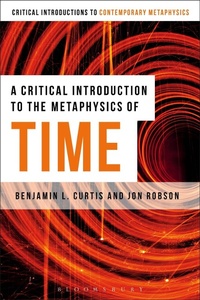
A Critical Introduction to the Metaphysics of Time
1st Edition
Published on 11. February 2016
256 pages
978-1-4725-6687-4 (ISBN)
Description

What is the nature of time? Does it flow? Do the past and future exist? Drawing connections between historical and present-day questions, A Critical Introduction to the Metaphysics of Time provides an up-to-date guide to one of the most central and debated topics in contemporary metaphysics.
Introducing the views and arguments of Parmenides, Plato, Aristotle, Descartes, Newton and Leibniz, this accessible introduction covers the history of the philosophy of time from the Pre-Socratics to the beginning of the 20th Century. The historical survey presents the necessary background to understanding more recent developments, including McTaggart's 1908 argument for the unreality of time, the open future, the perdurance/endurance debate, the possibility of time travel, and the relevance of current physics to the philosophy of time.
Informed by cutting-edge philosophical research, A Critical Introduction to the Metaphysics of Time evaluates influential historical arguments in the context of contemporary developments. For students looking to gain insights into how ideas within the philosophy of time have developed and better understand recent arguments, this is the ideal starting point.
Introducing the views and arguments of Parmenides, Plato, Aristotle, Descartes, Newton and Leibniz, this accessible introduction covers the history of the philosophy of time from the Pre-Socratics to the beginning of the 20th Century. The historical survey presents the necessary background to understanding more recent developments, including McTaggart's 1908 argument for the unreality of time, the open future, the perdurance/endurance debate, the possibility of time travel, and the relevance of current physics to the philosophy of time.
Informed by cutting-edge philosophical research, A Critical Introduction to the Metaphysics of Time evaluates influential historical arguments in the context of contemporary developments. For students looking to gain insights into how ideas within the philosophy of time have developed and better understand recent arguments, this is the ideal starting point.
More details
Series
Edition
1. Auflage
Language
English
Place of publication
London
United Kingdom
Publishing group
Bloomsbury Publishing PLC
Target group
Professional and scholarly
College/higher education
ISBN-13
978-1-4725-6687-4 (9781472566874)
Copyright in bibliographic data and cover images is held by Nielsen Book Services Limited or by the publishers or by their respective licensors: all rights reserved.
Schweitzer Classification
Other editions
Additional editions
Benjamin Curtis | Jon Robson
A Critical Introduction to the Metaphysics of Time
Book
02/2016
Bloomsbury Academic
€64.56
Shipment within 15-20 days
Benjamin Curtis | Jon Robson
A Critical Introduction to the Metaphysics of Time
Book
02/2016
Bloomsbury Academic
€177.70
Shipment within 15-20 days
Persons
Benjamin L. Curtis is Lecturer/Senior Lecturer in philosophy at Nottingham Trent University, UK.
Jon Robson is a Teaching Associate in philosophy at the University of Nottingham, UK.
Jon Robson is a Teaching Associate in philosophy at the University of Nottingham, UK.
Content
Introduction
1.The Ancient History
2.The Modern History
3. McTaggart and the Unreality of Time
4.The A-Theory and the B-Theory
5. Presentism vs. Eternalism
6.The Open Future
7. Perdurance and Endurance
8.The Experience of Time
9.Time Travel
10. Physics and the Philosophy of Time
Bibliography
Index
1.The Ancient History
2.The Modern History
3. McTaggart and the Unreality of Time
4.The A-Theory and the B-Theory
5. Presentism vs. Eternalism
6.The Open Future
7. Perdurance and Endurance
8.The Experience of Time
9.Time Travel
10. Physics and the Philosophy of Time
Bibliography
Index
