

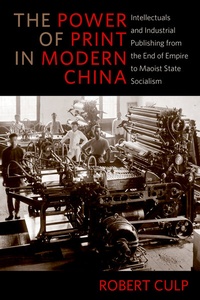
The Power of Print in Modern China
Intellectuals and Industrial Publishing from the End of Empire to Maoist State Socialism
1st Edition
Published on 17. June 2019
392 pages
978-0-231-54535-8 (ISBN)
Description

Amid early twentieth-century China's epochal shifts, a vital and prolific commercial publishing industry emerged. Recruiting late Qing literati, foreign-trained academics, and recent graduates of the modernized school system to work as authors and editors, publishers produced textbooks, reference books, book series, and reprints of classical texts in large quantities at a significant profit. Work for major publishers provided a living to many Chinese intellectuals and offered them a platform to transform Chinese cultural life.
In The Power of Print in Modern China, Robert Culp explores the world of commercial publishing to offer a new perspective on modern China's cultural transformations. Culp examines China's largest and most influential publishing companies-Commercial Press, Zhonghua Book Company, and World Book Company-during the late Qing and Republican periods and into the early years of the People's Republic. He reconstructs editors' cultural activities and work lives as a lens onto the role of intellectuals in cultural change. Examining China's distinct modes of industrial publishing, Culp explains the emergence of the modern Chinese intellectual through commercial and industrial processes rather than solely through political revolution and social movements. An original account of Chinese intellectual and cultural history as well as global book history, The Power of Print in Modern China illuminates the production of new forms of knowledge and culture in the twentieth century.
In The Power of Print in Modern China, Robert Culp explores the world of commercial publishing to offer a new perspective on modern China's cultural transformations. Culp examines China's largest and most influential publishing companies-Commercial Press, Zhonghua Book Company, and World Book Company-during the late Qing and Republican periods and into the early years of the People's Republic. He reconstructs editors' cultural activities and work lives as a lens onto the role of intellectuals in cultural change. Examining China's distinct modes of industrial publishing, Culp explains the emergence of the modern Chinese intellectual through commercial and industrial processes rather than solely through political revolution and social movements. An original account of Chinese intellectual and cultural history as well as global book history, The Power of Print in Modern China illuminates the production of new forms of knowledge and culture in the twentieth century.
All prices
More details
Other editions
Additional editions
Robert Culp
The Power of Print in Modern China
Intellectuals and Industrial Publishing from the End of Empire to Maoist State Socialism
Book
05/2019
Columbia University Press
€68.09
Article not available at the moment
Person
Robert Culp is associate professor of history and Asian studies at Bard College. His books include Articulating Citizenship: Civic Education and Student Politics in Southeastern China, 1912-1940 (2007).
Content
List of Figures
Acknowledgments
List of Abbreviations
Introduction
Part I. Recruiting Talent, Mobilizing Labor
1. Becoming Editors: Late Qing Literati's Scholarly Lives and Cultural Production
2. Universities or Factories? Academics, Petty Intellectuals, and the Industrialization of Mental Labor
Part I Epilogue: War, Revolution, Hiatus
Part II. Creating Culture
3. Transforming Word and Concept Through Textbooks and Dictionaries
4. Repackaging the Past: Reproducing Classics Through Industrial Publishing
5. Introducing New Worlds of Knowledge: Series Publications and the Transformation of China's Knowledge Culture
Part III. Legacies of Industrialized Cultural Production
6. Print Industrialism and State Socialism: Public-Private Joint Management and Divisions of Labor in the Early PRC Publishing Industry
7. Negotiated Cultural Production in the Pedagogical State
Conclusion
Notes
Bibliography
Index
Acknowledgments
List of Abbreviations
Introduction
Part I. Recruiting Talent, Mobilizing Labor
1. Becoming Editors: Late Qing Literati's Scholarly Lives and Cultural Production
2. Universities or Factories? Academics, Petty Intellectuals, and the Industrialization of Mental Labor
Part I Epilogue: War, Revolution, Hiatus
Part II. Creating Culture
3. Transforming Word and Concept Through Textbooks and Dictionaries
4. Repackaging the Past: Reproducing Classics Through Industrial Publishing
5. Introducing New Worlds of Knowledge: Series Publications and the Transformation of China's Knowledge Culture
Part III. Legacies of Industrialized Cultural Production
6. Print Industrialism and State Socialism: Public-Private Joint Management and Divisions of Labor in the Early PRC Publishing Industry
7. Negotiated Cultural Production in the Pedagogical State
Conclusion
Notes
Bibliography
Index

