

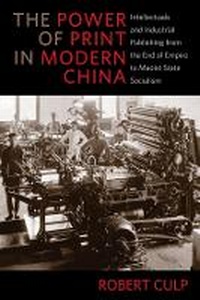
The Power of Print in Modern China
Intellectuals and Industrial Publishing from the End of Empire to Maoist State Socialism
Will be published approx. on 28. May 2019
Book
Hardback
392 pages
978-0-231-18416-8 (ISBN)
Description
Amid early twentieth-century China's epochal shifts, a vital and prolific commercial publishing industry emerged. Recruiting late Qing literati, foreign-trained academics, and recent graduates of the modernized school system to work as authors and editors, publishers produced textbooks, reference books, book series, and reprints of classical texts in large quantities at a significant profit. Work for major publishers provided a living to many Chinese intellectuals and offered them a platform to transform Chinese cultural life.
In The Power of Print in Modern China, Robert Culp explores the world of commercial publishing to offer a new perspective on modern China's cultural transformations. Culp examines China's largest and most influential publishing companies-Commercial Press, Zhonghua Book Company, and World Book Company-during the late Qing and Republican periods and into the early years of the People's Republic. He reconstructs editors' cultural activities and work lives as a lens onto the role of intellectuals in cultural change. Examining China's distinct modes of industrial publishing, Culp explains the emergence of the modern Chinese intellectual through commercial and industrial processes rather than solely through political revolution and social movements. An original account of Chinese intellectual and cultural history as well as global book history, The Power of Print in Modern China illuminates the production of new forms of knowledge and culture in the twentieth century.
In The Power of Print in Modern China, Robert Culp explores the world of commercial publishing to offer a new perspective on modern China's cultural transformations. Culp examines China's largest and most influential publishing companies-Commercial Press, Zhonghua Book Company, and World Book Company-during the late Qing and Republican periods and into the early years of the People's Republic. He reconstructs editors' cultural activities and work lives as a lens onto the role of intellectuals in cultural change. Examining China's distinct modes of industrial publishing, Culp explains the emergence of the modern Chinese intellectual through commercial and industrial processes rather than solely through political revolution and social movements. An original account of Chinese intellectual and cultural history as well as global book history, The Power of Print in Modern China illuminates the production of new forms of knowledge and culture in the twentieth century.
Reviews / Votes
Rich, meticulous, and sparkling with insight, this work further cements Culp's position as perhaps the foremost scholar of modern Chinese print culture, knowledge formation, and intellectual history working today. -- Thomas S. Mullaney, author of <i>The Chinese Typewriter: A History</i> The Power of Print in Modern China is unprecedented in its richly researched account of the three publishing powerhouses that helped establish the terms of modern Chinese discourse from the early twentieth century through the 1960s. In tracking multiple dimensions of this tumultuous trajectory, Culp is attentive to the complex ways both vestiges of late imperial culture and the economic imperatives of industrial capitalism shaped Chinese publishing and reshaped understandings of intellectual labor. -- Joan Judge, author of <i>Republican Lens: Gender, Visuality, and Experience in the Early Chinese Periodical Press</i> Comprehensive, well organized, and theoretically informed, The Power of Print in Modern China looks at the Chinese publishing industry, through its three major houses, from the inside out. The book highlights the surprising continuities found in the publishing industry from the late Qing into the early communist era until it was, in effect, destroyed in the Cultural Revolution. This is an important contribution to the social, cultural, and business history of modern China. -- Peter Zarrow, author of <i>Educating China: Knowledge, Society and Textbooks in a Modernizing World, 1902-1937</i> This groundbreaking work on the industrialization of book publishing in China's twentieth century resets the agenda of modern Chinese intellectual history. It offers a multifaceted interpretation about knowledge as work in the making of a pedagogical state under socialism. This is a must read for all concerned with issues about the state, knowledge professionals, and the structural transformation of the public sphere. -- Wen-hsin Yeh, University of California, Berkeley In his new book The Power of Print in Modern China, with the usual adagio of words, Robert Culp unfolds to us the radical changes in the Chinese knowledge system through commercial publishing from the early twentieth century to the 1960s. -- Lara Yuyu Yang * The PRC History Review * A must-read for anyone interested in print, power, modernity, or their interplay in China, and for anyone who might want to stroll through twentieth-century Chinese intellectual history with a new set of companions and not the usual suspects. * Modern Chinese Literature and Culture * [A] lively account. * Times Literary Supplement * It is fascinating to read about how ideas and hard work by enthusiastic and skillful people with physical tools created by mankind, as indicated by the cover of this book, are able to form a driving social force that moves the civilization forward. * Publishing Research Quarterly * A great contribution, not only to the field of Chinese studies but also to media studies. * MEDIENwissenschaft * Highly recommended for specialists of modern Chinese intellectual and cultural history, with classroom applications for instructors working with more advanced graduate students. * East Asian Journal of Popular Culture *More details
Series
Language
English
Place of publication
New York
United States
Target group
Professional and scholarly
Product notice
Trade binding
Illustrations
15 b&w illustrations
Dimensions
Height: 229 mm
Width: 152 mm
ISBN-13
978-0-231-18416-8 (9780231184168)
Copyright in bibliographic data and cover images is held by Nielsen Book Services Limited or by the publishers or by their respective licensors: all rights reserved.
Schweitzer Classification
Other editions
Additional editions
Robert Culp
The Power of Print in Modern China
Intellectuals and Industrial Publishing from the End of Empire to Maoist State Socialism
E-Book
06/2019
1st Edition
Columbia University Press
from
€56.95
Available for download
Person
Robert Culp is associate professor of history and Asian studies at Bard College. His books include Articulating Citizenship: Civic Education and Student Politics in Southeastern China, 1912-1940 (2007).
Content
List of Figures
Acknowledgments
List of Abbreviations
Introduction
Part I. Recruiting Talent, Mobilizing Labor
1. Becoming Editors: Late Qing Literati's Scholarly Lives and Cultural Production
2. Universities or Factories? Academics, Petty Intellectuals, and the Industrialization of Mental Labor
Part I Epilogue: War, Revolution, Hiatus
Part II. Creating Culture
3. Transforming Word and Concept Through Textbooks and Dictionaries
4. Repackaging the Past: Reproducing Classics Through Industrial Publishing
5. Introducing New Worlds of Knowledge: Series Publications and the Transformation of China's Knowledge Culture
Part III. Legacies of Industrialized Cultural Production
6. Print Industrialism and State Socialism: Public-Private Joint Management and Divisions of Labor in the Early PRC Publishing Industry
7. Negotiated Cultural Production in the Pedagogical State
Conclusion
Notes
Bibliography
Index
Acknowledgments
List of Abbreviations
Introduction
Part I. Recruiting Talent, Mobilizing Labor
1. Becoming Editors: Late Qing Literati's Scholarly Lives and Cultural Production
2. Universities or Factories? Academics, Petty Intellectuals, and the Industrialization of Mental Labor
Part I Epilogue: War, Revolution, Hiatus
Part II. Creating Culture
3. Transforming Word and Concept Through Textbooks and Dictionaries
4. Repackaging the Past: Reproducing Classics Through Industrial Publishing
5. Introducing New Worlds of Knowledge: Series Publications and the Transformation of China's Knowledge Culture
Part III. Legacies of Industrialized Cultural Production
6. Print Industrialism and State Socialism: Public-Private Joint Management and Divisions of Labor in the Early PRC Publishing Industry
7. Negotiated Cultural Production in the Pedagogical State
Conclusion
Notes
Bibliography
Index