

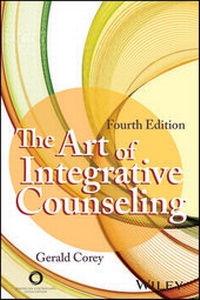
The Art of Integrative Counseling
Description

Useful as a supplemental text in advanced theories and practicum courses, this fourth edition discusses the key concepts and techniques from many contemporary theories and how to develop an integrative approach to the counseling process to better meet individual client needs. Dr. Corey introduces the techniques that he draws from in his own integrative approach to counseling using a wide variety of case examples with diverse clients. Topics covered include assessing presenting issues; developing a productive working alliance; establishing therapeutic goals; understanding and addressing diversity; working with resistant clients; using evidence-based practice in cognitive, emotive, and behavioral work with clients; dealing with transference and countertransference; and incorporating trends in integrative therapies. To encourage active learning, reflective exercises throughout the text provide readers with opportunities to put themselves in the role of therapist and client.
"No one knows more about theory-based counseling than Gerald Corey, who has spent the past 50+ years helping us to gain real insight into multiple models. In this book, Corey takes readers from forming a working alliance with clientsthrough the processes for setting and achieving goals. His skill at and understanding of the termination processes is worth the entire book. Not only will The Art of Integrative Counseling be the core text for counseling process and skills courses, it will provide the foundation for effective, truly integrated counseling throughout one's career." -James Robert Bitter, EdD, East Tennessee State University
"Gerald Corey's fourth edition of The Art of Integrative Counseling provides important concepts to consider when developing an integrative approach to working with clients. For beginning counselors, it demonstrates how one can be integrative whether one is behaviorally, cognitively, or affectively oriented. For more advanced counselors, it reminds them of the wealth of information that all theories offer and how techniques or theories can be synthesized into a more effective approach. Whether you are a new counselor trying to figure out how to integrate the many theories you learned about, or a seasoned professional seeking new ways of working with clients, this book has something for you." -Edward Neukrug, EdD, Old Dominion University *Requests for digital versions from ACA can be found on www.wiley.com.
*To purchase print copies, please visit the ACA website *Reproduction requests for material from books published by ACA should be directed to publications@counseling.org
More details
Other editions
Additional editions
Person
Content
- Intro
- Title Page
- Copyright
- Table of Contents
- Preface
- About the Author
- Acknowledgments
- Chapter 1 The Beginning Stages of Counseling
- An Integrative Theoretical Approach: An Overview
- Becoming the Client: Put Yourself in the Shoes of the Client
- The Initial Counseling Session
- Informed Consent
- Initial Assessment
- Therapeutic Time Limitations
- Initial Sessions and the Case of Gwen
- Intake Session
- Initial Sessions and the Case of Chet
- The Therapeutic Contract
- Initial Assessment
- Concluding Comments
- Chapter 2 The Therapeutic Relationship
- Developing a Working Alliance
- Self-Disclosure in the Therapeutic Relationship
- Your Role as a Counselor in Creating a Working Relationship
- Personal Characteristics of the Counselor
- Action-Oriented Approaches and the Therapeutic Relationship
- Establishing the Therapeutic Relationship
- Helping Clients Gain a Focus
- Becoming the Client: Sharing in a Collaborative Partnership
- Therapy as a Joint Venture
- The Relationship During the Early Stage of Counseling
- Developing a Therapeutic Alliance With Sidney
- Building the Therapeutic Relationship
- Developing a Therapeutic Alliance With Rita
- Stages of Counseling With Rita
- Concluding Comments
- Chapter 3 Establishing Therapeutic Goals
- Overview of Goals From Various Theoretical Perspectives
- Goals of Some of the Theoretical Perspectives
- Goals From an Integrative Perspective
- An Adlerian Perspective on Goal-Directed Behavior and Goal Setting
- Becoming the Client: Establishing Counseling Goals
- Various Types of Therapeutic Goals
- Clarifying Counseling Goals With Joleen
- Clarifying Counseling Goals With Aaron
- Concluding Comments
- Chapter 4 Understanding and Addressing Diversity
- My Introduction to Multicultural and Diversity Perspectives
- Perspectives on Multicultural Concerns
- Considering How We Are Alike and How We Are Different
- Paying Attention to the Individual
- Diversity as Central in the Counseling Process
- Counseling LGBTQI People
- Recognizing the Spiritual Domain
- Assessing Your Own Spirituality
- Considerations in Counseling Nonreligious Clients
- Becoming the Client: Understanding How to Work With Diversity
- Theories Applied to Understanding Diversity Perspectives
- Contributions From Theoretical Systems
- Understanding Win-May From a Diversity Perspective
- Understanding Gabriel From a Diversity Perspective
- Concluding Comments
- Chapter 5 Understanding and Working With Resistance
- Understanding the Dynamics of Resistance
- Respecting and Reframing Resistance
- Some Perspectives on Understanding Resistance
- Stages of Change
- Understanding How Resistive Behavior Affects You as a Counselor
- Becoming the Client: Experiencing Resistance in Yourself
- Understanding Kelsey's Resistance
- Working With Kelsey's Resistance Using Other Modalities
- Understanding Rico's Resistance
- Guidelines for Dealing With Resistance in Clients
- Concluding Comments
- Chapter 6 Cognitive Focus in Counseling
- Benefits and Limitations of a Cognitive Focus
- Key Concepts and Themes of Cognitive Therapy
- Becoming the Client: Experiencing Cognitive Behavior Techniques
- Paying Attention to Your Thinking
- Cognitive Restructuring
- Designing Homework or Between-Sessions Assignments
- Drawing on Adlerian Concepts
- Working With Marissa From a Cognitive Behavior Perspective
- Cognitive Interventions With Marissa
- Current Status of Marissa
- Working With Erv From a Cognitive Behavior Perspective
- Concluding Comments
- Chapter 7 Emotive Focus in Counseling
- Experiential Approaches and the Role of Emotion in Therapy
- Emotion-Focused Therapy
- Existential Therapy
- Person-Centered Therapy
- Gestalt Therapy
- Becoming the Client: Experiencing Emotion-Focused Therapy
- Working With Elaine in Identifying and Exploring Feelings
- Working With Andrew in Identifying and Exploring Feelings
- Concluding Comments
- Chapter 8 Behavioral Focus in Counseling
- Benefits and Limitations of a Behavioral Focus
- Multimodal Therapy: Assessment and Therapy Goals
- The Third Wave of Behavior Therapy
- Mindfulness and Acceptance in Psychotherapy
- Dialectical Behavior Therapy
- Mindfulness-Based Stress Reduction
- Mindfulness-Based Cognitive Therapy
- Acceptance and Commitment Therapy
- Using Mindfulness and Acceptance in an Integrative Approach
- Becoming the Client: Experiencing Behavior-Oriented Therapy
- Developing a Behavioral Contract
- Working With Shante Using a Behavioral Focus
- Working With Marlin Using a Behavioral Focus
- Concluding Comments
- Chapter 9 An Integrative Perspective
- Searching for Common Factors Across Therapy Schools
- The Foundation of My Integrative Approach
- Existential Therapy as a Philosophical Base
- Gestalt Therapy: A Holistic Perspective
- Psychodrama: An Integrative Approach
- Drawing on the Action-Oriented Therapies
- Adlerian Therapy
- Behavior Therapy
- Cognitive Behavior Therapy
- Reality Therapy/Choice Theory
- Solution-Focused Brief Therapy
- Motivational Interviewing
- Drawing on Feminist and Family Systems Approaches
- Feminist Therapy
- Family Systems Theories
- Becoming the Client: Becoming the Person You Want to Be
- Working With Petra From an Integrative Perspective
- Factors in Case Conceptualization With Petra
- Exploring Family Rules, Messages, and Early Childhood Decisions
- Petra's Existential Quest
- Feminist Perspective
- Encouraging Petra to Act
- A Basis for Selecting Techniques With Petra
- Moving Toward Termination
- Couples Counseling in an Integrative Way: Lani and Rob
- The Focus on Working With a Couple
- Applying an Integrative Approach in Couples Therapy
- Creating an Action Plan as a Couple
- Study a Primary Theory-But Be Open to Integration
- Benefits and Limitations of Integration
- Concluding Comments
- Chapter 10 Working With Transference and Countertransference
- Contrasting Views of Transference
- The Connection Between Transference and Countertransference
- Working With Transference Therapeutically
- Examples of Transference
- Addressing Countertransference Issues
- Personal Therapy as a Way to Understand Our Countertransference
- Becoming the Client: The Value of Personal Therapy
- Working With Transference and Countertransference With Matt
- Working With a Challenging Client
- The Interplay of Transference and Countertransference
- Therapeutic Interventions
- Working With Transference and Countertransference With Bonnie
- Concluding Comments
- Chapter 11 Understanding How the Past Influences the Present and the Future
- Understanding How the Past, Present, and Future Are Intertwined
- Bringing the Past Into the Present
- Envisioning the Future
- Becoming the Client: Examining Your Past, Present, and Future
- Working With Tricia's Past, Present, and Future
- Dealing With the Past in an Integrative Style
- Dealing With the Present in an Integrative Style
- Dealing With the Future in an Integrative Style
- Working With Jasper's Past, Present, and Future
- Forming and Maintaining Intimate Relationships
- Dealing With Jasper's Past
- Dealing With Jasper's Present
- Dealing With Jasper's Future
- Concluding Comments
- Chapter 12 Evaluation and Termination
- Guidelines for Effective Termination Strategies
- Becoming the Client: Taking Credit for Your Changes
- Evaluation and Termination With Chelsea
- Evaluation and Termination With Charles
- Your Thoughts on Ending the Therapeutic Relationship
- Some Final Thoughts on Psychotherapy Integration
- The Future of Psychotherapy Integration
- The Role of Research in Developing an Integrative Perspective
- Designing Your Personal Integrative Approach
- Concluding Comments
- References
- Index
- Technical Support
- End User License Agreement
Chapter 1
The Beginning Stages of Counseling
Although you may be just starting your practicum or internship in the helping professions, already you may have been asked to answer these questions: "What is your approach to counseling?" "How does your theoretical orientation influence the manner in which you practice?" You will revisit these questions throughout your career in job interviews and self-evaluations.
This book will assist you in conceptualizing what you do as a counseling practitioner and help you clarify your theoretical orientation. I want to stimulate your thinking about the importance of developing an integrative approach to counseling practice that pays attention to what your clients are thinking, feeling, and doing. Combining these three dimensions is the basis for a powerful and comprehensive approach to counseling practice. If any of these dimensions is excluded, the therapeutic approach is incomplete.
It is important to examine the contemporary theories of counseling to determine which concepts and techniques you can incorporate in your approach to practice. Creating your own integrative stance is truly a challenge. You cannot simply pick bits and pieces from theories in a random and fragmented manner. Each theory represents a different vantage point from which to look at human behavior. Study all the major theories, resist too quickly embracing any single point of view, and look for a basis for an integrative perspective that will guide your practice.
A theory is a good road map for understanding the therapy process, but no one theory is best for all clients under all sets of circumstances (Norcross, Goldfried, & Arigo, 2016). Research has clearly established that psychotherapy works and is remarkably effective, but no particular theory or technique has proved to be superior to all others (Wampold, 2010). Each theory has something unique to offer you. There is a growing recognition that counseling and therapy can be most effective when contributions from various approaches are integrated (Goldfried, Glass, & Arnkoff, 2011). Goldfried and colleagues believe that evidence-based practice will increasingly become the organizing force for integration. Empirical pragmatism, rather than theory, will be the integrative theme of the 21st century. In addition, evidence increasingly supports the idea that the therapeutic alliance (the therapeutic relationship) and the therapist as a person are critical factors in determining therapy outcomes (Elkins, 2016; Hubble, Duncan, Miller, & Wampold, 2010; Keenan & Rubin, 2016); these topics are addressed in detail in Chapter 2.
The aim of this book is to assist you in acquiring your own unique perspective on counseling, which will aid you in eventually developing your integrative approach to counseling practice. To develop this kind of integration, you need to be well grounded in a number of theories, be open to the idea that some aspects of these theories can be unified in different ways, be familiar with the research literature in the field of psychotherapy, and be willing to continually test your hypotheses to determine how well they are working. In developing and conceptualizing your integrative counseling approach, consider your own personality, and think about what concepts and techniques work best with a range of clients. Choosing techniques that are suitable for particular problems and for different clients requires knowledge, skill, art, and clinical experience. It is also an art to know when and how to use a particular therapeutic intervention.
To be an effective counselor it is essential that you be willing to take an honest look at your own life. Are you willing to do for yourself what you ask clients to do? It will be difficult to inspire clients to seek help when they need it if you are not open to change in your own life. Your own self-exploration likely will be one of the most important factors in learning how to use many of the techniques in this book. You can learn many ways to creatively intervene with your clients by experiencing what it is like to be a client. (See Chapter 10 for more on the value of personal therapy for counselors in training.) As much as possible, I will ask you to put yourself in the shoes of the client. The "Becoming a Client" sections in this book are useful sources of self-exploration and offer strategies for intervening with your own clients.
An Integrative Theoretical Approach: An Overview
This book represents my own integrative approach to counseling. I define an integrative approach to counseling as being rooted in a theory or theories, with techniques systematically borrowed from other approaches and tailored to a client's unique needs. I am not suggesting that you adopt my conceptualization of theory applied to practice. You will develop your own integrative style based on your personality and the kinds of clients you expect to counsel. By describing my personal orientation to counseling, I hope to provide a framework to assist you in designing a theoretical orientation that makes sense to you.
The early history of counseling was full of theoretical wars as practitioners argued over the "best" way to bring about personality change. Many practitioners and scholars were resistant to psychotherapy integration, often to the point of being blind to alternative theories and ignoring effective methods from other theoretical schools. However, since the 1980s most therapists have seriously considered integrating the best from the various schools. Therapists now acknowledge the limitations inherent in specific theories and the potential value of other theoretical systems. Most practitioners use some form of integration today, and research supports the efficacy of an integrative approach (Norcross et al., 2016). For example, two popular therapeutic approaches are cognitive behavior therapy and motivational interviewing. Naar and Safren (2017) devote an entire book to ways of combining these strategies for maximum effectiveness.
As a student, you can begin the process of developing a style tailored to your own personality by familiarizing yourself with the major approaches to therapeutic practice. Then choose one theory to study in some depth and branch out from there in your search for an integrative style. I recommend that you study in depth the one theory that comes closest to your worldview and values, and use this theory as a foundation for developing your personal orientation. Being grounded in a theory provides an anchor for making sense of what you are doing as a counselor. Without a theoretical foundation you are liable to flounder, and neither you nor your client is likely to experience productive results.
Attempting to practice without having an explicit theoretical rationale is like trying to build a house without a set of blueprints. The foundation of a house needs to be sturdy and strong to support the structure. If you operate in a theoretical vacuum and are unable to draw on theory to support your interventions, your attempts to help people change will have uncertain outcomes. Theory provides a foundation for understanding human nature, developmental processes, learning processes, function and dysfunction, and purposes and motivations. This model is not a rigid set of structures; rather, it provides a general framework that enables you to make sense of the many facets of the counseling process and gives direction to what you do and say.
You need to believe in the basic philosophy of the theory you embrace and that the treatment you are delivering will be effective. Therapists providing a treatment that they find interesting and fits for them are likely to be more effective than therapists who deliver a treatment not to their liking (Wampold, 2010). The treatment needs to be consistent with your beliefs, values, and personality. Ask yourself: "Which treatment delivered by me will be most effective?" (p. 49).
I draw on concepts and techniques from most of the contemporary counseling models. I then adapt them to a style that fits me personally, taking into account the universal thinking, feeling, and behaving dimensions of human experience. I typically ask clients to think about the decisions they have made about themselves. Some of these decisions may have been necessary for their psychological survival as children but may now be ineffective. I encourage clients to pay attention to their "self-talk" and to ask themselves these questions:
- How do your problems reflect the assumptions you make about yourself, about others, and about life?
- How do you create your problems by the thoughts and beliefs to which you cling?
- How can you begin to free yourself by critically evaluating the statements you repeat to yourself?
These interventions help clients think about events in their lives, how they have interpreted those events, and what they need to do cognitively to change their belief systems.
Once clients begin thinking about their problems, they often feel stuck due to unexpressed and unresolved emotional concerns. I encourage clients to experience the range of their feelings and to talk about how certain events have affected them. The healing process is facilitated by using techniques that engage clients' feelings and allow them to feel listened to and understood. In addition to encouraging clients to pay attention to their beliefs and decisions, I ask clients questions about their feelings and behavior:
- Do you ever feel so overwhelmed by your feelings that you think there is little or nothing you can do about...
