

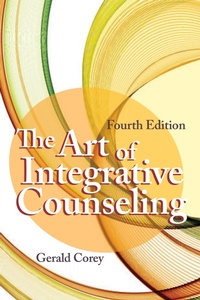
The Art of Integrative Counseling
4th Edition
Published on 1. August 2019
Book
Paperback/Softback
272 pages
978-1-55620-385-5 (ISBN)
Description
Useful as a supplemental text in advanced theories and practicum courses, this fourth edition discusses the key concepts and techniques from many contemporary theories and how to develop an integrative approach to the counseling process to better meet individual client needs. Dr. Corey introduces the techniques that he draws from in his own integrative approach to counseling using a wide variety of case examples with diverse clients. Topics covered include assessing presenting issues; developing a productive working alliance; establishing therapeutic goals; understanding and addressing diversity; working with resistant clients; using evidence-based practice in cognitive, emotive, and behavioral work with clients; dealing with transference and countertransference; and incorporating trends in integrative therapies. To encourage active learning, reflective exercises throughout the text provide readers with opportunities to put themselves in the role of therapist and client.
More details
Edition
4th New edition
Language
English
Place of publication
Alexandria, VA
United States
Target group
Professional and scholarly
Edition type
New edition
Product notice
Paperback (trade)
Illustrations
Illustrations
Dimensions
Height: 226 mm
Width: 150 mm
Thickness: 15 mm
Weight
907 gr
ISBN-13
978-1-55620-385-5 (9781556203855)
Copyright in bibliographic data and cover images is held by Nielsen Book Services Limited or by the publishers or by their respective licensors: all rights reserved.
Schweitzer Classification
Other editions
Additional editions
Gerald Corey
The Art of Integrative Counseling
E-Book
08/2018
4th Edition
Wiley
€62.99
Available for download
Gerald Corey
The Art of Integrative Counseling
E-Book
08/2018
4th Edition
Wiley
€62.99
Available for download
Person
GERALD COREY is Professor Emeritus of Human Services and Counseling at California State University at Fullerton. He received his doctorate in counseling from the University of Southern California. He is a Diplomate in Counseling Psychology, American Board of Professional Psychology; a licensed psychologist; a National Certified Counselor; a Fellow of the American Psychological Association (Counseling Psychology); a Fellow of the American Counseling Association; and a Fellow of the Association for Specialists in Group Work (ASGW). Along with his wife, Marianne Schneider Corey, Jerry received the Lifetime Achievement Award from the American Mental Health Counselors Association in 2011 and the Eminent Career Award from ASGW in 2001. He also received the Outstanding Professor of the Year Award from California State University at Fullerton in 1991. He regularly teaches both undergraduate and graduate courses in group counseling and ethics in counseling. He is the author or coauthor of 16 textbooks in counseling currently in print, along with numerous journal articles. His book, Theory and Practice of Counseling and Psychotherapy, has been translated into Arabic, Indonesian, Portuguese, Turkish, Korean, and Chinese. Theory and Practice of Group Counseling has been translated into Korean, Chinese, Spanish, and Russian.
Content
Preface
About the Author
Acknowledgments
Chapter 1 - The Beginning Stages of Counseling
Chapter 2 - The Therapeutic Relationship
Chapter 3 - Establishing Therapeutic Goals
Chapter 4 - Understanding and Addressing Diversity
Chapter 5 - Understanding and Working With Resistance
Chapter 6 - Cognitive Focus in Counseling
Chapter 7 - Emotive Focus in Counseling
Chapter 8 - Behavioral Focus in Counseling
Chapter 9 - An Integrative Perspective
Chapter 10 - Working With Transference and Countertransference
Chapter 11 - Understanding How the Past Influences the Present and the Future
Chapter 12 - Evaluation and Termination
References
Index
About the Author
Acknowledgments
Chapter 1 - The Beginning Stages of Counseling
Chapter 2 - The Therapeutic Relationship
Chapter 3 - Establishing Therapeutic Goals
Chapter 4 - Understanding and Addressing Diversity
Chapter 5 - Understanding and Working With Resistance
Chapter 6 - Cognitive Focus in Counseling
Chapter 7 - Emotive Focus in Counseling
Chapter 8 - Behavioral Focus in Counseling
Chapter 9 - An Integrative Perspective
Chapter 10 - Working With Transference and Countertransference
Chapter 11 - Understanding How the Past Influences the Present and the Future
Chapter 12 - Evaluation and Termination
References
Index